

Reliable Guide to BIS Certification and BIS License Process
Introduction
In India’s rapidly evolving industrial and consumer market, ensuring product quality, safety, and compliance is more important than ever. Whether a company manufactures electronics, appliances, steel products, toys, or chemicals, adherence to Indian standards is essential for entering and sustaining presence in this competitive ecosystem. That is where BIS Certification and the BIS License process become indispensable.
The Bureau of Indian Standards (BIS), the national standards body of India, is responsible for maintaining quality benchmarks across various sectors. With a combination of mandatory certifications, voluntary schemes, and specialized licensing processes, BIS ensures that products available to consumers meet the highest safety norms and quality expectations.
This blog provides a clear, structured, and practical guide to everything you need to know about BIS Certification and BIS License requirements—what they are, why they matter, how they work, and what steps businesses need to follow for smooth compliance.
What Is BIS Certification?
BIS Certification is an official authorization granted by the Bureau of Indian Standards confirming that a product meets the specific Indian Standard (IS) criteria. This certification is mandatory for several product categories such as electronic items, steel products, cement, LED lights, pressure cookers, helmets, and more.
The purpose of BIS Certification includes:
-
Ensuring consumer safety
-
Preventing substandard or hazardous products from entering the market
-
Encouraging manufacturers to follow consistent quality practices
-
Enhancing product acceptance in both domestic and international markets
For businesses, especially those in regulated product categories, acquiring BIS Certification is not an option—it is a compliance requirement.
What Is a BIS License?
A BIS License is the official approval granted to manufacturers whose products comply with the relevant Indian Standards following a strict testing and inspection process.
This license allows manufacturers to use the ISI Mark on their products, symbolizing trust, safety, and high quality. A BIS License is applicable for both Indian and foreign manufacturers depending on the scheme under which they apply.
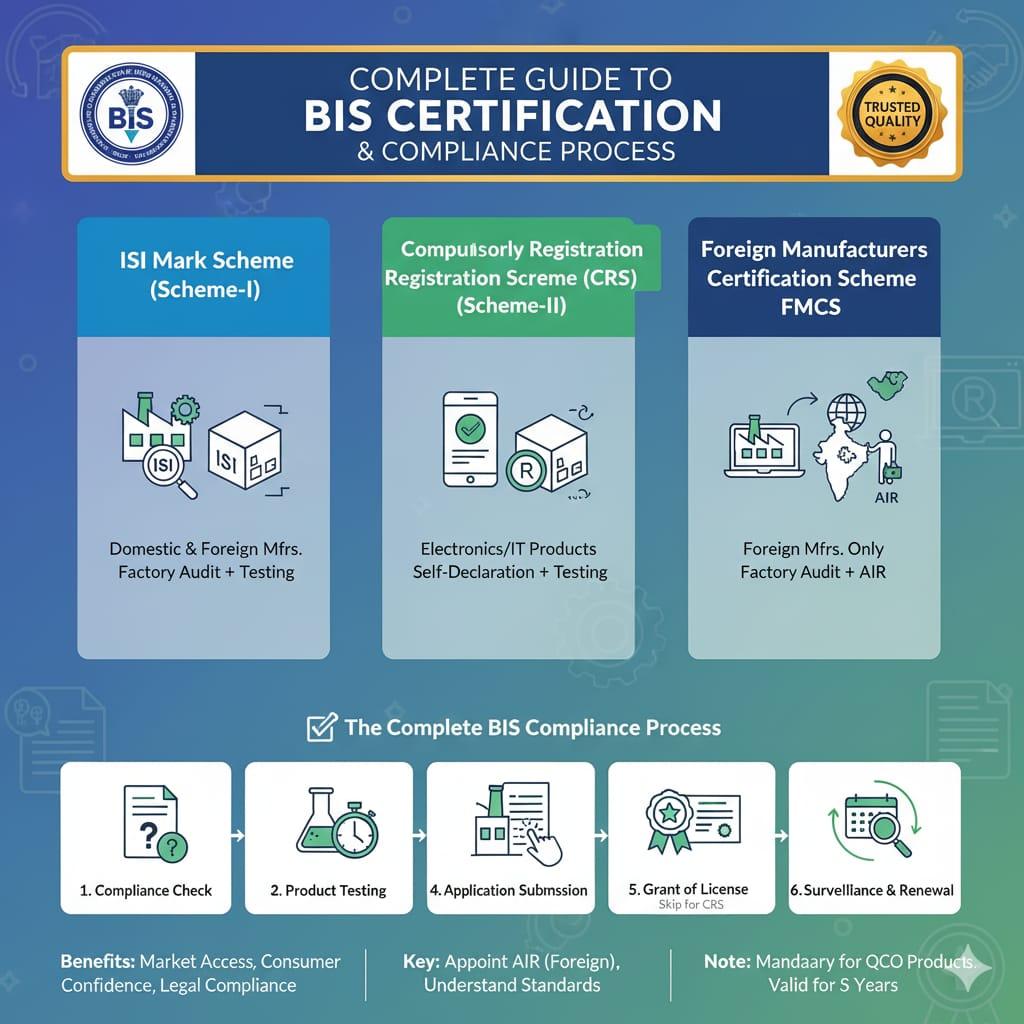
There are two major licensing schemes under BIS:
1. Domestic Manufacturers (ISI Scheme)
Companies producing goods within India must obtain a BIS License under the Indian Standards Institute (ISI) certification scheme.
2. Foreign Manufacturers (FMCS License)
Foreign manufacturing units must apply for BIS License under the Foreign Manufacturers Certification Scheme (FMCS) to sell their products in India with the ISI Mark.
Why BIS Certification and BIS License Matter
Acquiring a BIS License and Certification allows businesses to:
-
Legally market products in India where BIS norms are mandatory
-
Increase customer trust through quality assurance
-
Reduce risks related to product failures, recalls, or safety incidents
-
Improve brand reputation and market competitiveness
-
Expand market reach globally with recognized quality compliance
In today’s consumer-driven environment, credible certification is not just regulatory—it is a strategic advantage.
Who Needs BIS Certification?
Manufacturers involved in producing regulated products like electrical cables, switches, cement, household appliances, LED lighting, safety equipment, kitchenware, automotive components, chemicals, and numerous industrial materials must obtain BIS Certification.
Additionally, importers must ensure the products they bring into India are BIS-approved and carry the ISI mark if required under the mandatory certification list.
Step-by-Step Process for BIS Certification & BIS License
Understanding the BIS process can help businesses plan effectively and avoid delays. Here’s a simplified breakdown:
1. Identify Applicable Indian Standard (IS)
Each product category has a specific IS code. Determining the correct IS code is the first and most crucial step.
2. Prepare Required Documents
Typical documentation includes:
-
Manufacturing details
-
Product specifications
-
Test reports
-
Factory layout and machinery list
-
Quality control procedures
-
ISO certificate (if required)
3. Product Testing in BIS-Approved Laboratory
Products must be tested in a BIS-recognized laboratory. Test reports must strictly comply with the relevant Indian Standard.
4. Application Submission
Submit the online application along with all documents, test reports, and prescribed fees.
5. Factory Inspection (if applicable)
For many product categories—especially under FMCS—BIS officers conduct an on-site inspection to verify:
-
Factory operations
-
Manufacturing capabilities
-
Quality control systems
-
Product consistency
6. Grant of BIS License
If all requirements are satisfied, BIS issues the license allowing the manufacturer to use the ISI mark.
7. Follow-Up Surveillance
Post-licensing, BIS conducts regular surveillance checks, including:
-
Market sample testing
-
Factory visits
-
Periodic license renewal
Common Challenges in BIS Certification
Many companies face difficulties such as:
-
Identifying accurate IS codes
-
Managing documentation
-
Delays in testing
-
Understanding technical requirements
-
Handling compliance queries
-
Preparing for factory audits
These challenges often make expert guidance essential for smooth approval.
Final Thoughts
Obtaining BIS Certification and a BIS License is crucial for manufacturers and importers aiming to build consumer trust, enhance brand reputation, and stay compliant in the Indian market. A structured and knowledgeable approach can simplify the entire journey—from product testing to final license approval.
For businesses seeking professional guidance, reliable documentation support, and end-to-end compliance assistance, connect with sunconsultants.co.in

 English
 Arabic
 French
 Spanish
 Portuguese
 Deutsch
 Turkish
 Dutch
Dutch
 Italiano
 Romaian
 Portuguese (Brazil)
 Greek
Greek