

Why Website Design in California Is Essential for Business Growth
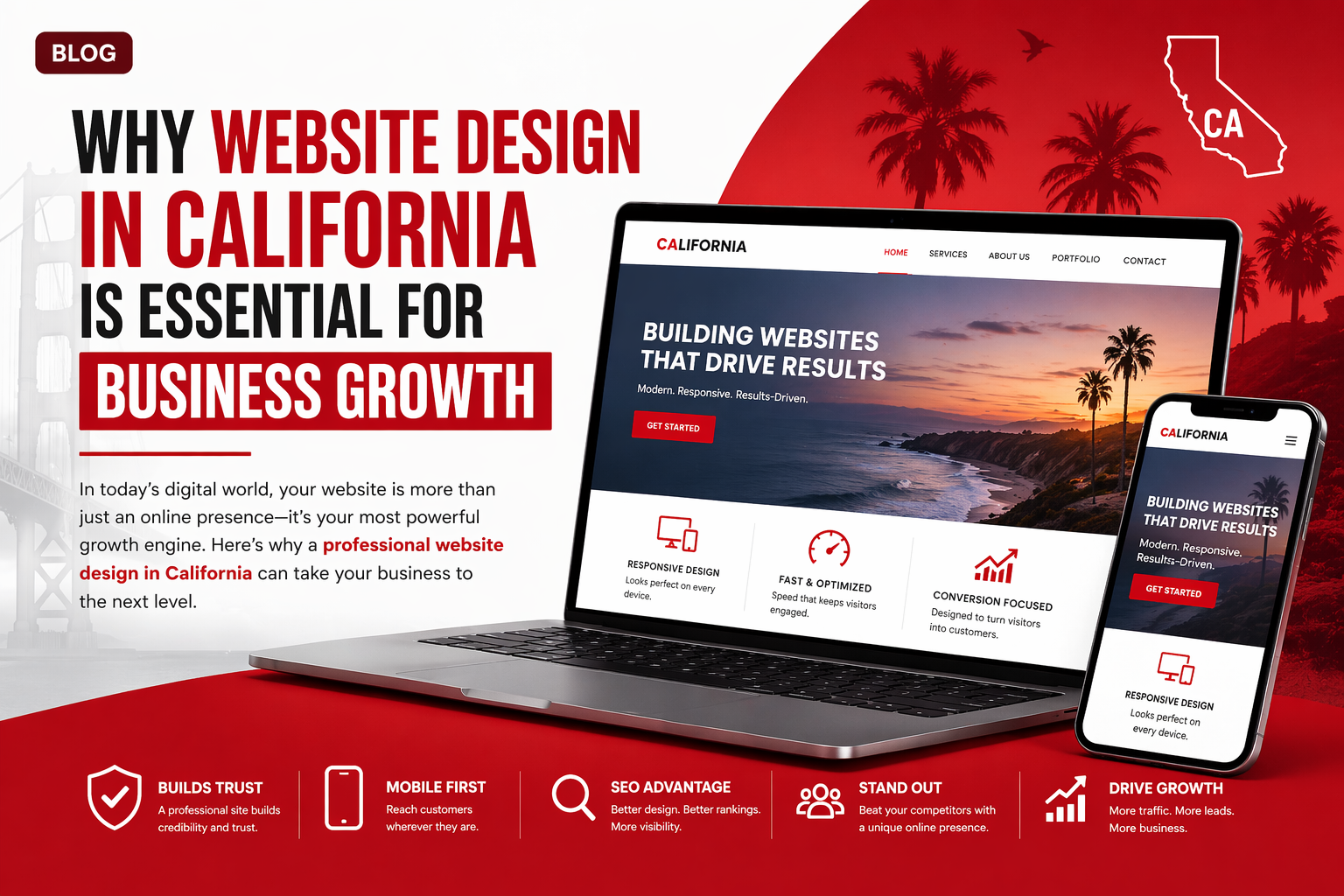
You’re standing in line at a coffee shop in Palo Alto or maybe walking down a sunny street in Santa Monica. You pull out your phone to look for a local service. You click a link.
The site takes five seconds to load. When it finally does, the text is tiny. You have to pinch and zoom just to find a phone number.
What do you do? You leave. You don't give them a second chance. You just go to the next person on the list.
That business just lost money. Not because their product was bad, but because their digital front door was stuck shut.
In a place like this, your website isn't just a "nice to have" thing. It is the business.
The California Standard
People here are spoiled. We live in the backyard of the biggest tech giants on earth. Because of that, the average customer in California has a very low tolerance for bad design.
They expect things to work instantly. They expect things to look clean. If your site looks like it was built in 2012, they won’t just think you’re old-fashioned. They’ll think you’re out of business.
This is why Website Design in California isn't just about making things look "pretty." It’s about survival in a market where everyone is tech-savvy and everyone is in a hurry.
If you aren't meeting that standard, you're effectively invisible.
It’s a trust thing
Think about the last time you bought something expensive online. You looked at the site’s layout, didn't you?
If the fonts are clashing and the images are blurry, your brain sends a red flag. You start wondering if your credit card info is safe.
A professional site says you care about the details. It says you have the budget to do things right. It creates a "halo effect." If the website is high-quality, the customer assumes the service will be too.
Is your current site doing that for you? Or is it making people hesitate?
The mobile reality
California is a state on the move. We’re in cars, on trains, or walking between meetings. Most of your customers are finding you while they’re doing something else.
If your site is only built for a desktop computer, you’re ignoring more than half of your potential growth.
A site that "works" on a phone isn't enough anymore. It has to be effortless. One-tap calling. Easy-to-read menus. Fast scrolling.
If a user has to fight your website to give you money, they’ll just stop fighting. They'll go to someone who made it easy.
Speed is the new currency
We’ve all been there. You’re waiting for a page to load and you feel that tiny spark of annoyance.
Google feels it too. They track how fast your pages pop up. If you’re slow, they push you down in the search results.
Good design includes the stuff you can’t see—the code. Clean code makes a site fast. Fast sites keep people around.
You could have the best business model in the world, but if your site is heavy and bloated, nobody will stay long enough to find out.
Standing out in the noise
California is crowded. No matter what you do—law, construction, baking, tech—there are a hundred other people doing it within ten miles of you.
Most of them have "okay" websites. They used a generic template and forgot about it.
That’s your opportunity.
When you invest in a design that actually reflects your personality, you stop being a commodity. You become a brand.
People don't want to buy from a faceless corporation. They want to buy from someone who gets them. Does your site feel like a person, or a brochure?
Solving the "Where do I go?" problem
A common mistake is giving people too many choices. You’ve seen those sites. There are twenty buttons on the home page.
The user gets "decision paralysis." They don't know what to do, so they do nothing.
Great design is like a good tour guide. It takes the visitor by the hand and says, "Click here to see our work" or "Call us here for a quote."
It’s about removing friction. The fewer steps between a customer's problem and your solution, the faster you grow.
The hidden cost of "Cheap"
I’ve seen a lot of people try to save money by doing it themselves or hiring the cheapest person they can find.
It usually ends up costing more in the long run.
You spend months tweaking it. It breaks after a browser update. It doesn't show up on Google.
Then you have to hire a pro to fix the mess. Meanwhile, you’ve lost six months of leads.
It’s better to build a solid foundation once than to keep patching a leaky roof.
Respecting the Law (and your users)
California is different. We have the CCPA and other privacy laws that most other states don't have yet.
A "grow-at-all-costs" mindset can get you in trouble here if your site doesn't respect user data.
Part of good design is making sure the "boring" stuff—privacy settings, opt-outs, secure forms—is handled correctly.
It’s not just about avoiding fines. It’s about showing your customers that you respect their data as much as you respect their business.
Local context matters
If you’re a contractor in the Central Valley, your site shouldn't look like a Silicon Valley SaaS startup.
Good design understands the local culture. It uses the right imagery. It speaks the language of the people who live there.
A cookie-cutter template from a generic builder can't do that. It doesn't know what makes a customer in Fresno different from a customer in San Diego.
When your design feels local, people feel more comfortable reaching out.
What actually moves the needle?
Growth doesn't happen by accident. It happens when your digital presence matches your real-world effort.
If you’re working hard to provide a great service, your website should work just as hard. It should be your best salesperson—working 24/7, never taking a day off, and always saying the right thing.
Does your current site represent the level of quality you actually provide?
If the answer is no, you're leaving money on the table every single day.
Moving forward
You don't need a site with flying graphics or music that plays automatically. In fact, please don't do that.
You need a site that loads fast, looks professional, and tells people exactly how you can help them.
In a place as competitive as California, that’s the baseline.
Once you get the digital side right, the rest of the growth usually follows. It’s just about making it easy for people to say yes to you.
That’s really all it comes down to.

 Arabic
 French
 Spanish
 Portuguese
 Deutsch
 Turkish
 Dutch
Dutch
 Italiano
 Russian
 Romaian
 Portuguese (Brazil)
 Greek
Greek