

Wire Harness Market Insights: Growth Analysis, Industry Trends & Future Outlook from 2026 to 2033
The global industrial landscape is undergoing a massive transformation driven by electrification, automation, and high speed data transmission. At the heart of this revolution lies the wire harness the "central nervous system" of modern machinery and vehicles. As industries transition toward smarter, more connected systems, the demand for sophisticated wiring solutions is reaching unprecedented heights.
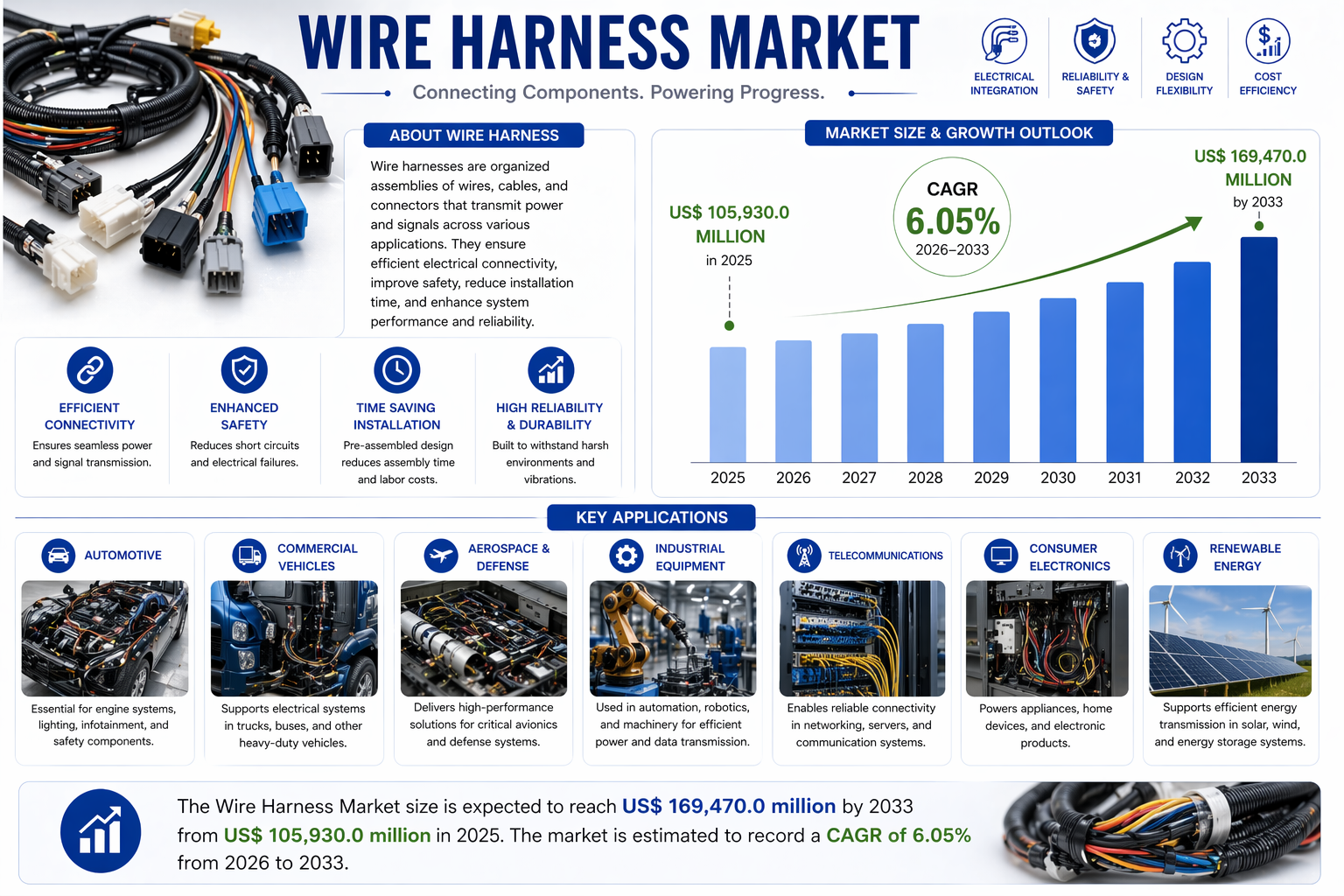
The Wire Harness Market size is expected to reach US$ 169,470.0 million by 2033 from US$ 105,930.0 million in 2025. The market is estimated to record a CAGR of 6.05% from 2026 to 2033. This steady growth is fueled by the integration of advanced electronics in the automotive, aerospace, and consumer electronics sectors. From the complex wiring required for autonomous driving systems to the robust cables needed for industrial robotics, wire harnesses remain a critical component in ensuring the reliability and safety of electrical systems worldwide.
Wire Harness Market Trends and Growth Analysis
The evolution of the wire harness industry is no longer just about connecting Point A to Point B. Today, Wire Harness Market Trends and Growth Analysis reveal a significant shift toward miniaturization and weight reduction. In the automotive sector, the rise of Electric Vehicles (EVs) has fundamentally changed harness design. Unlike traditional Internal Combustion Engine (ICE) vehicles, EVs require high voltage wire harnesses capable of handling immense power loads while maintaining electromagnetic compatibility (EMC) to prevent interference with sensitive onboard electronics.
Another dominant trend is the adoption of "Zonal Architecture" in vehicle design. Instead of a single, massive wiring loom that runs the length of the car, manufacturers are moving toward decentralized hubs. This reduces the total weight of the wiring which can be one of the heaviest and most expensive components in a vehicle and simplifies the manufacturing process through modular assembly.
In the industrial and telecommunications sectors, the rollout of 5G technology and the expansion of the Internet of Things (IoT) are driving the demand for high speed data harnesses. These harnesses must support rapid data transfer rates with minimal signal loss, leading to increased R&D investment in fiber optic integration and advanced shielding materials.
Download Sample PDF Report: https://www.businessmarketinsights.com/sample/BMIPUB00032697
Strategic Growth Drivers Across Key Industries
The growth of the wire harness market is inextricably linked to the technological advancements in its end user industries:
-
Automotive Electrification: As global regulations push for lower carbon emissions, the transition to EVs is the primary driver. High voltage harnesses for battery packs and power electronics are higher margin products compared to traditional low voltage sets.
-
Aerospace and Defense: The demand for "More Electric Aircraft" (MEA) is rising. Modern aircraft utilize electronic systems for flight control, landing gear, and cabin management, all of which require specialized, flame retardant, and high durability wiring.
-
Industrial Automation (Industry 4.0): Smart factories rely on a web of sensors and actuators. The wire harnesses used in these environments must withstand harsh conditions, including chemical exposure, extreme temperatures, and constant mechanical vibration.
Competitive Landscape and Key Players
The global market is characterized by the presence of several established players who focus on vertical integration and long term contracts with Original Equipment Manufacturers (OEMs). These companies are investing heavily in automated harness assembly to reduce labor costs and improve precision.
Top Players in the Global Wire Harness Market:
-
Sumitomo Electric Industries, Ltd.
-
Yazaki Corporation
-
Aptiv PLC
-
Leoni AG
-
Furukawa Electric Co., Ltd.
-
Lear Corporation
-
THB Group
-
Motherson Group
-
Nexans
-
TE Connectivity
Market Challenges and Future Outlook
While the growth prospects are strong, the industry faces challenges such as the rising cost of raw materials particularly copper. Since copper is the primary conductive material, price volatility directly impacts the profit margins of manufacturers. This has led to an increased interest in aluminum wiring for certain applications, despite its different conductivity and termination requirements.
Looking ahead to 2033, the focus will remain on sustainability and circular economy practices. Manufacturers are exploring recyclable insulation materials and more efficient production methods to reduce the environmental footprint of wiring systems.
Frequently Asked Questions (FAQ)
1. What is the projected value of the Wire Harness Market by 2033?
The market is projected to reach US$ 169,470.0 million by 2033.
2. What is the growth rate of the market?
The market is expected to grow at a CAGR of 6.05% between 2026 and 2033.
3. Which industry is the largest consumer of wire harnesses?
The automotive industry remains the largest end user, followed by aerospace, defense, and consumer electronics.
4. How is the transition to EVs affecting the market?
EVs require high voltage wiring systems and more complex data harnesses, which increases the average value of the wiring content per vehicle.
About Us
Business Market Insights is a leading market research platform that provides subscription based services for industry reports across various sectors, including Technology, Media, and Telecommunications; Semiconductors and Electronics; and Aerospace and Defense. Our expert analysts ensure that every report provides actionable insights and deep dive analysis.
Contact us:
Phone: +16464919876
Email: sales@businessmarketinsights.com

 Arabic
 French
 Spanish
 Portuguese
 Deutsch
 Turkish
 Dutch
Dutch
 Italiano
 Russian
 Romaian
 Portuguese (Brazil)
 Greek
Greek