Businesses generate enormous amounts of data every single day—sales numbers, inventory updates, customer records, operational metrics, and financial transactions. Yet surprisingly, many companies still rely on outdated spreadsheets and disconnected systems to understand what is happening inside their operations. That usually ends with teams spending more time hunting for reports than actually using them. Custom ERP solutions solve this problem by centralizing data and delivering real-time visibility across departments. An experienced ERP software development company can help businesses replace reporting chaos with clarity, speed, and smarter decision-making (without the endless Excel exports everyone secretly dreads).
What Is Real-Time Reporting in ERP?
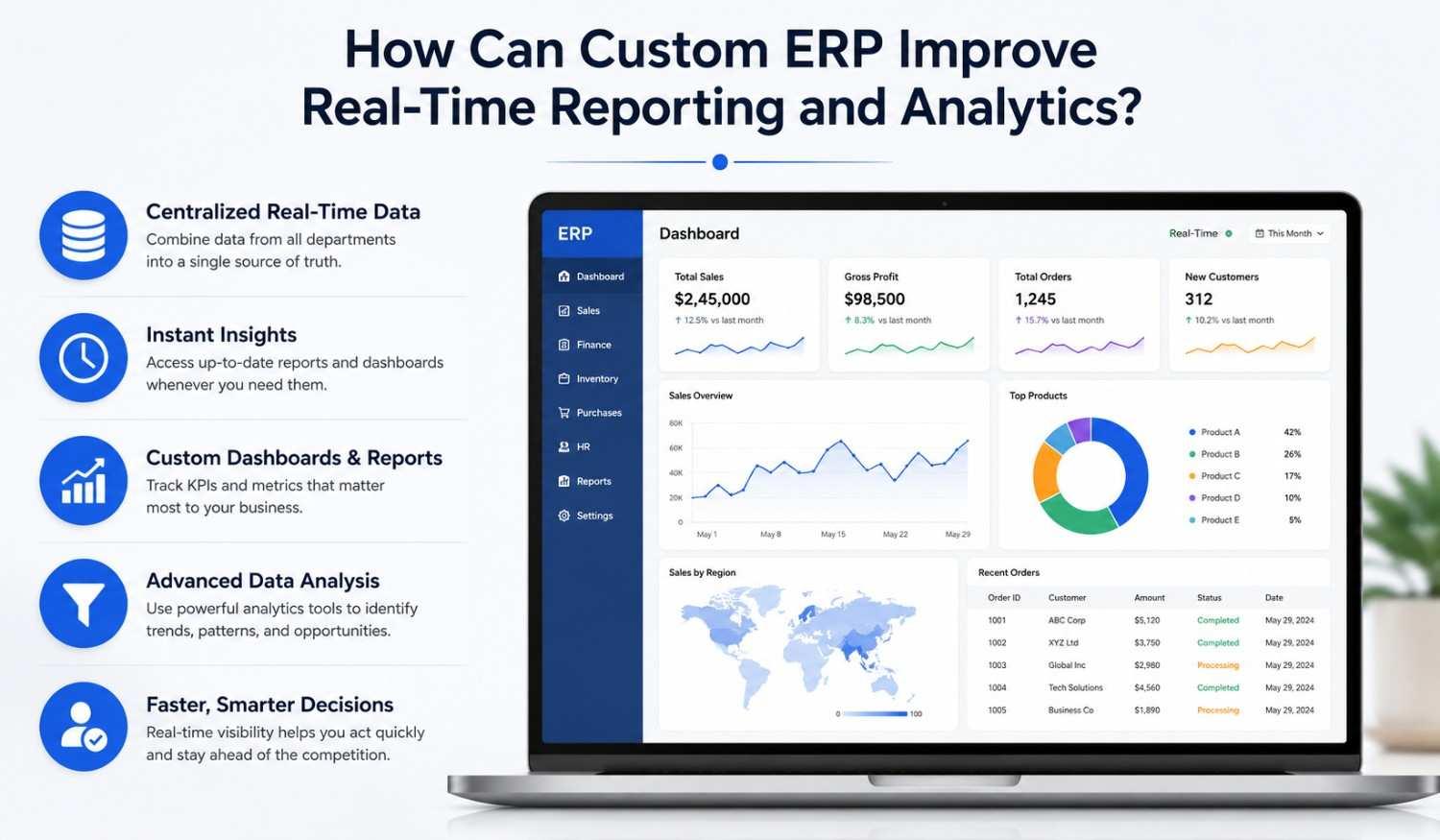
Real-time reporting in ERP refers to the ability to access live business data instantly as activities happen across the organization. Instead of waiting for daily or weekly reports, teams can monitor operations continuously through dashboards and automated analytics tools. Sales updates, inventory movements, financial records, and production data all sync automatically within the system. Consequently, businesses gain faster insights and improved operational awareness. Traditional reporting often feels like driving while looking in the rearview mirror, whereas real-time ERP analytics provides visibility into what is happening now—arguably much more useful for avoiding expensive surprises.
Why Standard ERP Reporting Often Falls Short
Many off-the-shelf ERP systems include reporting tools, but they are usually built for generic workflows rather than unique business operations. Companies often discover that standard dashboards show too much irrelevant information while missing the data that truly matters. As a result, employees create manual spreadsheets, export reports repeatedly, and spend hours reconciling conflicting numbers. Somewhere along the way, three departments somehow produce three completely different revenue reports. Standard ERP software can support basic reporting, but customization becomes essential when businesses need deeper analytics, flexible integrations, and reporting tailored to real operational challenges instead of cookie-cutter assumptions.
How Custom ERP Creates a Single Source of Truth
Custom ERP systems centralize information from multiple departments into one connected platform, creating what businesses often call a “single source of truth.” Sales, inventory, finance, operations, and customer service teams all work with synchronized live data instead of isolated spreadsheets or disconnected software. This significantly reduces reporting inconsistencies and manual duplication. For example, when a sales order is placed, inventory levels update immediately while finance records the transaction automatically. Suddenly, meetings become less about arguing over which spreadsheet is correct and more about making decisions that move the business forward—which is usually the healthier option.
Faster Decision-Making with Live Business Dashboards
Business decisions become far more effective when leaders have access to live operational insights instead of outdated reports. Custom ERP dashboards provide real-time visibility into KPIs, sales performance, production efficiency, customer activity, and financial trends. Managers can identify problems quickly, respond faster to market changes, and track performance without waiting for someone to manually compile reports. Additionally, role-based dashboards ensure employees only see the metrics relevant to their responsibilities. Modern businesses simply cannot afford to make important decisions using yesterday’s information. Competitive markets move quickly, and delayed reporting usually means delayed opportunities as well.
Custom ERP Integration Improves Reporting Accuracy
One major advantage of custom ERP systems is seamless integration with other business platforms such as CRM software, accounting systems, eCommerce platforms, and third-party APIs. These integrations eliminate the need for manual data entry while improving reporting accuracy across departments. Automated synchronization ensures customer data, sales transactions, inventory records, and operational metrics remain updated in real time. Consequently, businesses reduce costly human errors and gain more reliable analytics. Teams no longer need to compare multiple disconnected systems just to understand what happened yesterday. Instead, accurate reporting becomes part of the workflow rather than a separate full-time struggle.
Industry-Specific Analytics Through Custom ERP
Every industry measures success differently, which explains why generic ERP dashboards rarely satisfy long-term reporting needs. Manufacturing companies prioritize production efficiency and machine utilization, while retail businesses focus heavily on inventory turnover and customer purchasing trends. Logistics providers require shipment tracking and supply chain visibility, whereas healthcare organizations monitor compliance and operational workflows. Custom ERP systems allow businesses to build analytics specifically around their operational goals and industry challenges. This flexibility creates more meaningful insights and better reporting accuracy. After all, a warehouse manager and a finance executive probably should not rely on identical dashboards to run their departments.
Predictive Analytics and Business Intelligence Features
Modern custom ERP systems increasingly include predictive analytics and business intelligence tools that help companies anticipate trends before problems escalate. By analyzing historical data and operational patterns, ERP platforms can forecast inventory demand, predict revenue fluctuations, and identify operational inefficiencies. Businesses gain the ability to make proactive decisions instead of reacting after issues become expensive. Predictive reporting also improves planning accuracy and resource allocation. Interestingly, many companies only realize how valuable forecasting is after experiencing one too many “urgent” meetings caused by problems that could have been identified weeks earlier with better analytics visibility.
How ERP Developers Build Better Reporting Systems
Building effective ERP reporting systems requires more than adding attractive dashboards and colorful charts. Skilled ERP developers focus on database architecture, workflow automation, scalability, security, and real-time synchronization between systems. They design reporting structures that align directly with business operations while ensuring data remains accurate and accessible. Additionally, cloud-based ERP environments allow users to monitor performance from anywhere using secure dashboards and mobile access. Custom reporting also improves flexibility because businesses can add new metrics and workflows as operations grow. In many ways, strong ERP reporting resembles good infrastructure—nobody notices it until the system stops working properly.
Common Challenges Businesses Face Before ERP Customization
Before implementing custom ERP solutions, many businesses struggle with disconnected systems, inconsistent reports, slow data processing, and limited visibility across departments. Employees often spend excessive time manually compiling spreadsheets, correcting reporting errors, and reconciling conflicting information from multiple platforms. Eventually, leadership teams begin questioning why every department presents different numbers during the same meeting. These inefficiencies slow decision-making and create operational confusion. Custom ERP platforms solve these issues by automating workflows, synchronizing live data, and centralizing reporting processes. The result is improved transparency, faster analytics, and significantly fewer awkward conversations about “which spreadsheet is correct this time.”
Benefits of Real-Time ERP Analytics for Business Growth
Real-time ERP analytics helps businesses operate more efficiently by providing immediate access to actionable insights. Faster reporting enables companies to respond quickly to customer demands, market shifts, inventory shortages, and operational bottlenecks. Improved visibility also supports better financial planning, resource management, and long-term strategy development. Additionally, automated reporting reduces administrative workload, allowing teams to focus on productivity rather than repetitive manual tasks. Businesses that leverage live analytics often improve customer experiences because problems can be identified and resolved faster. Growth becomes more manageable when leaders have reliable information instead of assumptions stitched together from outdated reports.
Best Practices for Implementing Custom ERP Reporting
Successful ERP reporting implementation begins with clearly defining business goals, operational priorities, and reporting requirements before development starts. Organizations should focus heavily on data accuracy because even advanced analytics tools become unreliable when the underlying information is inconsistent. Building scalable dashboards is equally important since reporting needs typically evolve as businesses grow. Proper employee training also ensures teams understand how to use analytics effectively rather than ignoring dashboards completely after launch. Technology alone does not solve reporting challenges—process alignment and organizational adoption matter just as much. Otherwise, even sophisticated ERP systems risk becoming very expensive digital filing cabinets.
Future Trends in ERP Reporting and Analytics
ERP reporting continues evolving rapidly as businesses demand faster insights, predictive analytics, and smarter automation capabilities. Artificial intelligence now enhances dashboards by identifying patterns, generating forecasts, and automating routine analysis tasks. Cloud-based ERP systems also improve accessibility by enabling real-time reporting from virtually anywhere. Meanwhile, IoT-connected devices increasingly feed live operational data directly into ERP platforms for deeper analytics visibility. Future reporting systems may eventually provide answers before managers even realize there is a question to ask—which sounds slightly futuristic until remembering how quickly business technology continues changing. Real-time analytics is steadily becoming a business necessity rather than a competitive advantage.
Conclusion
Custom ERP systems transform fragmented business operations into connected ecosystems powered by real-time data, automation, and actionable analytics. Instead of relying on delayed reports and disconnected spreadsheets, businesses gain live visibility into operations, financial performance, inventory, and customer activity. Faster insights lead to smarter decisions, improved efficiency, and stronger long-term growth opportunities. More importantly, teams spend less time chasing information and more time solving actual business challenges. That alone tends to improve workplace morale surprisingly quickly. In a business environment driven by speed and accuracy, real-time ERP reporting is no longer optional—it has quietly become essential for staying competitive.
FAQs
What is real-time reporting in ERP?
Real-time reporting in ERP allows businesses to access live operational data instantly without waiting for manually generated reports.
Why is custom ERP better for analytics?
Custom ERP systems are tailored to specific workflows, making reporting more accurate, scalable, and relevant to business operations.
Can custom ERP integrate with existing business software?
Yes, custom ERP platforms can integrate with CRM systems, accounting software, APIs, eCommerce tools, and third-party applications.
How does ERP improve decision-making?
ERP systems centralize business data and provide live dashboards, helping organizations make faster and more informed decisions.
Are custom ERP systems scalable?
Yes, custom ERP solutions can scale alongside business growth by supporting additional workflows, users, and reporting requirements.
Which industries benefit most from ERP analytics?
Manufacturing, healthcare, logistics, retail, finance, and service industries benefit significantly from real-time ERP reporting and analytics.



 English
 Arabic
 French
 Spanish
 Portuguese
 Deutsch
 Turkish
 Dutch
Dutch
 Russian
 Romaian
 Portuguese (Brazil)
 Greek
Greek