

United States Smart TV Market Forecast Signals 58.01 Million Units by 2031 with Growing Connected Home Adoption
United States Smart TV Market Overview
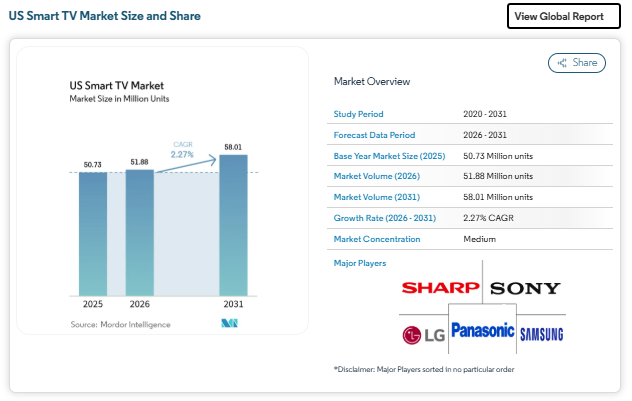
The United States smart tv market size was valued at 51.88 million units in 2026, reaching 58.01 million units by 2031 at a CAGR of 2.27% during the forecast period from 2026 to 2031. Demand patterns across the industry are being influenced by consumer interest in better picture quality, gaming-friendly displays, integrated streaming platforms, and larger screen formats. While the market is moving through a mature phase, replacement demand continues to support sales across multiple screen categories.
The United States smart tv market size is also benefiting from the steady shift toward connected home entertainment ecosystems. Consumers are increasingly choosing televisions that support streaming subscriptions, voice-enabled controls, gaming consoles, and personalized viewing experiences. Large-screen televisions, especially in the mid-sized and ultra-large categories, remain a preferred choice among households upgrading their entertainment setups.
Another important factor shaping the United States smart tv market growth is the competition among brands to improve display quality while maintaining attractive pricing. Display technologies such as OLED, Mini-LED, QLED, and advanced backlighting systems are influencing purchase decisions across premium and mid-range segments. At the same time, platform-driven advertising revenue and software ecosystems are helping manufacturers maintain competitiveness in a price-sensitive environment.
United States Smart TV Market Growth Driving Consumer Preferences
Rise in Demand for Larger Screen Sizes
One of the most visible United States smart tv market trends is the steady demand for larger displays. Screen categories above the traditional standard sizes are attracting buyers who want cinematic viewing experiences at home. Consumers are increasingly upgrading living room entertainment setups with televisions designed for sports streaming, movies, and gaming. The growing popularity of large-format televisions is also linked to changing consumer lifestyles. More households are investing in home-based entertainment options, encouraging demand for televisions with wider displays, stronger sound integration, and advanced visual performance.
Streaming Ecosystems Supporting the United States Smart TV Industry
Streaming services continue to play a central role in the United States smart tv industry. Smart televisions are now expected to support direct access to popular streaming applications without additional devices. This has increased competition among operating system providers seeking greater user engagement through customized interfaces and integrated content recommendations. Advertising-supported streaming models are also influencing the United States smart tv market share among manufacturers. Several brands are using connected television advertising revenue to support competitive hardware pricing, helping them attract consumers across multiple price bands.
Gaming Features Expanding Product Appeal
Gaming-focused features are becoming an important part of the United States smart tv market forecast. Consumers are increasingly looking for televisions with low input lag, high refresh rates, improved motion performance, and better response times. Gaming compatibility is no longer limited to premium television models, as brands continue expanding these features into mainstream product categories. Televisions designed for gaming are also benefiting from the broader popularity of home entertainment systems. As gaming consoles and cloud gaming services gain traction, smart television manufacturers are adjusting their product strategies to meet changing viewing and gaming expectations.
Panel Technology Competition Influencing Replacement Demand
The United States smart tv market growth is further supported by frequent panel technology upgrades. OLED, QLED, Mini-LED, and advanced LCD displays are encouraging consumers to replace older televisions earlier than expected. Consumers are paying more attention to color performance, brightness levels, contrast quality, and energy efficiency when selecting new devices. Manufacturers are also responding to state-level energy guidelines and data privacy expectations. These factors are influencing software integration, operating system functionality, and hardware design across the industry.
Check out more details and stay updated with the latest industry trends, including the Japanese version for localized insights: https://www.mordorintelligence.com/ja/industry-reports/united-states-smart-tv-market
United States Smart TV Market Segmentation
By Screen Size
-
Up to 45"
-
45-54"
-
55-64"
-
65-74"
-
75" and Above
By Resolution Type
-
HDTV
-
Full HD
-
4K UHD
-
8K UHD
By Panel Technology
-
LCD/LED
-
QLED
-
OLED
-
Mini-LED
By Price Band
-
Less than USD 500
-
USD 500-999
-
USD 1,000-1,999
-
More than USD 2,000
By Operating System
-
Roku OS
-
Google/Android TV
-
Tizen OS
-
webOS
-
Fire TV OS
-
VIDAA U
Key Players in the United States Smart TV Market
-
LG Electronics Inc.
-
Samsung Electronics Co. Ltd
-
Sharp Corporation
-
Sony Group Corporation
-
Panasonic Holdings Corporation
Explore more insights on United States smart tv market competitive landscape https://www.mordorintelligence.com/industry-reports/united-states-smart-tv-market/companies
Conclusion
The United States smart tv market continues to reflect changing entertainment preferences among consumers seeking better viewing quality, larger displays, and integrated streaming access. Although the market is moving through a relatively mature stage, replacement demand and premium product upgrades continue supporting long-term sales opportunities.
The United States smart tv market growth is expected to remain linked to display innovation, gaming compatibility, and connected entertainment ecosystems. Consumer interest in larger screens and advanced picture quality is likely to maintain demand across premium and mainstream categories.
As manufacturers continue refining display technologies and connected television experiences, the United States smart tv market share among leading brands will depend on their ability to deliver reliable performance, accessible streaming integration, and value-driven product offerings aligned with consumer expectations

 English
 Arabic
 French
 Spanish
 Portuguese
 Deutsch
 Turkish
 Dutch
Dutch
 Italiano
 Romaian
 Portuguese (Brazil)
 Greek
Greek