

The Role of Content Clusters in B2B SEO Strategy
Explore The Role of Content Clusters in B2B SEO Strategy
B2B SEO has evolved far beyond publishing individual blog posts around isolated keywords. Today, search engines focus on understanding topics, context, and depth of knowledge. As a result, businesses that rely on scattered content often struggle to achieve stable rankings. Content clusters have emerged as a structured and effective approach to solving this problem. In a B2B SEO strategy, content clusters help organize information, demonstrate expertise, and guide both users and search engines through complex subject areas. This blog explains the role of content clusters in B2B SEO, how they work, why they matter, and how they support long-term search visibility in a practical and focused way.
What Content Clusters Mean in B2B SEO
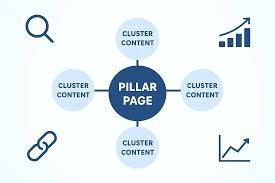
A content cluster is a group of related pages built around a central topic. At the core is a pillar page that provides a comprehensive overview of the subject. Supporting it are multiple cluster pages that cover specific subtopics in detail. These pages are internally linked in a logical structure. In B2B SEO, content clusters help search engines understand subject relevance and relationships. Instead of ranking single pages, search systems evaluate how well a website covers an entire topic area.
Why Traditional Content Approaches Fall Short
Many B2B companies still publish content randomly based on short-term keyword ideas. This leads to disconnected pages that compete with each other instead of reinforcing authority. Search engines may struggle to identify which page is most relevant. Users also face difficulty navigating such websites. Without a clear structure, content value remains underutilized. Content clusters solve this by creating clarity and cohesion across related topics.
How Content Clusters Improve Topical Authority
Topical authority refers to how strongly a website is associated with a specific subject. Content clusters build authority by covering a topic comprehensively rather than partially. When multiple pages address different aspects of the same topic, search engines recognize depth and consistency. In B2B SEO, where topics are often complex, this depth signals expertise. Over time, strong topical authority improves rankings across multiple related queries.
Pillar Pages as the Foundation
The pillar page acts as the main entry point for a content cluster. It provides a high-level explanation of the core topic while linking to detailed subpages. For B2B audiences, pillar pages help users understand a subject without overwhelming them. From an SEO perspective, pillar pages consolidate authority and prevent keyword cannibalization. They also serve as a central reference point for internal linking.
Cluster Pages and Intent Alignment
Cluster pages focus on specific questions, challenges, or use cases related to the main topic. Each page addresses a clear search intent. In B2B SEO, intent varies widely, from learning and evaluation to comparison and implementation. Content clusters allow businesses to match content with intent at different stages of the research journey. This improves relevance and engagement, which supports stronger search performance.
Internal Linking and Crawl Efficiency
Internal linking is a critical part of content clusters. Links between pillar and cluster pages help search engines crawl and understand content relationships. This structure improves indexing efficiency and distributes authority across pages. For users, internal links guide exploration and reduce friction. In B2B websites with large content libraries, this clarity improves both usability and discoverability.
Supporting EEAT Through Structured Content
Content clusters naturally support Experience, Expertise, Authority, and Trust. Experience is shown through practical subtopics. Expertise appears in detailed explanations. Authority builds as multiple pages reinforce the same subject. Trust increases when information is organized, consistent, and accurate. Search engines value these signals, especially in B2B contexts where decision-making carries higher risk.
Improving Keyword Coverage Without Stuffing
Content clusters allow broad keyword coverage without forced repetition. Instead of targeting many keywords on one page, each cluster page focuses on a specific variation or subtopic. This approach avoids keyword stuffing while improving semantic relevance. Search engines understand the topic holistically, which improves rankings for both primary and long-tail queries.
Enhancing User Experience and Engagement
B2B users seek clarity and efficiency. Content clusters make it easier for users to find related information without searching again. When users move naturally between pages, session duration increases and bounce rates decrease. These engagement signals indirectly support SEO performance. More importantly, users gain a clearer understanding of complex topics, which supports trust and confidence.
Content Clusters and Long B2B Sales Cycles
B2B decisions often take time. Users revisit websites multiple times before acting. Content clusters support this journey by offering structured learning paths. Early-stage users may start with a pillar page, while later-stage users explore specific cluster pages. This continuity keeps users engaged across sessions and positions the website as a reliable knowledge source.
Competitive Advantage in Saturated Markets
Scalability and Content Planning
Content clusters make content planning more strategic. Instead of brainstorming random topics, teams can expand clusters gradually. Each new page strengthens the overall structure. This scalability is especially useful for B2B websites that grow over time. Content creation becomes purposeful, aligned, and measurable.
Content Clusters and AI-Driven Search
AI-powered search tools rely on context and relationships between topics. Content clusters align well with this behavior. Structured content helps AI systems understand subject depth and recommend relevant pages. As AI-driven discovery grows, content clusters become even more important for maintaining visibility in evolving search environments.
Measuring the Impact of Content Clusters
The success of content clusters can be measured through improved rankings, increased organic impressions, stronger internal link performance, and higher engagement metrics. Over time, clusters reduce ranking volatility and support stable growth. Unlike isolated pages, clustered content continues to gain value as the ecosystem expands.
Common Mistakes When Building Content Clusters
Some businesses create pillar pages without meaningful cluster support. Others build cluster pages without clear intent alignment. Weak internal linking also reduces effectiveness. Another mistake is covering unrelated subtopics under one pillar. Content clusters work best when the topic focus is clear and consistent.
Content Clusters as a Long-Term SEO Asset
Content clusters are not quick fixes. They are long-term assets that grow stronger over time. As more pages are added and updated, authority increases. Search engines reward this consistency. For B2B businesses focused on sustainable growth, content clusters provide a reliable SEO foundation.
Conclusion
Content clusters play a critical role in modern B2B SEO strategy. They organize information, build topical authority, and improve both user experience and search visibility. By connecting pillar pages with focused cluster content, businesses create clarity for users and context for search engines. This structured approach supports EEAT, intent alignment, and long-term discoverability. In a search landscape that values depth and relevance, content clusters are essential for sustainable B2B SEO success.
FAQs (Frequently Asked Questions)
What are content clusters in B2B SEO
Content clusters are a structured way of organizing content around a central topic. A main pillar page provides an overview, while multiple supporting pages cover related subtopics in detail. In B2B SEO, this structure helps search engines understand topical relevance and helps users navigate complex information more easily.
How do content clusters improve search visibility
Content clusters improve visibility by building topical authority. When a website covers a subject comprehensively through connected pages, search engines recognize depth and consistency. This increases the chances of ranking for multiple related queries rather than relying on a single page.
Why are content clusters important for long B2B sales cycles
B2B buyers research over time and revisit content multiple times. Content clusters support this journey by offering structured learning paths. Users can move from general information to detailed explanations without leaving the website, which builds trust and supports informed decision-making.
How do content clusters support EEAT
Content clusters strengthen EEAT by demonstrating experience through practical subtopics, expertise through in-depth explanations, authority through consistent topic coverage, and trust through organized and accurate information. These signals are critical for B2B search visibility.
What is the difference between a pillar page and a cluster page
A pillar page provides a broad overview of a core topic and links to related pages. Cluster pages focus on specific aspects of that topic in detail. Together, they form a connected structure that improves clarity for users and context for search engines.
Can small B2B websites use content clusters effectively
Yes, even small B2B websites can benefit from content clusters. Starting with one focused topic and building a few supporting pages helps establish authority. Over time, additional clusters can be added, allowing scalable growth without overwhelming resources.


 English
 Arabic
 French
 Spanish
 Portuguese
 Deutsch
 Turkish
 Italiano
 Russian
 Romaian
 Portuguese (Brazil)
 Greek
Greek