

Future of Logistics with Trigent’s Intelligent Transportation & Supply Chain Software Solutions
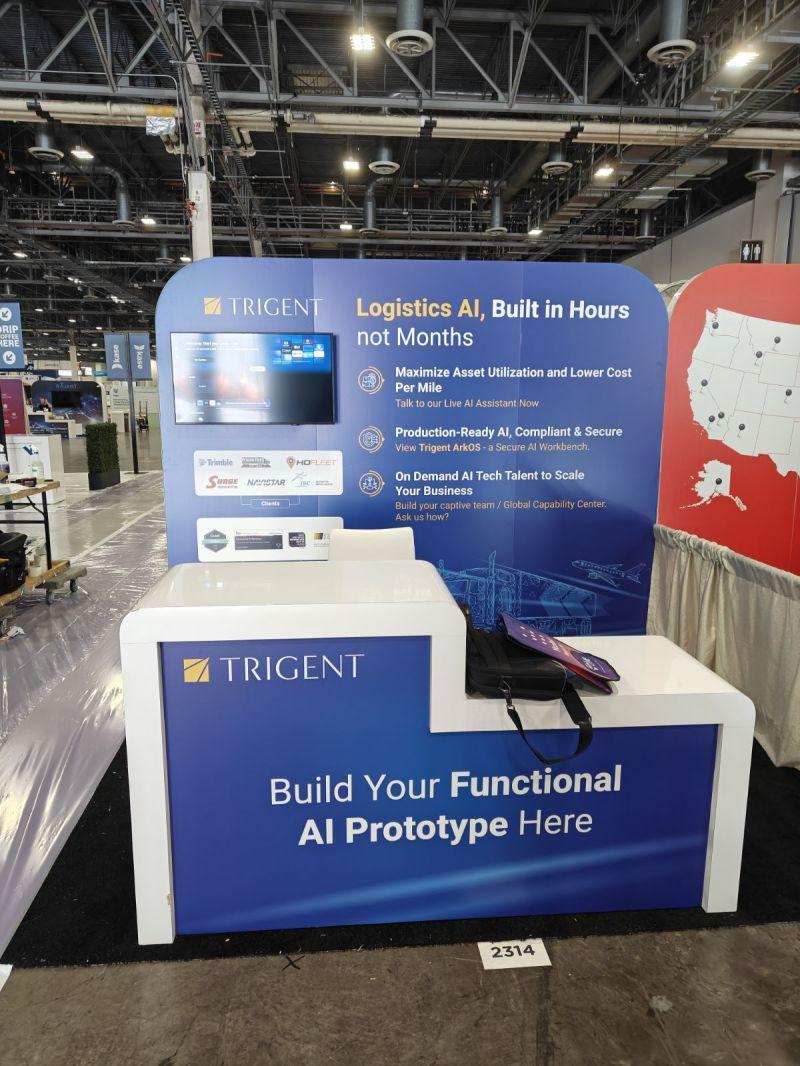
In today’s hyper-connected economy, logistics organizations need far more than off-the-shelf tools to stay competitive. They need a custom TMS development company that understands complex supply chains, emerging technologies, and real-world operational challenges. At Trigent, we combine deep domain expertise with advanced engineering to build scalable, future-ready logistics platforms.
As a trusted transportation software engineering firm, Trigent helps enterprises hire logistics software developers who specialize in custom TMS development for logistics, freight, and 3PL ecosystems. From legacy logistics system modernization services to greenfield platforms, we design solutions that deliver visibility, agility, and measurable ROI.
Our expertise spans custom freight forwarding software development, logistics software for 3PL providers, and EDI-ready shipping platforms that seamlessly integrate carriers, shippers, and partners. With cloud-based logistics software, we enable real-time collaboration, scalability, and secure data exchange across global networks.
Innovation is at the core of Trigent’s approach. We leverage AI in supply chain management to build predictive analytics for logistics, including real-time ETA prediction models, demand forecasting, and exception management. Our route optimization software reduces fuel consumption, improves delivery accuracy, and supports sustainable logistics solutions by lowering emissions and operational waste.
For next-generation visibility and control, Trigent delivers intelligent supply chain control towers that unify data from transportation, warehousing, and partners into a single, actionable view. These platforms power real-time freight tracking solutions, proactive alerts, and decision intelligence. We also implement automated warehouse management systems that optimize inventory, labor, and throughput.
Emerging technologies further strengthen our solutions. Digital Twins in Transportation allow organizations to simulate routes, assets, and disruptions before they happen, while blockchain for supply chain transparency ensures tamper-proof tracking, compliance, and trust across stakeholders.
Whether you are modernizing a legacy TMS, building a new AI-driven platform, or scaling a global logistics operation, Trigent delivers end-to-end engineering—from strategy and architecture to development, integration, and optimization. Partner with Trigent to transform logistics operations into intelligent, resilient, and future-proof digital ecosystems.
The US logistics industry loves to talk about resilience, packaged as the so-called resilience gap that somehow never gets any smaller. Yet the moment a storm shuts down a stretch of I-70 or the Panama Canal hits another draft limit, entire networks behave like someone kicked out the power cord. Add a Savannah vessel backlog or a labor flare-up at West Coast terminals, and routing engines start glitching as though they have never seen congestion before.
Loads get stranded, customer portals freeze, and the visibility tools that promise real-time clarity suddenly start showing the digital equivalent of a shrug.
Everyone claims they are modern and tech-forward, but the tech stack collapses long before the physical chain does. Economic shocks and the supply-chain cascades that follow expose the hidden costs of fragility faster than any quarterly review ever could.
We have digitized the industry, but we have not strengthened it.
What Really Breaks During a Disruption
Take the Key Bridge collapse in Baltimore. The physical damage was obvious. The invisible damage hit planning engines across the Eastern Seaboard because half the rerouting logic was never built for sudden constraint shifts.
Or consider LTL networks, which are often affected by thunderstorms sweeping across Missouri and Kansas. Those storms alone can knock linehaul schedules sideways for forty-eight hours. The problem is not the storm. The problem is how quickly the digital layer buckles.
Since the pandemic era, the definition of resilience across the supply chain has quietly evolved from ‘recover quickly’ to ‘don’t collapse in the first place.’ Unfortunately, many systems still behave like they’re stuck in 2019.
A container backlog in Savannah can trigger days of forced exception handling for 3PLs working inbound retail freight. A cyber incident at a mid-size carrier in the Midwest can ripple up the chain within hours.
None of these events is new. What’s new is how fragile the tech stack still is.
Five Insider Truths that Logistics Leaders Rarely Say Out Loud
Here is the part that industry veterans know but rarely write down.
1. Integrations fail more often than weather does
APIs, event triggers, batch processes, and connectors break under load. Your network is only as strong as the least reliable handshake.
2. Visibility is a mirror, not a steering wheel
A map full of truck icons tells you where things are, not what to do when everything goes wrong.
3. AI quietly gives up when the data is a mess
Models do not send panic alerts. They simply produce nonsense forecasts when inputs fall apart.
4. Data integrity is the real bottleneck
When two systems disagree on basic truths like location, time, or capacity, no tool can make decisions fast enough to matter.
5. Most operational crises are made worse by the tech stack, not the disruption itself
The physical world causes turbulence. The digital world amplifies it.
This is the real resilience problem. Cost-efficiency and resilience have been treated as opposing ideas, even though the modern US logistics network cannot function without both.
The Part Nobody Budgets for is the Part that Saves the Network
There is nothing glamorous about hardening the integration layer, normalizing operational data, stabilizing time-sensitive workflows, or testing how systems behave under simulated strain. None of this looks good in a conference keynote or convinces customers in a demo.
Public-private coordination and federal policy might help long-term, but they cannot fix the daily operational fragility inside carrier and 3PL tech stacks.
This is where companies like Trigent show up, usually quietly, to do the work everyone depends on but no one celebrates. Building reliable data pipelines. Fixing API behavior. Re-architecting fragile workloads in the cloud. Cleaning the operational data that AI systems choke on. Modernizing the backbone to prevent disruptions from taking down half the stack.
Not fancy. But, absolutely, essential.
The Resilience Playbook: A Practical Path Forward
This is what a resilient, modern US logistics network actually looks like in practice: strong integrations, stable data flows, a hardened decision layer, and organizations that test their systems as aggressively as they test their fleets.
1. Fix the integration layer first
If APIs buckle, everything buckles.
Audit every connection between your TMS, WMS, telematics, visibility tools, and dispatch systems. Measure latency, accuracy, and failure patterns. If your integrations behave like suggestions instead of guarantees, resilience ends here.
2. Clean and contract your operational data
Most disruptions become worse because systems spend half their time reconciling conflicting information. Normalize formats. Standardize timestamps. Instead of “we hope the feed stays the same this month,” build actual data contracts between teams to ensure the feeds won’t change without prior notice. Better data multiplies the effectiveness of every tool you already own.
3. Stabilize the workloads that decide the first two hours of chaos
Harden the systems that manage ongoing operations under pressure, such as linehaul planning, dynamic routing, appointment scheduling, dock availability, and capacity matching.
If these workloads choke during a disruption, everything downstream becomes guesswork.
Harden these engines, optimize triggers, and reduce dependency on manual overrides.
4. Automate the first ten minutes of every crisis
This alone can save a network.
Do not wait for a planner or dispatcher to manually update twenty screens. Let automated exception handling, constraint updates, and reroute triggers take over. Build rules that act immediately when constraints change.
5. Test your stack like you test your fleet
Simulate weather events, port congestion, and broken ELD feeds.
Run drills. Break things on purpose. If the system has never been tested against chaos, it will not survive actual chaos.
This is the part of the resilience journey where experienced engineering partners matter. Not for tools, but for architecture.
Does Agentic AI Fit the Bill?
Once the fundamentals are stable, carriers and 3PLs can finally experiment with more advanced tools like Agentic AI. This isn’t the hype version of AI that shows up in conference decks. This is the quieter, more useful kind that acts as a decision-orchestration layer. It monitors live constraints, spots operational fractures before humans can, triggers exception workflows automatically, and proposes reroutes or load shifts based on real-time disruptions.
But here’s the catch. Agentic AI only works when the underlying data, integrations, and planning engines are healthy. If the plumbing is fragile, autonomous agents behave like overconfident interns. If the foundation is stable, they act like an experienced dispatcher who never sleeps.
This is the difference between AI that produces noise and AI that actually strengthens resilience. You cannot automate good judgment until the system is capable of good judgment in the first place.
What the Industry Must Accept
The logistics world has spent the last decade chasing speed. Now it has to chase strength.
The next era of freight will not reward the fastest dashboards or the flashiest AI features. It will reward the companies whose tech stacks do not collapse when the unexpected becomes normal. The real operating model today is the seamless balance between cost-efficiency and supply-chain resilience.
Resilience is not magic. It is not marketing. It is not a software license. Rather, it is the outcome of disciplined engineering, clean data, strong integrations, and systems that can survive the same pressure that trucks and crews face every day.
The next disruption will not wait for perfect conditions. It never has.
The question is whether the industry will keep treating resilience as a buzzword or finally reinforce the part of the chain that fails first.
It has never been the trucks. It has always been the tech.
Website: https://trigent.com/lib/lp/ai-voice-agents-tls/

 English
 Arabic
 French
 Spanish
 Portuguese
 Deutsch
 Turkish
 Dutch
Dutch
 Italiano
 Romaian
 Portuguese (Brazil)
 Greek
Greek