

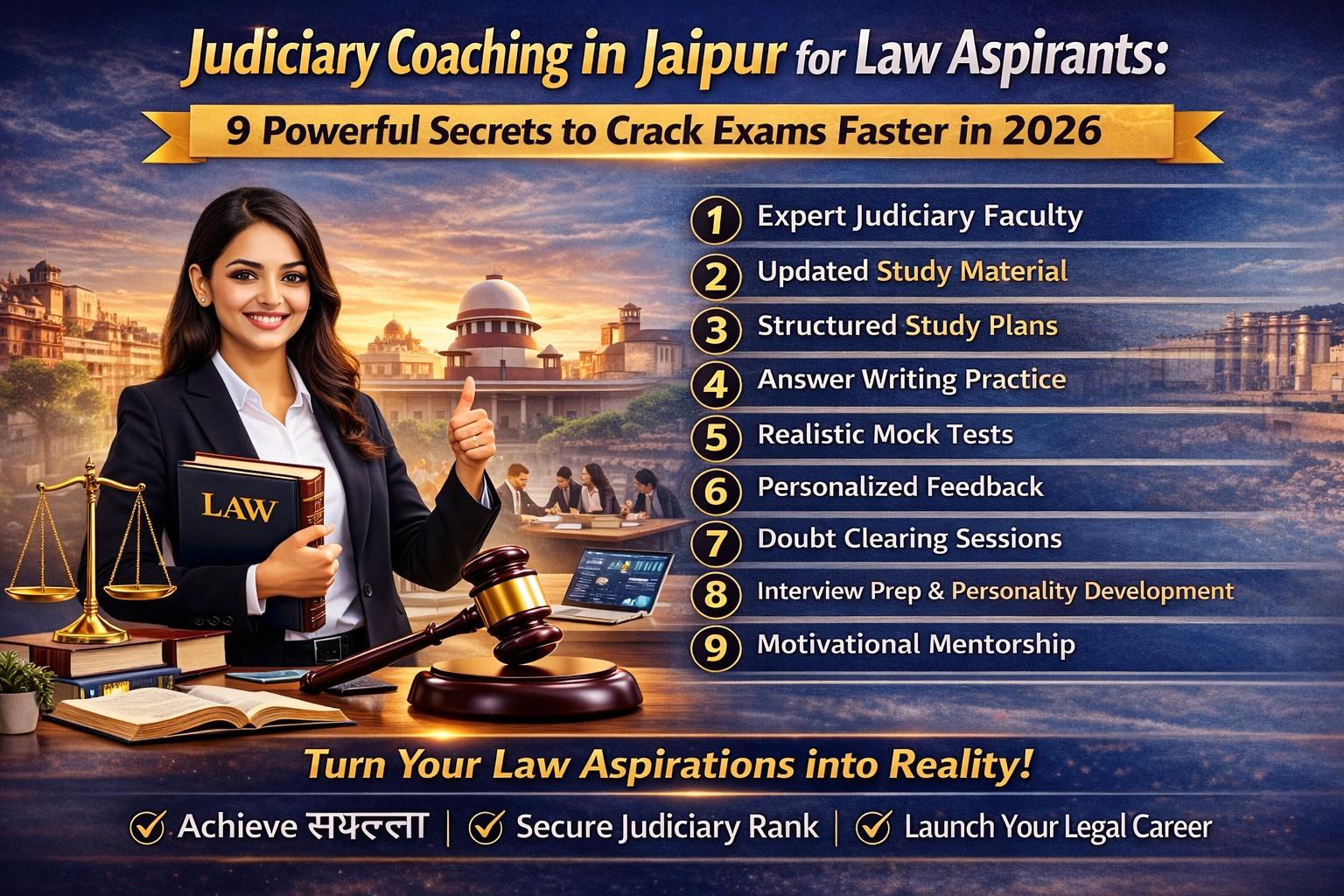
Judiciary Coaching in Jaipur for Law Aspirants: 9 Powerful Secrets to Crack Exams Faster in 2026
Judicial services examinations are among the most prestigious and competitive career paths for law graduates in India. Every year, thousands of aspirants compete for limited seats, making structured preparation essential rather than optional. Consequently, choosing the right judiciary coaching in Jaipur for law aspirants can be the defining factor between success and repeated attempts.
Jaipur has rapidly evolved into a prominent legal education hub, offering specialized coaching institutes, experienced faculty, and competitive learning environments. Moreover, aspirants increasingly prefer cities with strong academic ecosystems because they provide consistent motivation, peer learning, and expert mentorship. This blog reveals proven insights, practical strategies, and frequently asked questions to help you select the best coaching and maximize your chances of cracking judiciary exams on your first attempt.
Why Judiciary Coaching Matters for Law Aspirants
Preparing for judicial exams requires mastery over constitutional law, procedural laws, evidence, language papers, and current legal developments. While self-study is valuable, structured coaching accelerates preparation by:
-
Providing systematic syllabus coverage
-
Offering expert faculty guidance
-
Conducting regular mock tests
-
Delivering personalized feedback
-
Ensuring answer writing practice
According to exam trend analyses, aspirants who undergo structured mock testing improve answer accuracy by nearly 35–40% compared to those who rely only on reading-based preparation. Therefore, professional coaching is not merely support—it is a strategic advantage.
9 Proven Features of the Best Judiciary Coaching in Jaipur
1. Experienced Judiciary Faculty
Top institutes hire mentors who are former judiciary aspirants, practicing advocates, or legal scholars. Their experience helps students understand examiner expectations, judgment writing techniques, and case law interpretation.
2. Updated Study Material
Judicial exams frequently incorporate new amendments and landmark judgments. High-quality coaching centers update their notes regularly, ensuring students study only relevant content.
3. Structured Study Plans
A clear roadmap divides the syllabus into manageable weekly targets. As a result, aspirants avoid overwhelm and maintain consistent progress.
4. Intensive Answer Writing Practice
Mains exams demand analytical writing. Institutes that conduct daily or weekly answer writing sessions significantly enhance students’ presentation skills.
5. Realistic Mock Tests
Simulated exams mirror actual exam conditions. Students learn time management, accuracy, and stress handling.
6. Personalized Performance Feedback
Individual evaluation reports identify weak areas and recommend targeted improvement strategies.
7. Doubt Resolution Support
Immediate clarification prevents conceptual gaps from turning into long-term weaknesses.
8. Interview Preparation Programs
Top institutes conduct mock interviews with panel feedback to refine personality, articulation, and legal reasoning.
9. Motivational Mentorship
Preparation often lasts months or years. Continuous mentorship keeps aspirants focused, disciplined, and confident.
How Jaipur Became a Judiciary Preparation Hub
Jaipur’s academic culture, affordable living costs, and concentration of legal coaching institutes make it ideal for aspirants. In addition, the city attracts students from multiple states, creating a competitive environment that pushes individuals toward excellence.
Furthermore, accessibility plays a crucial role. Many institutes offer hybrid learning models combining classroom teaching with online access. This flexibility allows aspirants to revise lectures anytime, improving retention and efficiency.
Step-by-Step Success Roadmap for Judiciary Aspirants
Step 1 – Understand the Exam Pattern
Study the syllabus, marking scheme, and previous year papers before starting preparation.
Step 2 – Build Strong Conceptual Foundation
Focus first on core subjects like IPC, CPC, CrPC, Evidence Act, and Constitutional Law.
Step 3 – Join a Structured Coaching Program
Professional guidance shortens preparation time by eliminating guesswork.
Step 4 – Practice Writing Daily
Judiciary exams reward clarity and precision. Writing practice builds both.
Step 5 – Revise Strategically
Revision cycles every 15–20 days ensure long-term retention.
Step 6 – Analyze Mock Performance
Identify weak topics and revise them immediately.
Step 7 – Prepare for Interview Early
Start personality development alongside mains preparation.
Frequently Asked Questions
Is coaching necessary to crack judiciary exams?
Not mandatory, but highly recommended. Coaching provides structure, guidance, and evaluation that self-study often lacks.
How long should I prepare for judiciary exams?
Most successful candidates prepare for 8–14 months depending on prior legal knowledge and consistency.
What should I check before choosing a coaching institute?
Evaluate faculty experience, past results, test series quality, student reviews, and batch size.
Are online judiciary coaching programs effective?
Yes. Hybrid models combining live classes and recorded lectures improve flexibility and revision efficiency.
Do toppers rely only on coaching?
No. Toppers combine coaching guidance with disciplined self-study and regular revision.
Common Mistakes Aspirants Must Avoid
Many candidates fail not because of lack of knowledge but because of strategic errors. Avoid these pitfalls:
-
Ignoring answer writing practice
-
Studying without a timetable
-
Skimming bare acts instead of understanding concepts
-
Skipping mock tests due to fear of low scores
-
Comparing progress with others excessively
Correcting these mistakes alone can increase your selection probability dramatically.
Powerful Study Techniques Used by Judiciary Toppers
Active Recall: Test yourself regularly rather than rereading notes.
Spaced Repetition: Revise topics at increasing intervals for long-term memory.
Case Law Mapping: Link landmark judgments with legal principles.
Micro Notes: Summarize chapters into one-page revisions.
Timed Writing Drills: Practice answers within strict time limits.
These methods improve retention, speed, and analytical ability simultaneously.
The Emotional Edge: Why Mindset Matters
Judicial exam preparation is as much psychological as academic. Aspirants often face self-doubt, pressure, and burnout. Therefore, maintaining a strong mindset is essential. Coaching institutes that integrate mentorship sessions, peer discussions, and motivational workshops help students stay resilient. Confidence, consistency, and clarity together create the winning combination.
Conclusion
Choosing the right judiciary coaching in Jaipur for law aspirants is not simply about enrolling in classes—it is about investing in a structured success system. With expert faculty, disciplined study plans, realistic mock testing, and continuous mentorship, aspirants gain a competitive edge that dramatically improves their chances of selection.
Ultimately, success in judicial exams depends on three pillars: strategy, consistency, and guidance. When these elements align, even the most challenging exams become achievable milestones rather than distant dreams. If you aim to secure a judicial rank quickly and confidently, start by selecting a coaching institute that provides a proven roadmap and commit to disciplined preparation from day one.

 Arabic
 French
 Spanish
 Portuguese
 Deutsch
 Turkish
 Dutch
Dutch
 Italiano
 Russian
 Romaian
 Portuguese (Brazil)
 Greek
Greek