

Gesture Recognition For Smart TV Market Trend Analysis 2025-2031: Emerging Technologies and Competitive Landscape
Gesture Recognition for Smart TV enhances hygiene and safety by offering touch-free control. This feature became especially valuable in shared environments where reducing contact with surfaces is important.
Market Overview
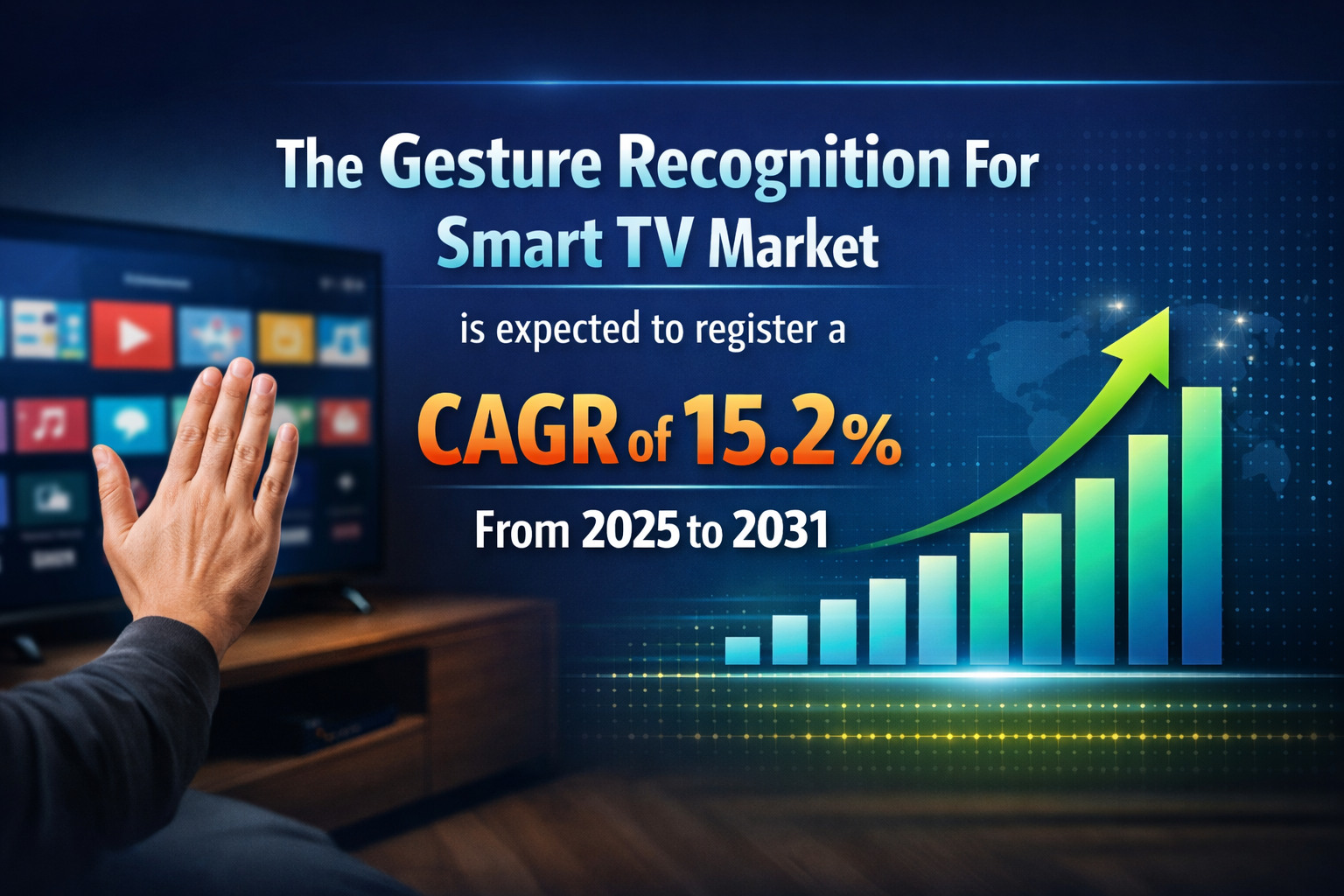
The Gesture Recognition For Smart TV Market is projected to register a CAGR of 15.2% during the forecast period from 2025 to 2031. The study by The Insight Partners evaluates the market landscape using historical data from 2021 to 2023 and provides value estimates in USD for all segments and regions. Gesture recognition technology enables users to control smart televisions through hand, finger, and body movements, reducing reliance on conventional remote controls. As smart home ecosystems expand and consumer expectations evolve, gesture enabled interfaces are emerging as a transformative feature in next generation smart TVs.
The market is segmented by software and hardware components. On the software side, 2D and 3D image sensor technologies form the foundation of gesture interpretation systems. On the hardware side, the ecosystem includes image sensors, IR proximity sensors, IR temperature sensors, light sensors, and semiconductor integrated circuits. Each component plays a critical role in capturing motion, processing signals, and translating gestures into actionable commands.
Gesture Recognition For Smart TV Market Segmentation Analysis
By Software
Software capabilities determine the precision and responsiveness of gesture based systems. 2D image sensors focus on planar motion detection, suitable for basic navigation functions such as channel switching or volume adjustment. 3D image sensors enable depth perception and complex gesture mapping, supporting immersive interactions and gaming applications. Growing demand for realistic and intuitive interfaces is pushing manufacturers to invest in advanced 3D software algorithms that enhance real time interpretation accuracy.
By Hardware
Hardware innovation underpins the scalability of gesture recognition in smart TVs. Image sensors capture visual input, while IR proximity and IR temperature sensors enhance detection in low light or varying environmental conditions. Light sensors optimize performance based on ambient brightness levels. Semiconductor integrated circuits process high volumes of motion data efficiently. Declining sensor costs and miniaturization trends are supporting broader adoption across mid range and premium smart TV models.
Download Sample PDF:https://www.theinsightpartners.com/sample/TIPRE00039441
Growth Drivers
One of the primary drivers is consumer demand for enhanced user experience. Modern viewers expect seamless and interactive control systems that align with digital lifestyles. Gesture recognition eliminates the need for physical contact and supports intuitive browsing of streaming platforms.
Technological advancements in sensor technologies are another major catalyst. Depth sensing cameras and AI enabled processors significantly improve gesture accuracy and responsiveness. As these technologies become more affordable, manufacturers can integrate them without significantly increasing product prices.
Integration within smart home ecosystems further strengthens growth. Consumers increasingly seek centralized control mechanisms for connected devices. Gesture enabled smart TVs can act as command hubs, interacting with lighting, climate control, and entertainment systems. This interoperability appeals strongly to technology savvy households.
Market Trends
A notable trend is the increasing focus on natural user interfaces. Consumers prefer organic interactions that mirror real world movements. Manufacturers are developing systems capable of recognizing subtle gestures and differentiating between intentional and accidental movements.
The adoption of artificial intelligence and machine learning is accelerating innovation. AI powered algorithms allow systems to learn from user behavior and refine gesture recognition over time. This leads to personalized viewing experiences and improved device responsiveness.
Collaborations between hardware developers and software innovators are also shaping the competitive landscape. Strategic partnerships enable the creation of integrated solutions that combine advanced sensors with intelligent processing software, expanding use cases beyond entertainment to include fitness, education, and virtual conferencing.
Gesture Recognition For Smart TV Market Regional Insights
North America remains a significant market, driven by high smart TV penetration in the United States, Canada, and Mexico. Europe shows steady growth, particularly in the United Kingdom, Germany, France, Italy, and Russia, where smart home adoption is increasing. Asia Pacific is expected to witness robust expansion, with China, Japan, India, and Australia contributing significantly due to rapid urbanization and technology uptake. South and Central America, led by Brazil and Argentina, along with the Middle East and Africa including Saudi Arabia, UAE, and South Africa, present emerging opportunities as digital infrastructure improves.
Key Players
Leading companies shaping the competitive environment include:
-
Eyesight Tech
-
Leap Motion Inc.
-
LG Electronics Inc.
-
Panasonic Corporation
-
Pointgrab Limited
-
Samsung Electronics Co., Ltd.
-
Softkinetic
-
Sony Corporation
-
Tesna Inc.
-
Texas Instruments Incorporated
These players focus on research and development, sensor innovation, and strategic collaborations to strengthen their market presence.
Future Outlook
The future outlook for the Gesture Recognition For Smart TV Market remains highly promising. Continuous advancements in AI, computer vision, and semiconductor technologies are expected to improve performance and reduce implementation costs. As smart home adoption expands and consumers increasingly demand contactless interfaces, gesture recognition is likely to transition from a premium feature to a mainstream standard. Emerging markets will play a crucial role in volume expansion, while developed regions will drive innovation and high value product development. Overall, sustained investment in research, ecosystem integration, and user centric design will define long term success in this rapidly evolving market.
Related Reports:

 English
 Arabic
 French
 Spanish
 Portuguese
 Deutsch
 Turkish
 Dutch
Dutch
 Italiano
 Russian
 Portuguese (Brazil)
 Greek
Greek