As artificial intelligence continues to evolve, the importance of high-quality training data has never been greater. While much attention is given to image and text data, audio data is equally critical—especially for applications like speech recognition, virtual assistants, call analytics, and emotion detection. This is where audio annotation comes into play.
In this comprehensive guide, Annotera explains what audio annotation is, why it matters, the different types involved, and how AI teams can leverage professional support from a data annotation company to scale efficiently.
What Is Audio Annotation?
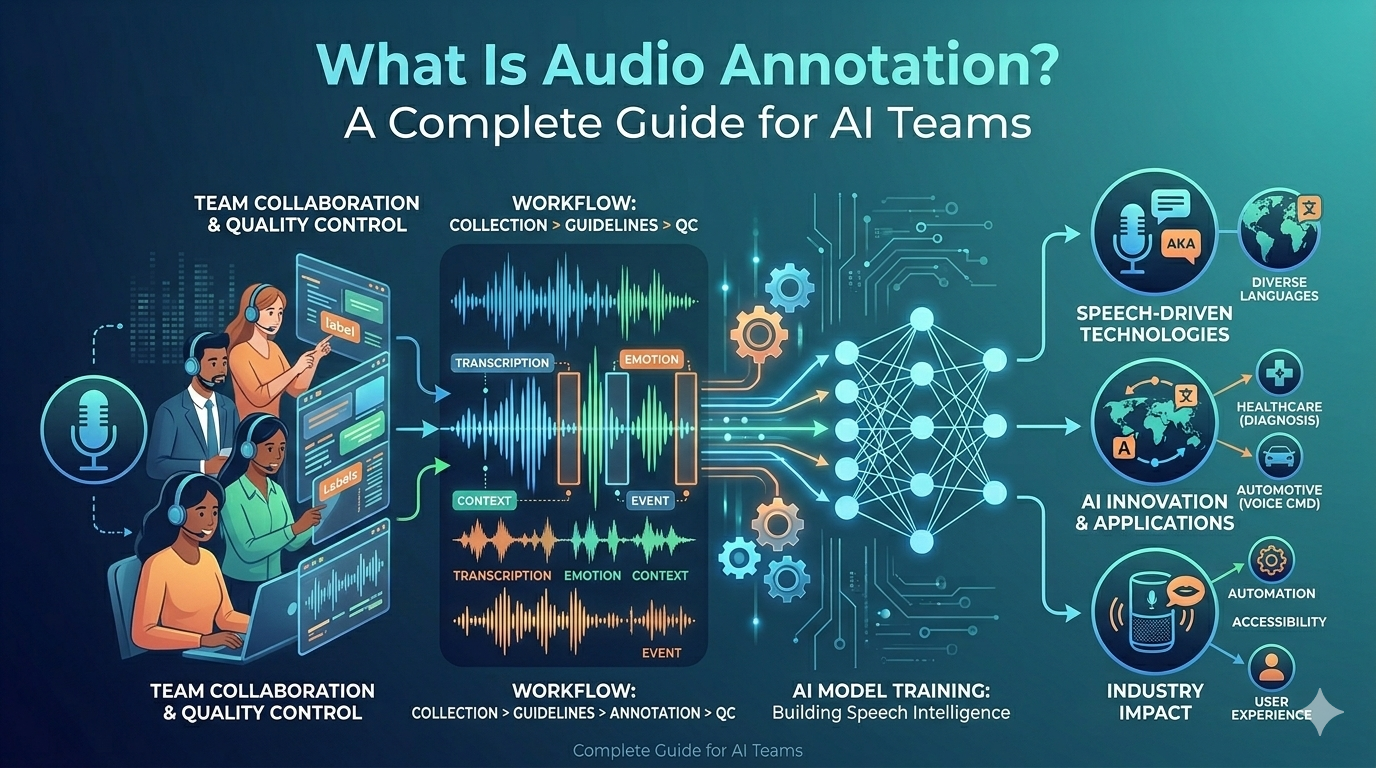
Audio annotation is the process of labeling or tagging audio data so that machine learning models can understand, interpret, and learn from it. It involves adding structured metadata to audio files—such as transcriptions, speaker labels, timestamps, or emotional cues—making the data usable for training AI systems.
For example, in a customer service call recording, audio annotation may include:
-
Transcribing spoken words into text
-
Identifying different speakers
-
Tagging emotions like frustration or satisfaction
-
Marking pauses, interruptions, or background noise
These annotations allow AI systems to learn patterns in human speech and sound, improving their ability to perform real-world tasks.
Why Audio Annotation Matters for AI Development
Audio annotation plays a foundational role in building intelligent systems that interact with or interpret sound. Without properly labeled data, even the most advanced algorithms struggle to deliver accurate results.
Key Benefits:
1. Improved Model Accuracy
Annotated audio helps machine learning models understand linguistic nuances, accents, and context, leading to better performance.
2. Enhanced Speech Recognition
Applications like voice assistants and transcription tools rely heavily on precisely annotated datasets.
3. Emotion and Sentiment Analysis
Audio annotation enables AI to detect tone, mood, and intent—critical for customer experience analytics.
4. Real-World Context Understanding
Tagging environmental sounds or background noise helps models function reliably in diverse conditions.
For AI teams aiming to scale quickly, partnering with a data annotation company or opting for data annotation outsourcing ensures consistent quality and faster turnaround.
Types of Audio Annotation
Audio annotation is not a one-size-fits-all process. Different use cases require different annotation techniques.
1. Speech-to-Text Transcription
This is the most common form of audio annotation. It involves converting spoken language into written text.
Use cases:
2. Speaker Diarization
This technique identifies and labels different speakers in an audio file.
Example:
Speaker 1: “Hello, how can I help you?”
Speaker 2: “I have an issue with my account.”
Use cases:
-
Call center analytics
-
Interviews and podcasts
3. Audio Classification
Audio files are categorized based on their content, such as music, speech, or environmental sounds.
Use cases:
-
Smart home devices
-
Security systems
4. Sound Event Detection
Specific events within an audio stream are identified and timestamped.
Examples:
-
Gunshots
-
Car horns
-
Dog barking
5. Emotion Annotation
Annotators label the emotional tone of speech, such as happiness, anger, or sadness.
Use cases:
6. Phonetic Annotation
This involves breaking down speech into phonemes (basic sound units), which is particularly useful for linguistic research and advanced speech models.
Key Challenges in Audio Annotation
Despite its importance, audio annotation presents several operational and technical challenges.
1. Variability in Audio Quality
Background noise, accents, and recording inconsistencies can make annotation difficult and error-prone.
2. Language and Accent Diversity
AI models must be trained on diverse datasets to ensure inclusivity and accuracy across regions.
3. Time-Intensive Process
Manual annotation requires significant time and effort, especially for large datasets.
4. Subjectivity in Labeling
Tasks like emotion detection can vary between annotators, affecting consistency.
This is why many organizations turn to an experienced audio annotation company to maintain quality standards and scalability.
Best Practices for High-Quality Audio Annotation
To achieve reliable and scalable results, AI teams should follow structured annotation workflows.
1. Define Clear Guidelines
Provide annotators with detailed instructions, including examples and edge cases, to minimize ambiguity.
2. Use High-Quality Tools
Annotation platforms with waveform visualization, playback controls, and timestamping features improve accuracy and efficiency.
3. Implement Quality Assurance Processes
Use multi-layer reviews, inter-annotator agreement checks, and validation pipelines.
4. Train Annotators Effectively
Ensure annotators understand domain-specific requirements, especially for complex tasks like emotion labeling.
5. Leverage Data Annotation Outsourcing
Outsourcing to a specialized data annotation company allows AI teams to scale operations while maintaining quality.
In-House vs. Outsourced Audio Annotation
AI teams often face a strategic decision: build in-house annotation capabilities or outsource to experts.
In-House Annotation
Pros:
Cons:
-
High operational costs
-
Limited scalability
-
Time-consuming setup
Audio Annotation Outsourcing
Pros:
Cons:
For most growing AI teams, audio annotation outsourcing offers a practical balance between cost, speed, and quality.
How Annotera Supports Audio Annotation at Scale
As a specialized data annotation company, Annotera provides end-to-end audio annotation services tailored for AI teams across industries.
What Sets Annotera Apart:
1. Domain Expertise
From telecom and healthcare to automotive and conversational AI, Annotera delivers industry-specific annotation solutions.
2. Skilled Workforce
A trained team of annotators ensures high accuracy across diverse audio datasets.
3. Scalable Operations
Whether you need thousands or millions of annotated audio files, Annotera scales seamlessly.
4. Robust Quality Control
Multi-level validation processes ensure consistency and reliability.
5. Flexible Engagement Models
Clients can choose customized workflows aligned with their project requirements.
By choosing a trusted audio annotation company like Annotera, organizations can accelerate AI development while maintaining data quality.
Future Trends in Audio Annotation
The field of audio annotation is rapidly evolving alongside advancements in AI.
1. AI-Assisted Annotation
Semi-automated tools are reducing manual effort while improving efficiency.
2. Multimodal Data Integration
Combining audio with text and visual data for richer AI models.
3. Real-Time Annotation
Growing demand for real-time processing in applications like live transcription and voice assistants.
4. Increased Focus on Low-Resource Languages
Expanding datasets to include underrepresented languages and dialects.
These trends highlight the growing importance of partnering with a forward-thinking data annotation company that can adapt to changing technological demands.
Conclusion
Audio annotation is a critical component of modern AI development, enabling machines to understand and interpret sound with precision. From speech recognition to emotion analysis, its applications span multiple industries and use cases.
However, achieving high-quality annotation at scale requires expertise, structured workflows, and robust quality control. For AI teams looking to accelerate development while maintaining accuracy, data annotation outsourcing to a specialized audio annotation company like Annotera offers a strategic advantage.
By investing in high-quality audio annotation today, organizations can build smarter, more reliable AI systems for tomorrow.



 English
 Arabic
 French
 Spanish
 Portuguese
 Deutsch
 Turkish
 Dutch
Dutch
 Russian
 Romaian
 Portuguese (Brazil)
 Greek
Greek