

Dry Ice Market Analysis 2022–2030 | Industry Expansion to US$ 936.90 Million at 6.0% CAGR
The term dry ice refers to carbon dioxide in its solid form, commonly used for refrigeration and cooling applications. Unlike ordinary ice, which melts into water, dry ice changes directly into gas through sublimation when exposed to atmospheric conditions. It remains extremely cold, maintaining temperatures close to -78°C (-109.3°F). This makes it highly suitable for preserving delicate products during shipping and storage. Because it leaves no liquid residue, dry ice finds extensive use in food packaging, pharmaceutical transport, industrial cleaning processes, stage effects, and temperature-controlled logistics.
Dry Ice Market Overview
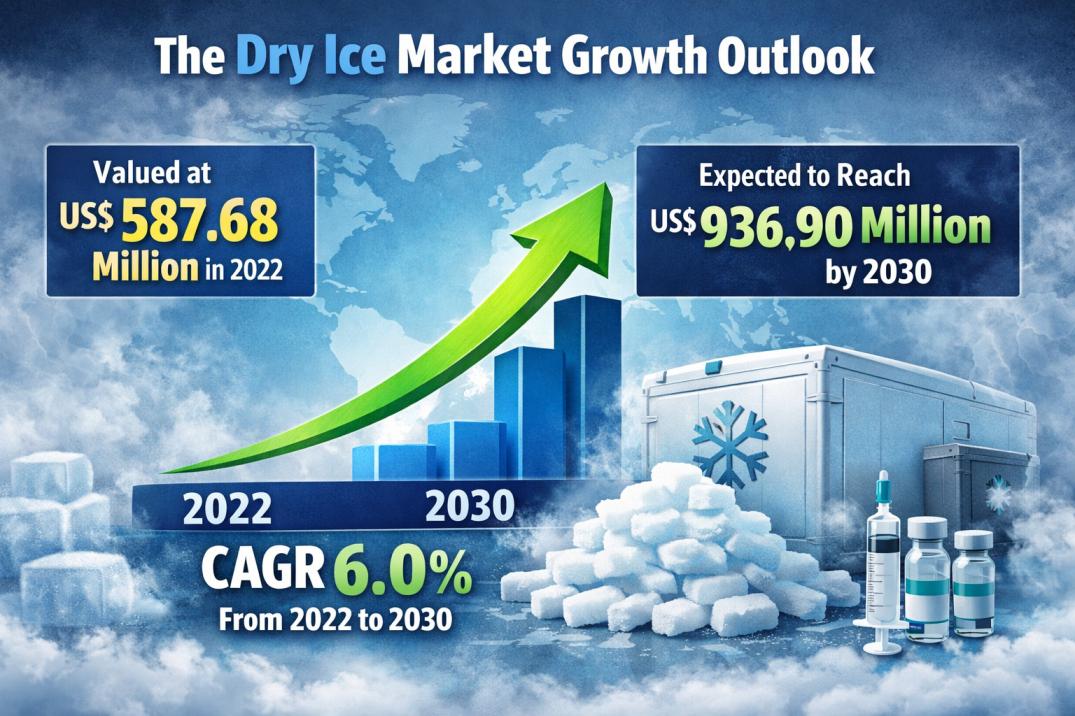
The dry ice market has witnessed significant growth due to the increasing demand for reliable cooling solutions across various industries. The dry ice market size was valued at US$ 587.68 million in 2022 and is projected to reach US$ 936.90 million by 2030, registering a CAGR of 6.0% during the forecast period. The rising need for efficient storage and transportation of perishable goods, pharmaceuticals, and biological materials has driven the adoption of dry ice globally.
Dry ice is widely used in cold chain logistics because it maintains ultra-low temperatures for longer durations compared to water-based ice. Its ability to sublimate directly into gas eliminates the risk of liquid residue, making it a safer and cleaner solution for transporting sensitive products. As global trade in perishable goods continues to expand, the demand for dry ice is expected to grow steadily.
Market Drivers Supporting Dry Ice Industry Growth
One of the major factors driving the growth of the dry ice market is the increasing preference for dry ice over traditional water-based ice. Dry ice offers significantly lower temperatures and longer cooling duration, which is essential for transporting temperature-sensitive products such as frozen foods, vaccines, and biological samples.
Another key driver is the rapid growth of the food and beverage industry. Frozen foods, seafood, meat products, and ready-to-eat meals require consistent cold temperatures during transportation and storage. Dry ice helps maintain product quality by preserving taste, texture, and freshness.
The healthcare sector is also contributing to market expansion. Dry ice is widely used for transporting vaccines, blood samples, organs, and pharmaceutical products that require strict temperature control. With the increasing global demand for medical logistics and biological sample transportation, the role of dry ice in healthcare supply chains continues to grow.
Growth Challenges in the Dry Ice Market
Despite its advantages, the dry ice market faces certain challenges. One of the major limitations is its short storage life. Dry ice gradually sublimates and converts into gas within 18 to 24 hours if not stored properly. This makes long-term storage difficult and requires continuous supply for logistics operations.
Additionally, dry ice must be handled carefully due to its extremely low temperature. Improper handling can cause frostbite or damage to materials. Special storage containers and ventilation systems are often required, which can increase operational costs for businesses.
Sample PDF:- https://www.theinsightpartners.com/sample/TIPRE00019661
Dry Ice Market Segmentation
Based on type, the market is divided into pellets, blocks, and others. Among these, the blocks segment accounted for the largest market share in 2022. Dry ice blocks are commonly used for temporary refrigeration and industrial cleaning applications. Due to their lower surface area, blocks sublimate more slowly compared to pellets, making them suitable for longer cooling requirements.
Based on application, the market is segmented into food and beverages, storage and transportation, healthcare, industrial applications, and others. The storage and transportation segment dominated the market in 2022. Dry ice plays a crucial role in maintaining cold chain logistics for shipping products such as seafood, flowers, herbs, meat, and other perishable goods.
Regional Analysis of the Dry Ice Market
North America holds a significant share of the global dry ice market due to the presence of advanced cold chain infrastructure and a strong food processing industry. The region also has a high demand for pharmaceutical logistics, which further supports dry ice consumption.
Europe is another major market, driven by the expansion of food export industries and strict quality standards for temperature-sensitive products. Meanwhile, the Asia-Pacific region is expected to witness strong growth due to rising food consumption, expanding healthcare infrastructure, and increasing international trade of perishable goods.
Key Players in the Dry Ice Market
Major companies operating in the dry ice market include:
-
Polar Ice
-
Continental Carbonic Products Inc.
-
Sicgil India Limited
-
Linde PLC
-
Dry Ice UK Ltd.
-
Dry Ice Corp
-
Reliant Dry Ice
-
CryoCab
-
Praxair Technology, Inc.
-
ACP
These companies focus on expanding production capacity, developing efficient dry ice distribution networks, and strengthening supply chains to meet the growing demand across industries.
What factors are driving the growth of the dry ice market?
The growth of the dry ice market is primarily driven by the increasing demand for cold chain logistics, rising consumption of frozen foods, and the growing need for temperature-controlled transportation in the pharmaceutical industry.
Which industry uses dry ice the most?
The storage and transportation sector is the largest user of dry ice. It is widely used to preserve perishable products such as seafood, meat, frozen foods, flowers, and pharmaceuticals during shipping and distribution.
Who are the leading companies operating in the dry ice market?
Key companies in the market include Polar Ice, Continental Carbonic Products Inc., Sicgil India Limited, Linde PLC, Dry Ice UK Ltd., Dry Ice Corp, Reliant Dry Ice, CryoCab, Praxair Technology, Inc., and ACP. These players focus on expanding their manufacturing capabilities and strengthening global distribution networks.
Future Outlook
The dry ice market is expected to witness steady growth over the coming years due to the expansion of global cold chain logistics and the rising demand for frozen and perishable products. The increasing adoption of dry ice in pharmaceutical transportation and vaccine distribution is also expected to support market expansion. As industries continue to prioritize efficient temperature-controlled supply chains, the dry ice market is likely to experience sustained demand and technological advancements through 2030.
Related Reports:-
Foliar Spray Market Size, Share, Growth & Scope Analysis 2031
Tocopherol Market Insights | Size, Share and Scope by 2031

 English
 French
 Spanish
 Portuguese
 Deutsch
 Turkish
 Dutch
Dutch
 Italiano
 Russian
 Romaian
 Portuguese (Brazil)
 Greek
Greek