Power utilities, EPC contractors, and grid infrastructure developers require transmission conductors that deliver strength, reliability, and cost efficiency. Among the most widely used overhead conductors in modern power networks is the ACSR Cable (Aluminum Conductor Steel Reinforced).
Designed for long-distance power transmission and heavy mechanical loads, ACSR cables combine the conductivity of aluminum with the strength of a steel core. This hybrid structure allows utilities to build durable overhead lines capable of spanning long distances while maintaining excellent electrical performance.
In this article, we explore the ACSR cable structure, advantages, applications, and key selection factors for engineers and procurement professionals planning transmission or distribution projects.
What is an ACSR Cable?
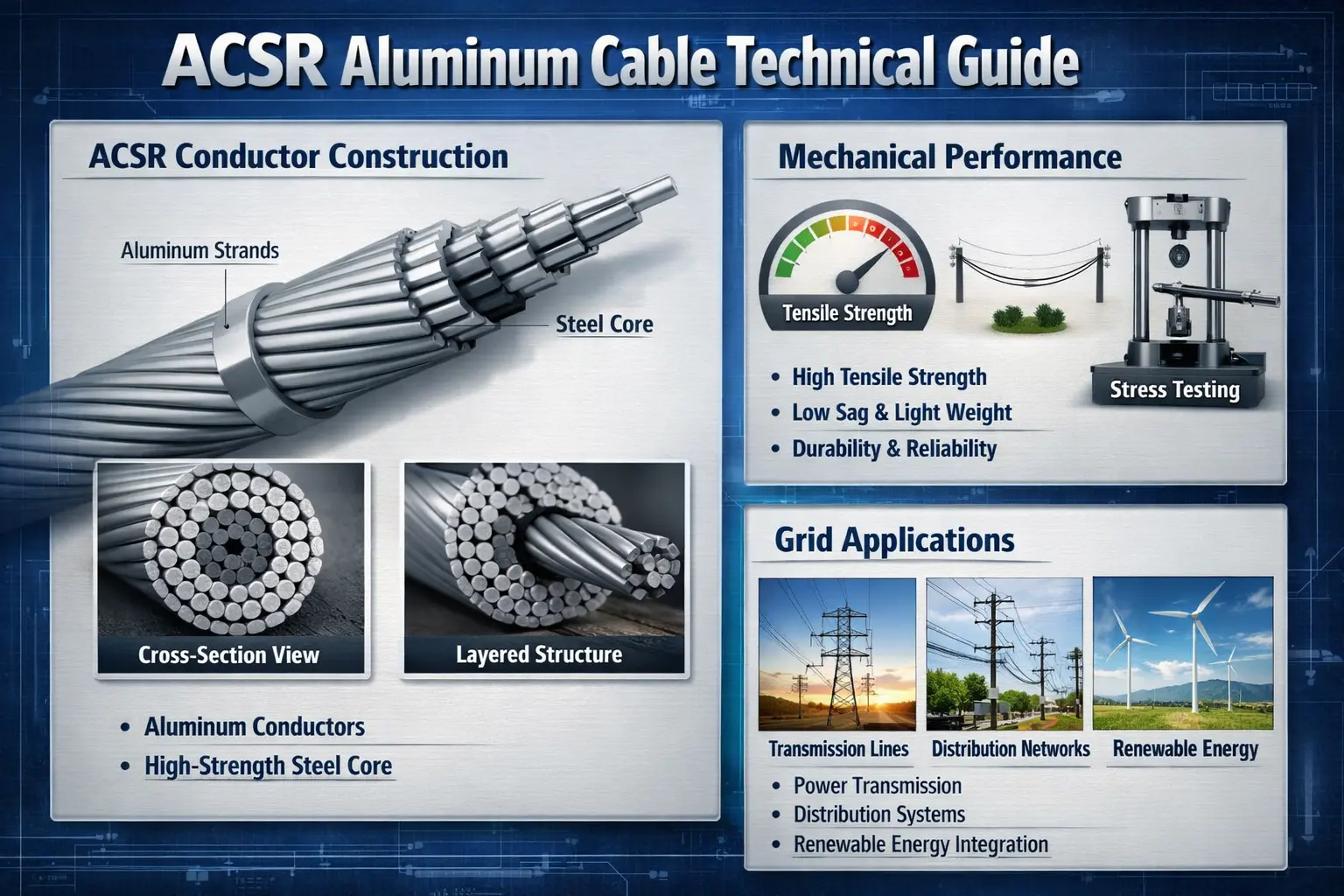
ACSR Cable (Aluminum Conductor Steel Reinforced) is an overhead power transmission conductor consisting of:
The steel core supports the conductor’s weight and resists mechanical stress caused by wind, ice, or long spans. Meanwhile, the outer aluminum layers carry most of the electrical current.
This design makes ACSR one of the most trusted conductors for medium and high-voltage overhead transmission systems worldwide.
Structure of an ACSR Conductor
Understanding the construction of ACSR helps engineers determine its suitability for specific transmission projects.
Steel Core
The central steel wire or strand bundle serves as the reinforcement component, giving the conductor high tensile strength. It allows the cable to handle:
The steel core is often galvanized to improve corrosion resistance, ensuring durability over decades of service.
Aluminum Layers
Surrounding the steel core are concentric layers of aluminum wires. Aluminum is chosen for its:
-
Excellent conductivity
-
Lightweight properties
-
Cost-effectiveness
These aluminum strands carry the majority of the electrical current in the conductor.
Stranding Design
ACSR conductors are produced using multiple stranding configurations, allowing utilities to optimize performance for different applications such as:
Manufacturers like HNBF Power design various conductor sizes and constructions to match the electrical and mechanical requirements of specific grid projects.
Key Advantages of ACSR Cable
ACSR conductors have been widely adopted in transmission networks due to several engineering benefits.
High Tensile Strength
The steel reinforcement provides excellent mechanical strength, allowing the cable to support long spans without excessive sag. This is particularly important for transmission lines crossing valleys, rivers, or highways.
Cost-Effective Transmission Solution
Compared with many alternative conductors, ACSR provides a strong balance between performance and cost, making it a popular choice for large-scale transmission projects.
Good Electrical Conductivity
The aluminum strands ensure efficient current flow, reducing transmission losses and improving overall network performance.
Durability in Harsh Environments
ACSR conductors are designed to operate reliably under:
-
High wind loads
-
Ice accumulation
-
Temperature fluctuations
When manufactured with high-quality materials and proper galvanization, these cables can provide decades of dependable service.
Wide Range of Configurations
ACSR cables are available in numerous sizes and stranding combinations, enabling utilities to select conductors based on:
Typical Applications of ACSR Cable
Because of its strength and reliability, ACSR cable is commonly used in a variety of power transmission and distribution scenarios.
Overhead Transmission Lines
ACSR is widely used for medium and high-voltage overhead transmission lines, where mechanical strength and conductivity are essential.
Long-Span Power Lines
Projects requiring extended spans between towers benefit greatly from ACSR's reinforced steel core.
Utility Distribution Networks
Electric utilities often install ACSR conductors for primary distribution feeders and rural electrification systems.
Harsh Environment Installations
ACSR performs well in environments where conductors must resist:
-
Strong winds
-
Heavy ice loading
-
Extreme temperatures
These characteristics make ACSR a dependable choice for grid infrastructure expansion and modernization projects.
How to Select the Right ACSR Conductor
Selecting the appropriate ACSR cable involves careful technical evaluation. Engineers and procurement teams should consider several key factors.
Current Carrying Capacity
The conductor size must match the expected electrical load and thermal limits of the transmission line.
Mechanical Strength Requirements
Long spans or challenging terrain require conductors with higher tensile strength and optimized steel core ratios.
Environmental Conditions
Environmental factors such as wind pressure, ice accumulation, and corrosion risk must be evaluated when choosing conductor specifications.
Installation and Maintenance Considerations
Utilities should also assess:
-
Sag and tension calculations
-
Compatibility with existing towers
-
Long-term maintenance requirements
Partnering with an experienced manufacturer ensures the conductor specifications meet both technical performance and project reliability standards.
Why Power Utilities Choose HNBF Power
For transmission projects, the quality of the conductor directly affects the reliability of the entire grid system.
HNBF Power specializes in manufacturing high-performance overhead conductors designed for modern power infrastructure projects worldwide.
Key advantages of working with HNBF Power include:
-
Advanced conductor manufacturing technology
-
Strict quality control and international standards compliance
-
Wide product range including AAC, AAAC, ACSR, ABC cables, and LV power cables
-
Custom conductor specifications for EPC and utility projects
-
Reliable global supply capabilities
By focusing on engineering precision, consistent quality, and project-focused solutions, HNBF Power supports utilities and contractors in building reliable transmission networks.
Frequently Asked Questions (FAQs)
What does ACSR stand for?
ACSR stands for Aluminum Conductor Steel Reinforced, a type of overhead power transmission conductor that combines aluminum conductivity with steel strength.
Why is steel used in ACSR cables?
The steel core provides mechanical reinforcement, allowing the conductor to withstand long spans, high tension, and environmental stress.
Where are ACSR cables commonly used?
ACSR cables are widely used in overhead power transmission lines, distribution systems, and long-span power projects.
How long do ACSR conductors last?
With proper installation and maintenance, ACSR conductors can typically operate for 30–50 years or more in power transmission systems.
What is the difference between AAC and ACSR conductors?
AAC conductors are made entirely of aluminum and provide good conductivity but lower strength. ACSR conductors include a steel core for higher mechanical strength, making them suitable for longer spans and heavy loads.
Build Reliable Power Transmission with HNBF Power
Choosing the right conductor is critical for building safe, efficient, and long-lasting power transmission networks. ACSR cables remain one of the most reliable solutions for utilities and EPC contractors requiring strong and efficient overhead conductors.
If you are planning a transmission or distribution project and need high-quality ACSR cables tailored to your technical specifications, the experts at HNBF Power are ready to help.
Contact HNBF Power today to discuss your project requirements and receive customized conductor solutions designed for modern power infrastructure.



 English
 Arabic
 French
 Spanish
 Portuguese
 Deutsch
 Turkish
 Dutch
Dutch
 Italiano
 Russian
 Romaian
 Greek
Greek