

Optimizing High-Speed Spindles with 70 Angular Contact Ball Bearing
In the world of high-volume automotive manufacturing, the spindle is the heart of the operation. Whether it’s milling engine heads or grinding transmission gears, the demand for higher RPMs and tighter tolerances is constant. However, as production targets increase, many B2B plant managers face a recurring nightmare: spindle seizure and thermal instability.
When a machine tool fails, the cost isn't just the price of the part—it's the hundreds of units of lost production and the ripple effect through the just-in-time (JIT) supply chain. The primary cause of these failures often traces back to an improperly specified bearing series. Specifically, for high-speed, light-to-medium load applications, the 70 angular contact ball bearing has emerged as the industry's answer to the "speed vs. heat" dilemma.
The Problem: The High-Speed Friction Trap
Traditional deep-groove ball bearings or heavier series bearings (like the 72 or 73 series) are robust, but they possess a physical limitation: mass. In high-speed automotive machining, mass is the enemy.
-
Centrifugal Force Stress: At high velocities, the rolling elements in heavier bearings are pushed outward with immense force, causing "skidding" and increased friction.
-
Lubricant Breakdown: Excessive heat generation from heavy-duty series bearings causes grease to bleed or oil films to thin, leading to metal-to-metal contact.
-
Dimensional Drift: As heat builds up, the spindle shaft expands. If the bearing can't handle this thermal growth, the preload increases, creating a "death spiral" of rising temperature and eventual seizure.
For B2B partners, these technical failures manifest as poor surface finishes on automotive components and frequent, unplanned maintenance intervals.
The Engineering Solution: The 70 Series Advantage
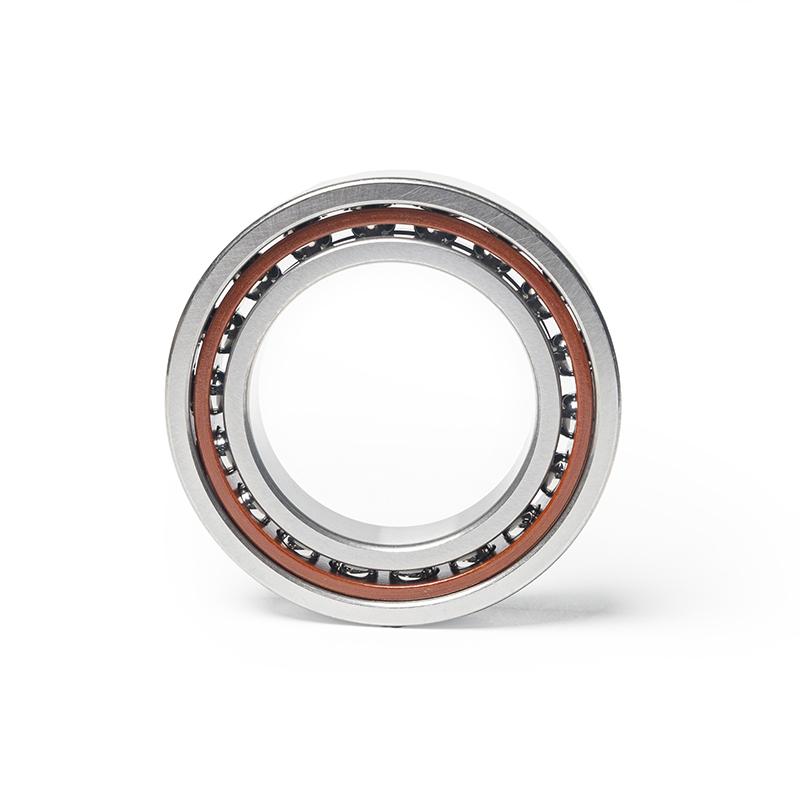
The 70 angular contact ball bearing is characterized by its "Extra Light" cross-section. It is designed specifically for applications where speed is the priority and space is at a premium. By utilizing a smaller ball diameter and thinner rings, the 70 series minimizes the centrifugal forces acting on the rolling elements.
1. High-Speed Capacity
Because the balls are smaller, the 70 angular contact ball bearing can reach significantly higher DmN values (a measurement of speed capability) compared to its thicker counterparts. This allows automotive manufacturers to push their CNC machines to higher feeds and speeds, reducing cycle times.
2. Precise Contact Angles
Available typically in 15° (C) or 25° (AC) contact angles, these bearings allow for a customized balance between radial stiffness and axial load support. In a spindle set, they are often used in "Back-to-Back" (DB) or "Face-to-Face" (DF) arrangements to provide rigid support in both directions.
Technical Performance Benchmarks for B2B Sourcing
When sourcing a 70 angular contact ball bearing, automotive engineers must look beyond the basic dimensions. The "70" designation tells you the size, but the suffix tells you the performance.
| Feature | Automotive Requirement | 70 Series Specification |
| Tolerance Class | High-Precision Machining | P4S / P2 (High Precision) |
| Rolling Element | Low Mass / High Speed | Ceramic (Hybrid) or Chrome Steel |
| Preload Level | Minimal Heat / High Rigidity | Light or Extra-Light Preload |
| Cage Material | High RPM Stability | Phenolic Resin or PEEK |
Solving the EV Component Precision Crisis
As the automotive sector transitions to Electric Vehicles (EVs), the requirements for machining have become even more stringent. EV motor housings and battery trays require ultra-precise milling. Any vibration during the machining process can lead to structural weaknesses or cooling leaks.
Using a 70 angular contact ball bearing in the machining spindle ensures a "zero-play" environment. This high degree of running accuracy minimizes the vibration transmitted to the cutting tool, resulting in the mirror-like surface finishes required for high-sealing EV assemblies.
The Procurement Perspective: Strategic ROI and Life-Cycle Costs
From a B2B purchasing standpoint, the 70 series represents a move toward Value Engineering. While high-precision angular contact bearings are an investment, their ability to prevent spindle failure offers a massive return:
-
Reduced Unplanned Downtime: A properly cooled 70-series setup can last twice as long as an over-specified, heavy-duty bearing in high-speed applications.
-
Energy Efficiency: Lower friction means the spindle motor draws less current to maintain speed, contributing to factory-wide sustainability goals.
-
Inventory Streamlining: Because the 70 series is a standard ISO dimension, it is highly interchangeable, allowing for better supply chain resilience.
Conclusion: Engineering for Speed and Stability
The 70 series is the silent hero of the modern automotive machine shop. By addressing the fundamental problem of centrifugal friction and thermal growth, the 70 angular contact ball bearing provides the stability that high-speed manufacturing demands.
In the competitive B2B landscape, the winner isn't the one who builds the biggest machine, but the one who builds the most efficient one. By optimizing your bearing selection for speed and precision, you ensure that your production line remains cool, fast, and profitable.

 English
 Arabic
 Spanish
 Portuguese
 Deutsch
 Turkish
 Dutch
Dutch
 Italiano
 Russian
 Romaian
 Portuguese (Brazil)
 Greek
Greek