

Top Reasons Accounting Firms Are Adopting Offshore Bookkeeping Solutions:
In the modern financial environment, accounting firms are expected to deliver precise financial reporting, ensure compliance with regulations, and manage an increasing number of clients. At the same time, firms must keep operational costs under control while maintaining high service quality.
As the client base expands, managing bookkeeping tasks internally often becomes complex and resource-intensive. This is why offshore bookkeeping services for accounting firms have become an effective operational solution. By outsourcing bookkeeping responsibilities to experienced offshore professionals, accounting firms can streamline workflows, reduce operational expenses, and dedicate more time to strategic advisory services.
Understanding Offshore Bookkeeping Services
Offshore bookkeeping services involve outsourcing daily accounting and bookkeeping activities to skilled professionals located in another country. These offshore teams function as an extended part of the accounting firm, managing financial records and supporting business operations while maintaining accuracy, confidentiality, and compliance with global accounting standards.
Common offshore bookkeeping tasks include:
-
Managing accounts payable and receivable
-
Bank and credit card reconciliation
-
Maintaining general ledger records
-
Preparing financial statements
-
Payroll bookkeeping assistance
-
Month-end and year-end closing processes
-
Tracking expenses and financial reports
Rather than expanding internal teams, accounting firms gain access to qualified professionals who work remotely using secure cloud-based accounting software.
Why Offshore Bookkeeping Is Gaining Popularity Among Accounting Firms
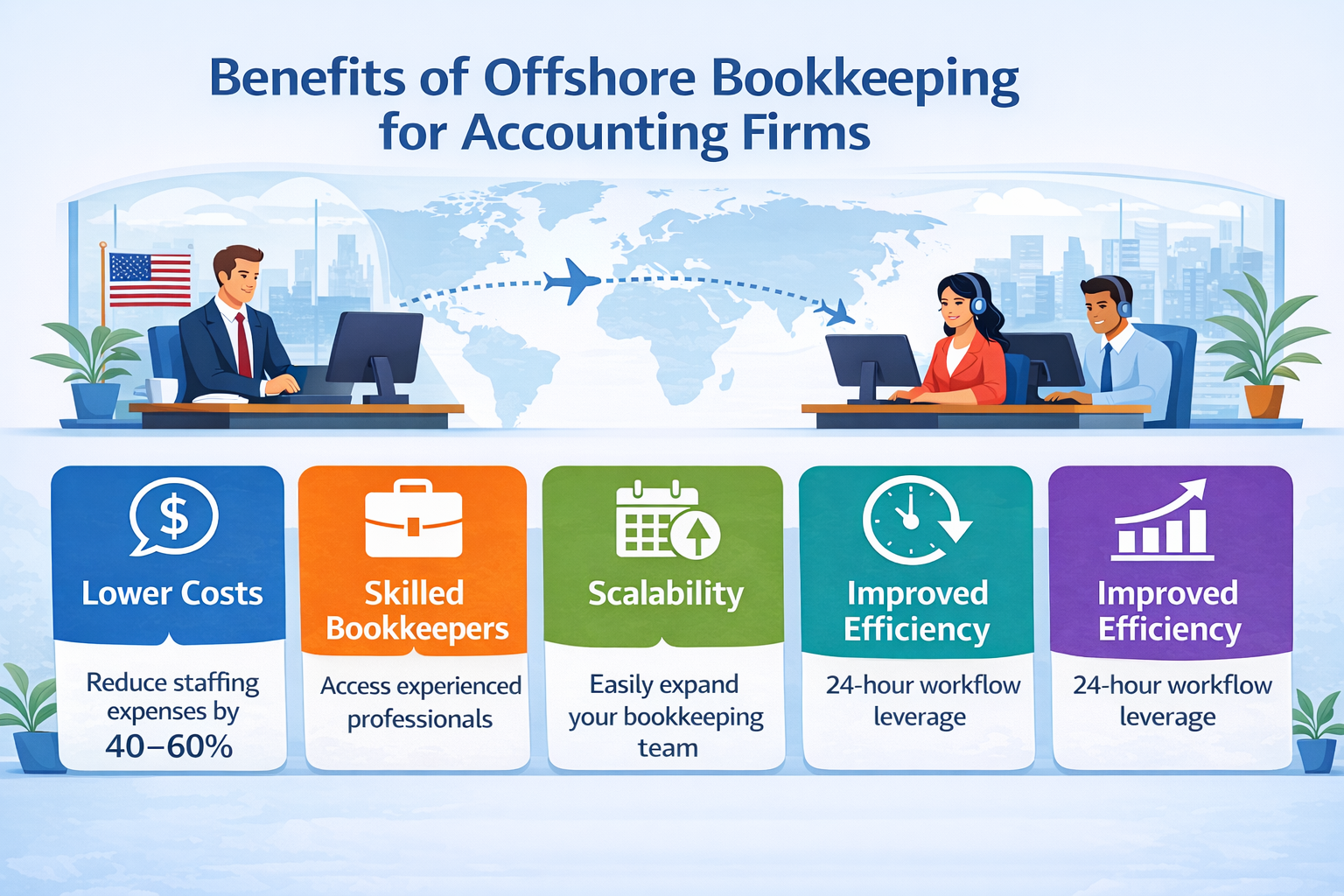
1. Lower Operational Costs
Hiring full-time in-house bookkeeping staff involves salaries, employee benefits, office infrastructure, and training expenses. Offshore bookkeeping allows accounting firms to significantly reduce operational costs while maintaining service quality.
Many firms experience cost reductions of 40–60%, enabling them to improve profitability without increasing fees for clients.
2. Access to Experienced Accounting Professionals
Offshore bookkeeping providers typically employ trained accounting professionals who are skilled in widely used accounting platforms such as QuickBooks, Xero, NetSuite, Sage, and FreshBooks.
These professionals are knowledgeable about U.S. accounting practices and Generally Accepted Accounting Principles, ensuring accurate and reliable financial management.
3. Flexible Scaling During Busy Periods
Accounting firms frequently experience workload spikes during tax season and financial reporting periods. Offshore bookkeeping teams provide flexibility by allowing firms to scale resources up or down depending on workload demands.
This flexibility helps firms maintain productivity without the pressure of hiring additional staff during peak seasons.
Major Benefits of Offshore Bookkeeping Services for Accounting Firms
Increased Operational Efficiency
Outsourcing repetitive bookkeeping tasks allows internal teams to concentrate on higher-value services such as financial advisory, tax planning, and strategic consulting. This shift improves overall productivity and service quality.
Faster Processing and Reporting
With offshore teams working in different time zones, accounting tasks can continue even after the local office closes. This enables faster financial reporting and quicker turnaround times for client deliverables.
Greater Focus on Advisory Services
Today’s accounting firms are increasingly transitioning from compliance-based services to advisory-focused roles. Offshore bookkeeping allows senior accountants and partners to focus on strategic financial planning, business consulting, and client advisory services.
Strong Data Security Measures
Professional offshore bookkeeping providers implement advanced security protocols to protect financial data, including:
-
Secure cloud-based system access
-
Encrypted data transfer
-
Non-disclosure agreements (NDAs)
-
Controlled user access and permissions
These security practices ensure that confidential financial information remains protected.
How Offshore Bookkeeping Helps Accounting Firms Grow
Accounting firms looking to expand often encounter limitations related to staffing capacity and operational costs. Offshore bookkeeping removes these barriers by creating a scalable business model.
With offshore bookkeeping support, accounting firms can:
-
Serve more clients without increasing internal workforce
-
Expand service offerings
-
Improve operational profitability
-
Maintain consistent service delivery
-
Operate across multiple time zones efficiently
By optimizing internal resources, firms can position themselves for sustainable growth and competitive advantage.
Industries Supported Through Offshore Bookkeeping
Offshore bookkeeping teams assist accounting firms that serve a wide range of industries, including:
-
Small and medium-sized businesses
-
Startup companies and technology firms
-
Real estate businesses
-
E-commerce companies
-
Healthcare organizations
-
Professional service providers
Offshore teams customize bookkeeping processes based on industry-specific financial reporting requirements.
Best Practices for Implementing Offshore Bookkeeping
To successfully implement offshore bookkeeping services, accounting firms should follow a structured approach.
Select an Experienced Offshore Partner
Choose a provider with proven experience supporting accounting firms and CPA practices.
Utilize Cloud-Based Accounting Software
Cloud accounting platforms allow real-time collaboration, secure document sharing, and improved workflow management.
Maintain Clear Communication
Regular communication, workflow tracking, and reporting systems help ensure smooth coordination between internal and offshore teams.
Develop Standard Operating Procedures (SOPs)
Clearly documented processes help maintain accuracy, consistency, and accountability in financial operations.
The Future of Accounting Firms with Offshore Bookkeeping
The accounting industry is rapidly evolving due to digital transformation, automation, and the growing demand for advisory services. Offshore bookkeeping plays a key role in this transformation by helping accounting firms operate efficiently while maintaining high-quality services.
As cloud accounting technologies continue to advance, offshore teams can integrate seamlessly into digital workflows, helping firms stay competitive in a global business environment.
Conclusion
Offshore bookkeeping services for accounting firms have evolved beyond a simple cost-reduction strategy. They have become an essential operational model that supports growth, scalability, and efficiency.
By outsourcing routine bookkeeping tasks to skilled offshore professionals, accounting firms can improve operational performance, reduce overhead costs, and focus on delivering strategic financial guidance to their clients.
Firms that embrace offshore bookkeeping gain the flexibility needed to handle growing client demands while maintaining accuracy, compliance, and profitability in an increasingly competitive accounting industry

 English
 Arabic
 French
 Spanish
 Portuguese
 Deutsch
 Turkish
 Dutch
Dutch
 Italiano
 Russian
 Romaian
 Greek
Greek