

How to Travel Around Japan Efficiently?
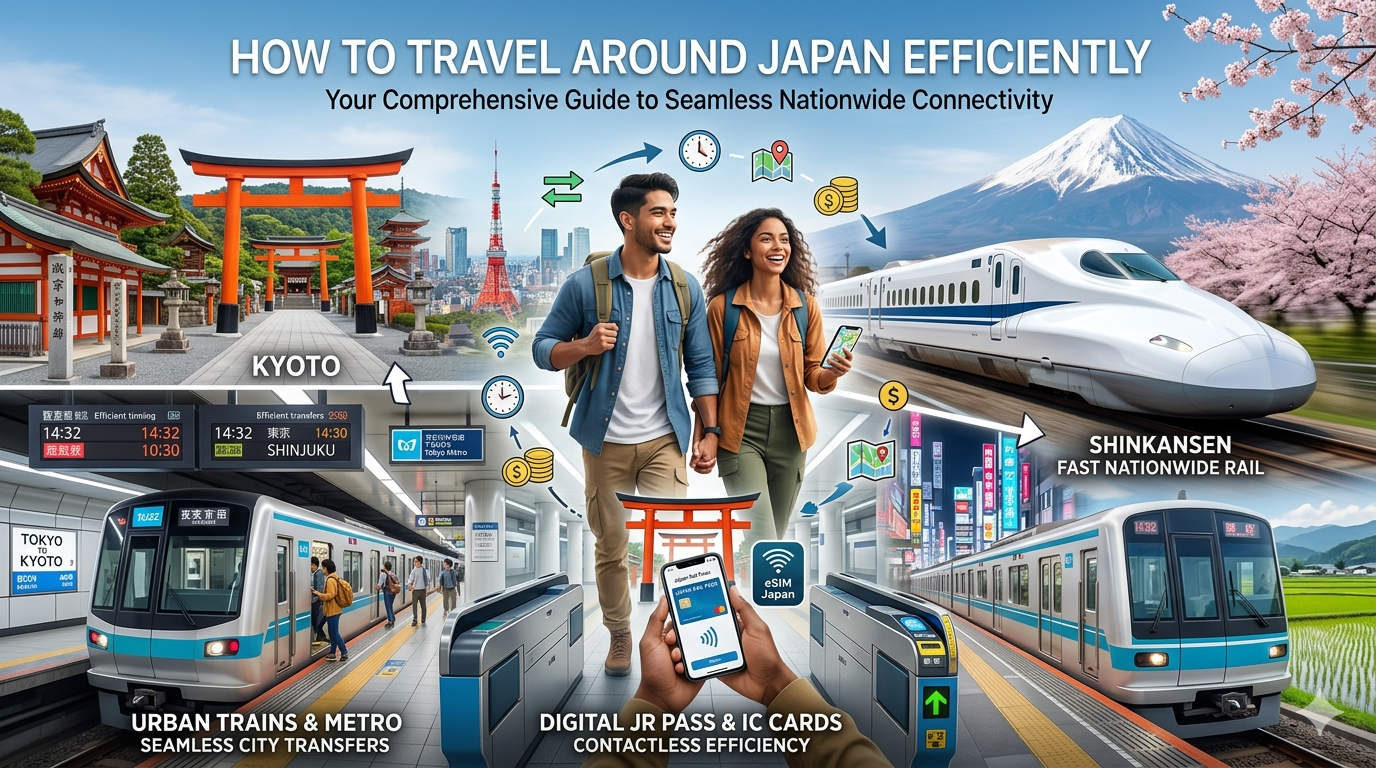
Ask almost any seasoned traveller which country has the best transport infrastructure in the world, and Japan comes up immediately. The trains arrive on time sometimes to within ten seconds of the posted schedule. The metro systems in Tokyo and Osaka are dense, logical, and remarkably easy to navigate even without a word of Japanese. The highway bus network covers routes the trains don't, often at a fraction of the price. And threading it all together is a national IC card system that works everywhere from a turnstile in Sapporo to a vending machine in Fukuoka.
But efficient travel in Japan isn't just about knowing which train to take. It's about understanding how the system fits together, which pass saves you money, when to book ahead, when a rental car beats the shinkansen, and how to stay oriented in a country where the signage, while surprisingly good, occasionally drops into Japanese-only at the most inconvenient moments. This guide covers all of it.
1. The Shinkansen: Fast, Reliable, and Worth Every Yen
The Shinkansen — Japan's bullet train network — is the centrepiece of long-distance travel in the country. Travelling at speeds up to 320 km/h, it connects major cities with the kind of punctuality that makes European rail travel look casual. Tokyo to Osaka takes about 2 hours 15 minutes. Tokyo to Hiroshima is roughly 4 hours. Tokyo to Fukuoka (Hakata) is 5 hours — shorter than many domestic flights when you factor in airport check-in and transit time.
The shinkansen experience itself is worth noting: seats are wide and comfortable, windows are large, and bento boxes purchased at the station (ekiben) are a genuine culinary tradition. Long-distance travel in Japan is genuinely pleasant in a way that changes how you think about getting between places.
Tickets can be booked at station ticket offices, at self-service machines (most have English), or online through services like SmartEX. Reserved seats are recommended on busy routes and during peak travel periods — Golden Week (late April to early May), Obon (mid-August), and New Year holidays.
2. The JR Pass: How to Know if It's Worth It
The Japan Rail Pass (JR Pass) is a multi-day unlimited travel pass available exclusively to foreign tourists visiting Japan. It covers the majority of JR-operated trains nationwide — including most shinkansen lines — and comes in 7, 14, and 21-day options. It must be purchased before arriving in Japan through authorised overseas agents or online platforms.
Whether the JR Pass saves you money depends entirely on your itinerary. A rough rule of thumb: if you're travelling between three or more major cities in a week, the 7-day pass typically pays for itself. A single Tokyo–Kyoto–Tokyo round trip in reserved shinkansen seats alone comes close to the cost of the 7-day pass.
The pass does not cover all lines. The Nozomi and Mizuho shinkansen services (the fastest on the Tokaido and Sanyo lines) are not included — use the slightly slower Hikari or Sakura services instead. Private rail lines, some subway systems, and the Narita Express (depending on the pass type) may also require separate tickets.
3. IC Cards: The Unsung Hero of Japanese Travel
If the Shinkansen is the headline act of Japanese transport, the IC card is the workhorse. Suica (issued by JR East) and Pasmo (issued by Tokyo Metro) are the most widely known, but Icoca, Manaca, and several regional equivalents all operate on the same interoperable network. For practical purposes, one card works everywhere.
The IC card is a rechargeable contactless card that covers city subways, local JR trains, buses, trams, monorails, and ferry services across the country. Beyond transport, it works at convenience stores, vending machines, station kiosks, taxis, and many restaurants — which makes it genuinely useful as a lightweight payment card even outside the transit system.
Pick one up at the airport or any major station when you arrive. Load it with ¥3,000–¥5,000 to start and top it up at any station machine as needed. Tap in, tap out — the correct fare is deducted automatically. No queuing for tickets, no guessing at fare charts.
Tourist-specific IC cards are also available, including the Welcome Suica, designed specifically for visitors. These are valid for 28 days from first use and don't require a deposit, making them a clean, simple option for short trips.
4. City Subways and Local Trains
Tokyo's subway system is often cited as one of the most complex in the world — 13 lines, over 280 stations, and two overlapping operators (Tokyo Metro and Toei). In practice, it is far more navigable than its reputation suggests. English signage is comprehensive at all major stations, platform maps are clearly laid out, and Google Maps handles multi-leg journeys with line changes accurately and in real time.
A few practical points for city train travel:
-
Colour-coded line maps are posted at every station and inside every carriage — orient yourself visually first
-
Exit numbers matter enormously in large stations like Shinjuku, Shibuya, and Umeda — always check which exit you need before tapping out
-
Last trains run between 11:30pm and midnight on most lines — missing the last train means a taxi or an expensive capsule hotel booking
-
Rush hour on Tokyo lines (roughly 7:30–9:00am and 5:30–7:30pm) is genuinely crowded — if you can shift your timing, do
Osaka, Kyoto, Sapporo, Nagoya, and Fukuoka all have their own clean, efficient subway systems that follow the same tap-in, tap-out IC card logic.
5. Highway Buses: The Budget Long-Distance Option
Japan's highway bus network is extensive, comfortable, and significantly cheaper than the shinkansen on most routes. Tokyo to Osaka by overnight bus, for example, can cost as little as ¥3,000–¥4,000 compared to ¥13,000+ by bullet train. The trade-off is time — the bus takes around 8–9 hours — but overnight buses let you sleep through the journey and save on a night's accommodation.
Willer Express, WILLER, and JR Bus are the major operators. Most long-distance buses offer Wi-Fi, reclining seats, and power outlets. Booking is done online well in advance, particularly for popular routes during holiday periods.
Buses are also the primary way to access certain destinations that trains don't serve directly — including Hakone (from Shinjuku), parts of the Izu Peninsula, and many ski resorts in the Japanese Alps.
6. Domestic Flights: When They Make Sense
Japan's domestic flight network is efficient and surprisingly affordable when booked early. The routes where flying genuinely competes with the shinkansen are the longer ones: Tokyo to Okinawa (no train option), Tokyo to Sapporo in Hokkaido, and Tokyo to Fukuoka or Nagasaki. On these routes, ANA, JAL, and low-cost carriers like Peach, Jetstar Japan, and Skymark regularly offer fares competitive with — or cheaper than — the equivalent rail journey.
Factor in airport transit time realistically: Haneda is 30–40 minutes from central Tokyo; Narita is closer to 60–90 minutes. For routes under 3.5 hours by shinkansen, the train usually wins on total door-to-door time. For anything longer, run the numbers.
7. Renting a Car: Essential for Rural Japan
Japan's public transport network is superb between cities and within them — but it has gaps. Rural areas of Hokkaido, the Noto Peninsula, Yamaguchi Prefecture, inland Shikoku, and many mountain regions are genuinely difficult to explore without a vehicle. In these places, a rental car transforms the trip from logistically constrained to completely open.
Driving in Japan is straightforward: roads are well-maintained, signage is excellent (and increasingly bilingual), and traffic flows predictably. An International Driving Permit (IDP) is required alongside your home licence — obtain one before leaving your country. Japan drives on the left. Expressway tolls add up, so budget for them: a full day of highway driving can add ¥3,000–¥6,000 in tolls.
Major rental companies — Toyota Rent a Car, Nippon Rent-A-Car, Times Car — have desks at most airports and major train stations. Book online in advance, especially during peak seasons. GPS units are available in English and are strongly recommended outside urban areas.
8. Cycling: Japan's Hidden Transport Gem
Japan is a quietly excellent cycling country, and many tourists never discover it. Dedicated cycle routes, shared-use paths, and bike-friendly rural roads make two wheels an appealing option for exploring at a human pace.
The Shimanami Kaido — a 70 km route crossing six islands between Honshu and Shikoku via a series of suspension bridges — is one of the most celebrated cycling routes in Asia. The Bikepackers' Route through Hokkaido and the routes around the Noto Peninsula in Ishikawa Prefecture are similarly spectacular.
Within cities, bike-share schemes (Docomo Bike Share in Tokyo, Pippa in Osaka, and various others) make cycling a viable option for short urban hops. Many ryokan and guesthouses in rural areas also offer bicycles for guest use.
Japan Transport Options: Quick Comparison
|
Transport Type |
Best For |
Cost Range |
Book In Advance? |
JR Pass Covered? |
|---|---|---|---|---|
|
Shinkansen |
City-to-city travel |
¥3,000–¥22,000 |
Recommended |
Mostly yes |
|
Local Train / Metro |
City exploration |
¥170–¥500/trip |
No — use IC card |
No |
|
Highway Bus |
Budget long-distance |
¥1,500–¥8,000 |
Yes |
No |
|
Domestic Flight |
Tokyo–Okinawa / Hokkaido |
¥3,000–¥18,000 |
Yes (early) |
No |
|
Rental Car |
Rural & off-the-beaten path |
¥5,000–¥15,000/day |
Yes |
No |
|
IC Card (Suica etc) |
All city transport & shops |
Top-up as you go |
No |
Partial |
9. Planning Your Route: Practical Tips
A few principles that make Japanese travel planning significantly smoother:
-
Use Hyperdia or Google Maps for train route planning — both handle complex multi-line journeys with IC card fares and JR Pass eligibility clearly
-
Download offline maps via Google Maps or Maps.me for any area you plan to visit — signal can be patchy in rural mountainous regions
-
Check whether a destination requires a reservation (some popular onsens, restaurants, and experience activities book out weeks ahead)
-
Build in transfer time at large stations — Shinjuku, Osaka, and Nagoya are genuinely large and exits can be 8–10 minutes apart on foot
-
The Jorudan app is an excellent backup for train timetables and route planning, with offline functionality
-
Keep coins handy — lockers at major stations (for storing luggage between check-in and check-out) still commonly require 100-yen coins
10. Staying Connected: The Foundation of Efficient Travel
Every practical piece of advice in this guide, checking train times, navigating station exits, finding the right bus stop, translating a sign, booking a last-minute restaurant — depends on one thing: having reliable mobile data. In Japan, this is not optional. It is the infrastructure beneath the infrastructure.
The most convenient solution for most international visitors is a travel eSIM. An eSIM is a digital SIM plan that loads directly onto your compatible smartphone — no physical card, no airport kiosk queue, no risk of misplacing a tiny piece of plastic. You purchase and download the plan before departure, and it activates the moment your flight lands in Japan. You step off the plane at Narita or Kansai Airport with Google Maps already running and your IC card app already loaded.
A travel eSIM works on all major Japanese networks — covering 4G and 5G nationwide, including on shinkansen routes and in regional cities. Most plans offer between 5GB and unlimited data across 7 to 30 days, with pricing typically ranging from ¥1,500 to ¥3,500 depending on duration and data allowance. For a trip involving heavy navigation across multiple cities, a 10–15GB plan covers most travellers comfortably.
If you'd prefer a physical card, a Japan SIM card for tourists is available at all major international airports — Narita, Haneda, Kansai, Chubu, and New Chitose (Sapporo) — as well as at electronics retailers like Yodobashi Camera and BIC Camera in city centres. These data-only SIM cards typically cover the same national network and come in plans ranging from 3GB to 50GB, valid for 8 to 30 days.
When comparing options, the best eSIM for Japan for most tourists will combine reliable nationwide coverage, a reasonable data cap for the trip length, and a straightforward activation process. Airalo, Ubigi, and Holafly are consistently recommended by frequent Japan travellers. If you need to receive calls or a local number for restaurant reservations, hotel confirmations, or tour bookings, look for a voice-capable Japan SIM card rather than a data-only eSIM, as most standard tourist plans are data-only.
One underappreciated advantage of having your own mobile data rather than relying on hotel Wi-Fi or borrowed hotspots is the freedom it gives you to change plans spontaneously. Spot a sign for a festival two towns over. Decide to extend a hike. Miss a train and need to reroute. Japan's transport system is flexible enough to accommodate all of this in real time, but only if you have the data connection to navigate it.
Final Thoughts
Efficient travel in Japan is not about moving as fast as possible through as many cities as possible. It is about understanding how the system works well enough to move through it with ease so that the journey itself becomes part of the experience rather than a source of friction.
The shinkansen is extraordinary. The IC card is indispensable. The highway buses are underrated. The rural roads, driven slowly with no agenda, are some of the best travel experiences the country has to offer. Japan rewards the prepared traveller enormously and preparation here means understanding the network, carrying the right pass, and having a reliable connection from the moment you land.
Sort out your transport pass and your data plan before departure. Everything else can be figured out on the ground.

 English
 Arabic
 French
 Spanish
 Portuguese
 Deutsch
 Turkish
 Dutch
Dutch
 Italiano
 Russian
 Portuguese (Brazil)
 Greek
Greek