

Global Water Crisis 2026: Why the World Is Running Out of Water — And India Is at the Centre of It
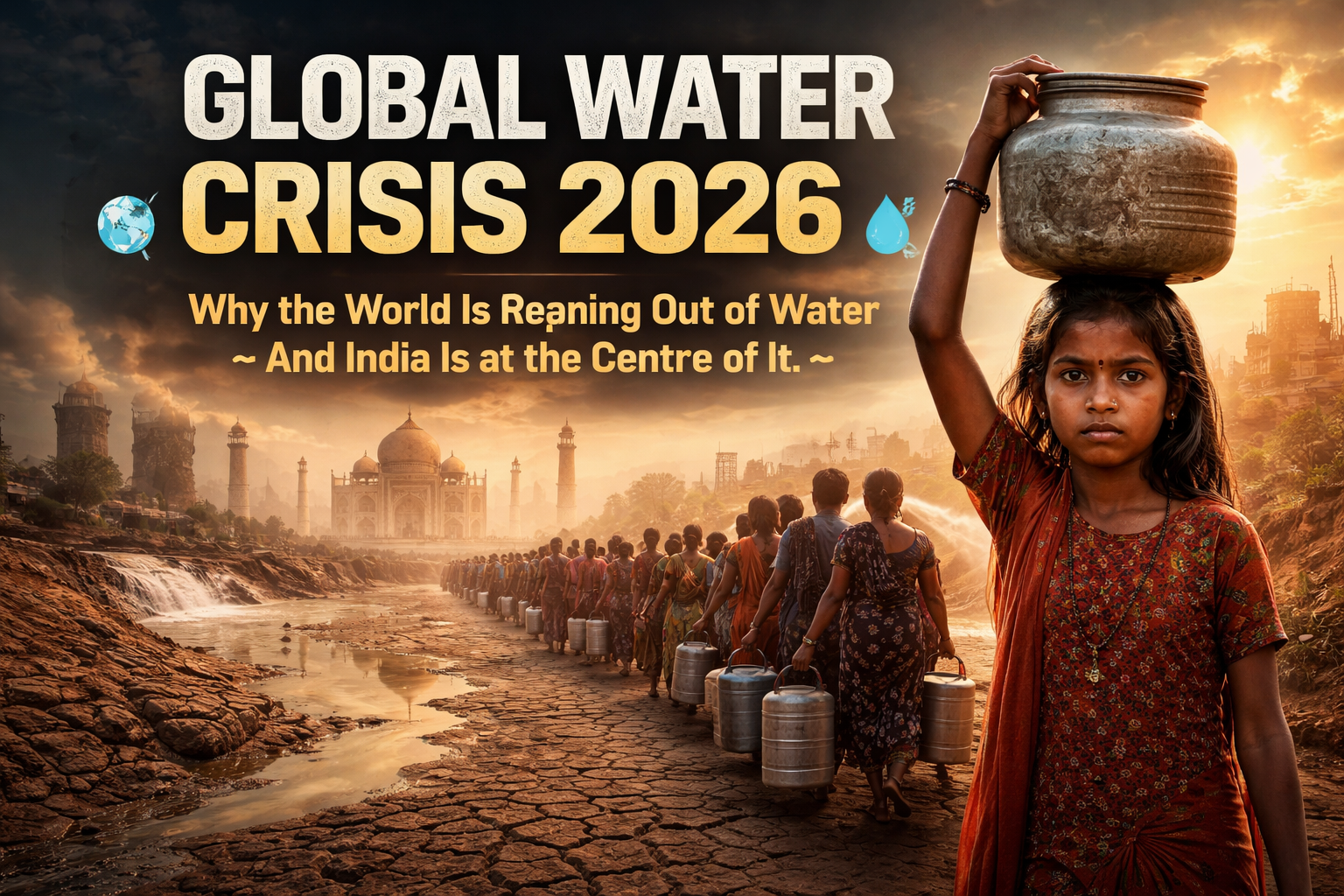
The Wake-Up Call Nobody Wanted to Hear
Imagine turning on your tap one morning and getting nothing. No water. Not even a drip.
For millions of people — from the deserts of Central Asia to the crowded streets of Chennai — this is already real life. Not a future scenario. Not a warning. Reality.
For years, the world called this a "water crisis." But in 2026, the United Nations changed the language entirely. They stopped using the word crisis. They started using a much scarier word: bankruptcy.
A crisis, you can recover from. Bankruptcy means the resources are gone — and getting them back is not guaranteed.
That one word change should wake every single one of us up.
What "Water Bankruptcy" Actually Means
The World Has Spent What It Cannot Afford
Think of the planet's water systems like a bank account. Glaciers, lakes, rivers, underground aquifers — these are savings built over thousands of years. And humanity has been spending those savings faster than nature can ever refill them.
The UN's landmark 2026 report made it official: we are not in a crisis. We are in a hydrological bankruptcy.
The numbers are staggering:
-
4 billion people face severe water scarcity at least one month every year
-
75% of the world's population lives in water-insecure countries
-
The planet has lost over 30% of its glacier mass since 1970
-
More than half of the world's large lakes have shrunk significantly
-
70% of major aquifers are in long-term decline
-
Droughts now cost the global economy over $307 billion every year
These are not predictions. This is what is showing up in today's live international news, in weather reports, in food prices, and in empty wells across the world.
Latest World News Update Today: What Is Happening Globally
Rivers That No Longer Reach the Sea
One of the most alarming trends in the latest world news update today is the disappearance of major rivers. The Colorado River in the United States — which supplies water to 40 million people across seven states — has permanently shrunk. The agreements that govern its use were written for a river that no longer exists at that size.
The Yellow River in China. The Nile in Africa. The Amu Darya in Central Asia. All telling the same story. Less flow. Less storage. More people depending on less water every year.
This is structural collapse — not a bad season of rain.
The Ground Beneath Our Cities Is Hollow
Here is something most people never think about: when cities pump too much groundwater out of the earth, the land above literally sinks.
Mexico City is sinking by roughly 25 centimetres every year. Jakarta, Bangkok, and Ho Chi Minh City face similar problems. And once the underground structure collapses, it can never be refilled. That water storage capacity is permanently lost.
This is exactly what makes water bankruptcy irreversible. You cannot undo a collapsed aquifer.
Artificial Intelligence Has a Hidden Water Cost
There is one story that rarely makes headlines in international news in Hindi or English — and it should.
AI data centres, which power everything from chatbots to cloud services, need enormous amounts of fresh water to cool their servers. As the AI industry explodes in 2026, these facilities are being built at speed — often in cities already running low on water. The tech boom and the water crisis are heading straight toward each other, and very few people are paying attention.
Why India Is in a Uniquely Dangerous Position
The Numbers Tell a Hard Truth
India carries 18% of the world's population but controls just 4% of its freshwater. That gap alone is alarming. But the details make it even more serious.
India is the world's largest consumer of groundwater — more than China and the United States combined. Nearly 89% of that extracted groundwater goes directly to agriculture. And over 70% of India's monitored aquifers are in persistent decline.
Every time this comes up as a latest national news update in India, it deserves more than a single news cycle. Because the math simply does not work — and the consequences are already arriving.
Indian Cities Are Approaching "Day Zero"
"Day Zero" is the term for the moment a city's water taps go completely dry. Cape Town, South Africa, nearly reached it in 2018. India has been edging toward its own version ever since.
21 major Indian cities — including Delhi, Bengaluru, Chennai, and Hyderabad — are projected to run out of groundwater by 2030. Bengaluru came dangerously close in 2024, when a combination of extreme heat and shrinking reservoirs pushed the city to the brink.
India receives enough rainfall annually to meet the needs of its entire population. The problem is that the country captures only about 8% of it. The rest runs off into the sea — wasted, because the infrastructure to store it simply isn't there.
Interstate Water Wars Are Already Beginning
The Cauvery River dispute between Karnataka and Tamil Nadu has roots going back over a century. But as rainfall deficits deepen and reservoirs shrink, these kinds of conflicts are becoming more intense — and more frequent.
As water scarcity grows across India, river-sharing disputes between states will become one of the defining political tensions of this decade.
What Can Actually Be Done
The UN's 2026 report carries a crucial message: water bankruptcy is not a death sentence. Bankruptcy is the beginning of a recovery plan — not the end of the road. But that recovery requires honest action, not just policy promises.
Here is what works:
Reform agriculture. Farming uses 70% of the world's fresh water. Even small efficiency improvements — drip irrigation, crop diversification, smarter subsidies — can free up enormous volumes of water without harming food production.
Store the rain that already falls. India's traditional water systems — johads, stepwells, check dams — were built for exactly this purpose. Reviving them, alongside modern rainwater harvesting mandates in urban buildings, can transform India's water resilience.
Protect wetlands. Wetlands are nature's water storage. Restoring what has been lost is far cheaper than building desalination plants or water pipelines decades from now.
Use data to enforce limits. Satellite-based aquifer monitoring and community water accounting can make enforcement of groundwater limits real — not just theoretical.
Make water a mandatory part of every development decision. Data centres, townships, industrial zones — none of them should be approved without a water impact assessment. Right now, many don't require one.
Conclusion: The Tap Won't Warn You Before It Runs Dry
There is a very human tendency to assume that problems this big will be solved by someone else — a government, a scientist, a policy committee.
But water bankruptcy doesn't wait for committees.
Whether you're tracking it through the latest world news update today, reading international news in Hindi, or catching the latest national news update in India on your phone, the message is consistent across every language and every platform: the world's water systems are under serious, structural stress — and India, with its vast population and limited water share, is one of the most exposed countries on earth.
The water story gets buried under cricket, politics, and market news. But the water crisis doesn't disappear just because the headline does.
India has the knowledge, the tradition, and the tools to act. What it needs — urgently — is the will to use them.
Because when the tap runs dry, there is no breaking news alert. There is just silence.

 English
 Arabic
 Spanish
 Portuguese
 Deutsch
 Turkish
 Dutch
Dutch
 Italiano
 Russian
 Romaian
 Portuguese (Brazil)
 Greek
Greek