

Supply Chain Control Tower 2026: Driving Real-Time Visibility and Resilience
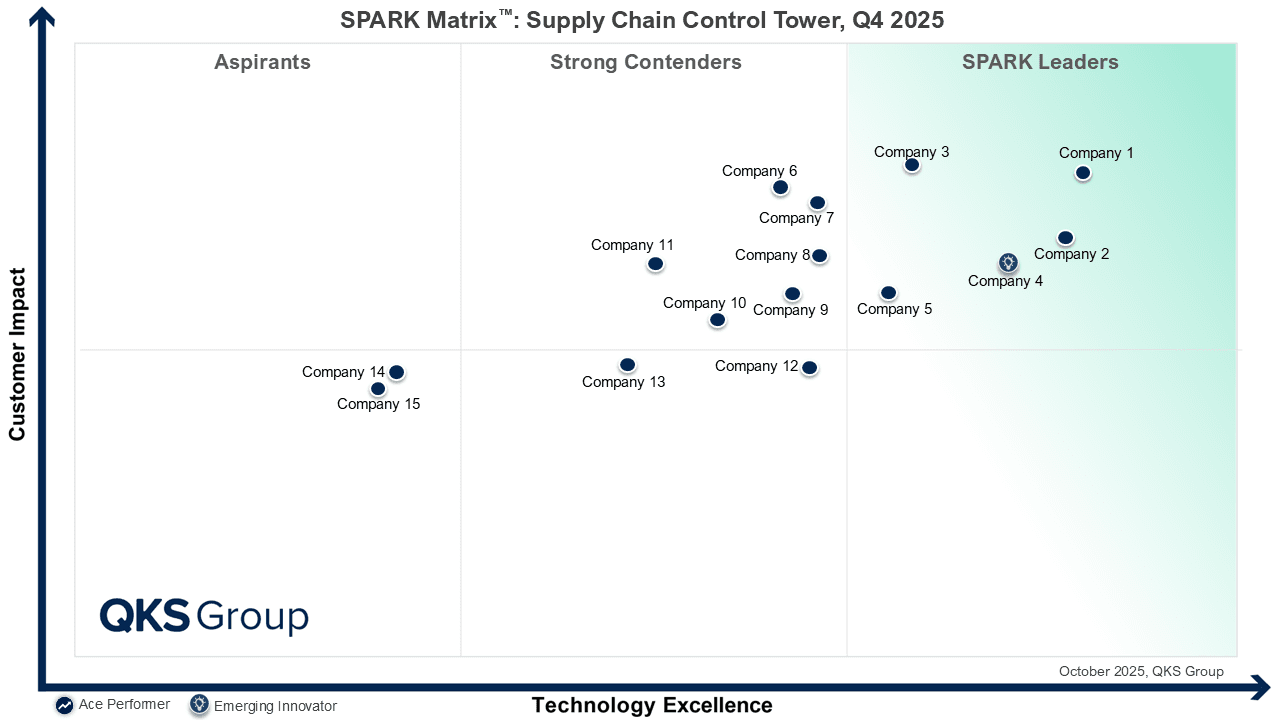
The global supply chain landscape in 2025 is more complex and unpredictable than ever before. Businesses are facing disruptions from geopolitical tensions, demand fluctuations, rising costs, and regulatory pressures. To manage these challenges effectively, organizations are increasingly adopting Supply Chain Control Tower (SCCT) solutions. According to the latest QKS Group SPARK Matrix™ report, SCCT platforms have become a critical technology for achieving real-time visibility, intelligent decision-making, and supply chain resilience.
What is a Supply Chain Control Tower?
A Supply Chain Control Tower is a centralized, technology-driven platform that integrates data from multiple supply chain systems such as procurement, logistics, manufacturing, and distribution. It provides a unified view of operations and enables organizations to monitor, analyze, and optimize their supply chain in real time.
Modern SCCT platforms go beyond simple dashboards. They combine advanced analytics, artificial intelligence (AI), and automation to deliver predictive insights and support faster, data-driven decisions. These platforms help organizations detect disruptions early, simulate possible scenarios, and take proactive actions to minimize risks.
Key Market Trends in 2025
The Q4 2025 SPARK Matrix highlights several important trends shaping the SCCT market:
1. AI-Driven Decision Intelligence
Artificial intelligence and machine learning are playing a major role in transforming supply chain operations. SCCT platforms use AI to analyze large volumes of data, predict risks, and recommend optimal actions. This improves accuracy in forecasting and enhances operational efficiency.
2. Digital Twins and Simulation Models
Digital twin technology is gaining traction in supply chain management. It creates a virtual replica of the supply chain, allowing organizations to test different scenarios and prepare for disruptions. This helps in better planning and improved resilience.
3. Real-Time End-to-End Visibility
Organizations are demanding complete visibility across the entire supply chain ecosystem, including suppliers, logistics partners, and distribution networks. SCCT platforms enable real-time tracking and monitoring, ensuring better coordination and faster response to issues.
4. Autonomous and Self-Correcting Supply Chains
Future-ready control towers are moving towards automation and autonomy. These systems can automatically identify disruptions and take corrective actions without human intervention, reducing delays and operational costs.
5. Integrated Collaboration and Workflow Automation
SCCT solutions are evolving into orchestration platforms that enable seamless collaboration across teams and partners. Automated workflows help in faster issue resolution and improved productivity.
Market Growth and Adoption
The Supply Chain Control Tower (SCCT) market is experiencing strong growth due to increasing demand for agility and resilience. Reports suggest that the market is projected to grow at a CAGR of over 13% through 2030, reflecting its rising importance across industries.
Organizations are investing in SCCT solutions to improve supply chain performance, reduce risks, and enhance customer satisfaction. Industries such as manufacturing, retail, healthcare, and logistics are leading the adoption of these platforms.
Competitive Landscape
The SPARK Matrix evaluates leading vendors based on technology excellence and customer impact. Key players in the SCCT market include Blue Yonder, e2open, IBM, Oracle, SAP, Kinaxis, and o9 Solutions. These companies are driving innovation through AI-powered analytics, cloud-based platforms, and advanced orchestration capabilities.
Each vendor offers unique capabilities, such as predictive analytics, multi-tier visibility, and integrated planning and execution. This competitive landscape helps enterprises choose solutions that align with their business needs.
Business Benefits of SCCT Platforms
Implementing a Supply Chain Control Tower provides several strategic benefits:
Improved Visibility: Real-time insights across the supply chain
Better Decision-Making: Data-driven and predictive analytics
Risk Mitigation: Early detection of disruptions and faster response
Operational Efficiency: Automation of workflows and reduced manual effort
Enhanced Collaboration: Better coordination between internal teams and external partners
These benefits enable organizations to build a more agile and resilient supply chain.
The Future of Supply Chain Control Towers
The future of SCCT platforms lies in intelligent automation, AI-driven insights, and ecosystem-wide orchestration. As technologies like AI assistants, digital twins, and IoT continue to evolve, control towers will become more advanced and autonomous.
In the coming years, SCCT solutions will act as decision-centric command centers, enabling organizations to respond quickly to disruptions and optimize supply chain performance. Companies that invest in these platforms today will gain a strong competitive advantage in the digital economy.
Conclusion
The QKS Group SPARK Matrix™: Supply Chain Control Tower, Q4 2025 report clearly shows that SCCT platforms are no longer optional—they are essential for modern supply chain management. With capabilities like real-time visibility, predictive analytics, and automation, these solutions are transforming how businesses operate in a dynamic environment.
As supply chains continue to evolve, adopting a robust control tower strategy will be key to achieving resilience, efficiency, and long-term success.

 English
 Arabic
 French
 Spanish
 Portuguese
 Deutsch
 Turkish
 Dutch
Dutch
 Italiano
 Russian
 Romaian
 Portuguese (Brazil)