

Navigating Global Trade in 2025: Supply Chain Challenges, Customs Clearance, and Policy Insights
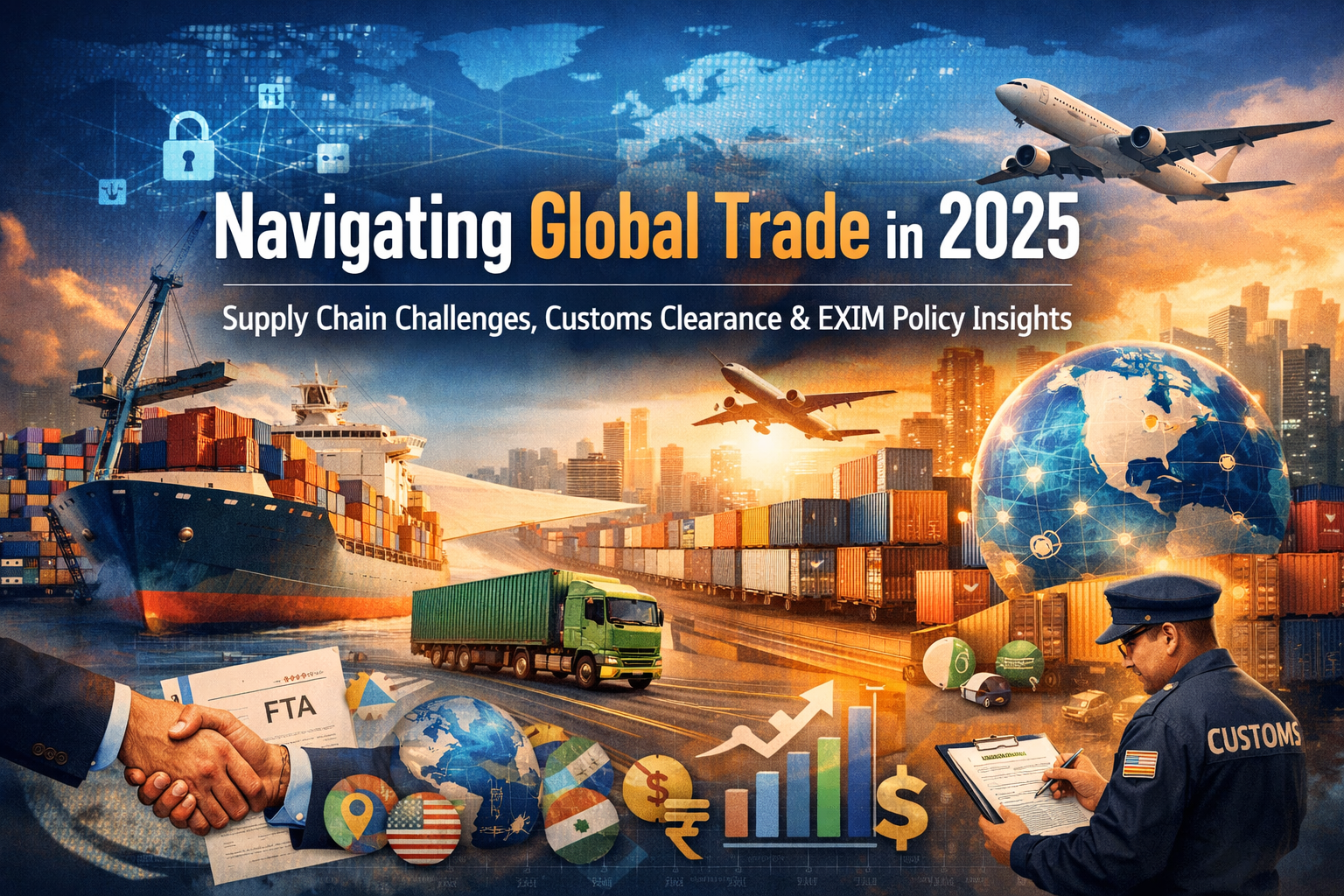
Global trade in 2025 is evolving rapidly due to technological advancements, regulatory changes, and economic uncertainty. Industries such as automotive and aviation are facing increasing pressure to maintain efficient supply chains while complying with international trade laws. Businesses must understand key aspects like customs clearance, free trade agreements, and national policies such as India’s EXIM policy to stay competitive in today’s global market.
Automotive Supply Chain Challenges
The automotive industry is one of the most complex sectors when it comes to global supply chains. It relies heavily on cross-border trade of components, making it vulnerable to disruptions.
One of the major challenges is regulatory compliance. Different countries have varying safety, environmental, and quality standards, which complicates manufacturing and distribution processes. Companies often face delays and increased costs due to non-uniform regulations.
Another critical issue is supply chain disruption. Events like pandemics, geopolitical tensions, and semiconductor shortages have exposed the fragility of global supply networks. These disruptions directly impact production timelines and increase operational costs.
Additionally, tariffs and trade uncertainty continue to affect pricing and profitability in the automotive sector, while rising costs of labor and materials further strain margins.
To overcome these challenges, businesses are adopting strategies such as supplier diversification, nearshoring, and the use of AI-driven supply chain tools.
Understanding the Customs Clearance Process
Customs clearance is a crucial step in international trade, ensuring that goods comply with regulations before entering or leaving a country.
Traditional customs processes are often slow and complex, involving extensive paperwork and manual verification. However, the introduction of digital customs systems is transforming this process. These systems enable electronic documentation, automated risk assessment, and real-time data sharing, significantly reducing delays and errors.
Efficient customs clearance depends on:
- Accurate classification of goods using HS codes
- Proper documentation and compliance with regulations
- Understanding tariffs and duties
- Working with experienced customs brokers
Automation in customs clearance not only speeds up processes but also minimizes compliance risks and enhances transparency across supply chains.
Aviation Industry Outlook 2025
The aviation sector is experiencing rapid transformation driven by innovation and increasing global demand. In 2025, the focus is on improving efficiency, sustainability, and supply chain resilience.
One key trend is the adoption of smart trade technologies, including AI, IoT, and blockchain. These technologies provide real-time visibility into shipments, improve inventory management, and enable predictive decision-making.
Another major development is the emphasis on digital customs integration, which helps streamline the movement of high-value aviation components. This reduces downtime and ensures faster delivery of critical equipment.
Additionally, sustainability is becoming a priority, with stricter environmental regulations pushing companies to adopt greener practices.
Overall, the aviation industry in 2025 is moving toward a more connected, automated, and data-driven supply chain ecosystem.
Free Trade Agreements: Advantages and Challenges
Free Trade Agreements (FTAs) play a vital role in global trade by reducing barriers and promoting economic cooperation between countries.
Advantages:
- Reduced tariffs and import/export costs
- Increased market access for businesses
- Simplified trade procedures
- Enhanced competitiveness in global markets
FTAs also encourage companies to restructure their supply chains to take advantage of cost efficiencies and new sourcing opportunities.
Challenges:
- Complex compliance requirements
- Rules of origin and documentation complexities
- Frequent updates and policy changes
- Risk of overdependence on specific trade partners
Businesses must stay updated on FTA regulations to fully benefit from these agreements while avoiding compliance issues.
EXIM Policy of India Explained
India’s Export-Import (EXIM) Policy is a key framework governing international trade in the country. It aims to promote exports, regulate imports, and ensure sustainable economic growth.
The policy includes guidelines related to:
- Export incentives and schemes
- Import restrictions and licensing
- Trade facilitation measures
- Compliance with international trade standards
One of the main objectives of India’s EXIM policy is to boost exports by providing financial support and simplifying procedures for exporters. It also ensures that imports align with national economic priorities.
Understanding the EXIM policy is essential for businesses operating in India, as it directly impacts trade operations, costs, and compliance requirements.
The Role of Technology in Modern Supply Chains
Technology is revolutionizing global trade and supply chain management. Automation, artificial intelligence, and data analytics are enabling businesses to operate more efficiently and proactively.
For example:
- AI-powered analytics help predict demand and identify potential disruptions
- IoT devices provide real-time tracking of shipments
- Blockchain technology ensures secure and transparent transactions
Automation in supply chain processes reduces human errors, improves speed, and enhances decision-making capabilities.
Moreover, integrated systems that combine customs, logistics, and compliance functions are becoming essential for building resilient supply chains.
Building Supply Chain Resilience in 2025
Supply chain resilience refers to the ability of businesses to adapt to disruptions and maintain operations. In 2025, resilience is a key competitive advantage.
Companies are focusing on:
- Diversifying suppliers and sourcing locations
- Investing in digital tools and automation
- Enhancing visibility across supply chains
- Strengthening compliance and risk management
Integrated customs systems and predictive analytics are helping businesses respond quickly to changes and minimize disruptions.
Resilient supply chains not only reduce risks but also improve efficiency and customer satisfaction.
Conclusion
Global trade in 2025 is shaped by a combination of challenges and opportunities. From automotive supply chain disruptions to evolving customs processes and trade policies, businesses must stay informed and adaptable.
By leveraging technology, understanding regulations, and adopting strategic approaches, companies can overcome these challenges and thrive in the competitive global market. Whether it is navigating customs clearance, utilizing free trade agreements, or aligning with India’s EXIM policy, success in international trade depends on proactive planning and continuous innovation.

 Arabic
 French
 Spanish
 Portuguese
 Deutsch
 Turkish
 Dutch
Dutch
 Italiano
 Russian
 Romaian
 Portuguese (Brazil)
 Greek
Greek