

UP Pollution Control Board: Process of Approvals & Consent
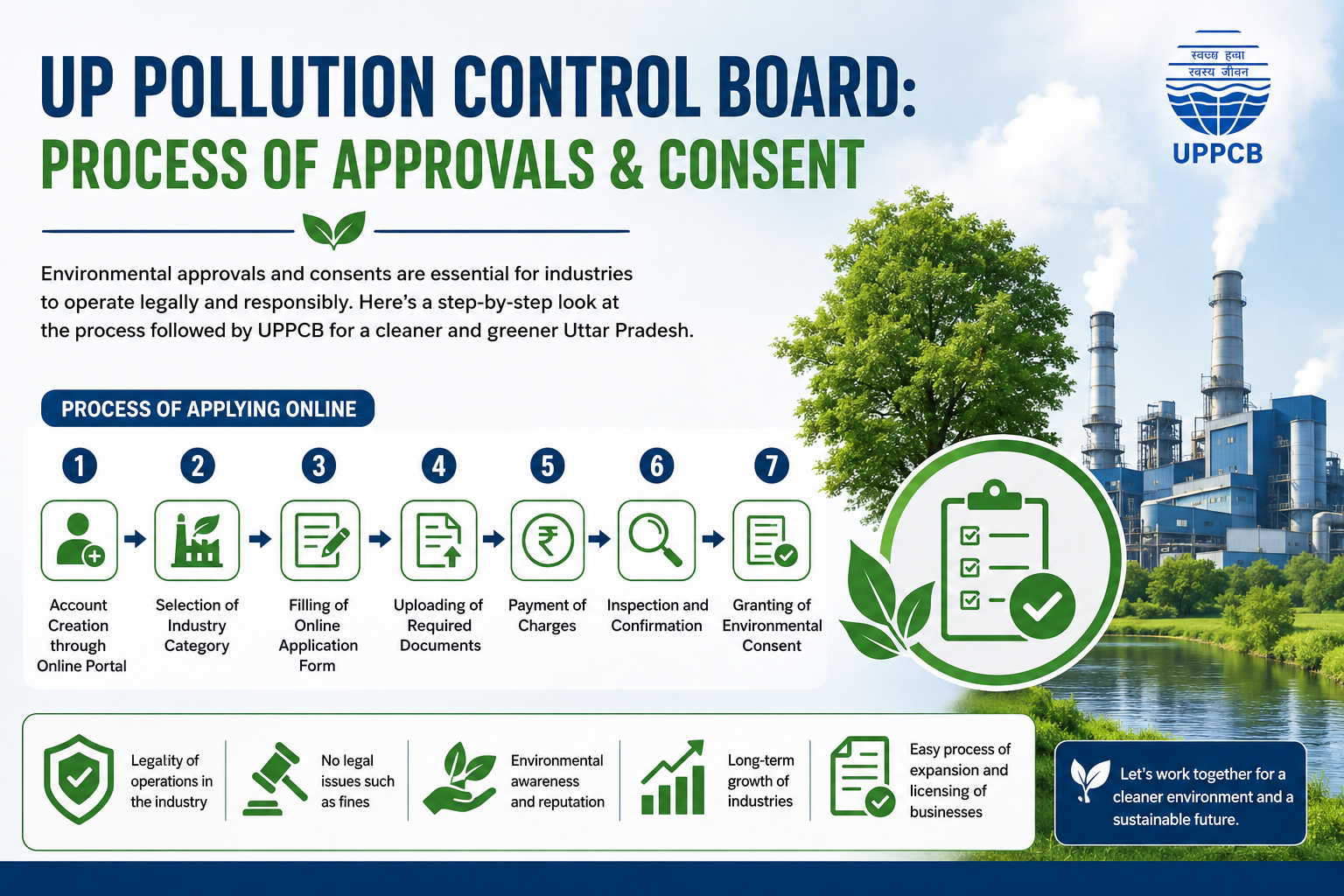
As far as sustainable development is concerned, there should be a blend between industrial expansion and environmental conservation. To ensure that all the industries abide by the environmental regulations and the rules of pollution control, all the units involved in manufacturing, production or processing activities must obtain environmental clearances. The process of approval and consent ensures that industries operate in accordance with the environmental laws responsibly.
The aim of this guide is to inform industries about the process of environmental clearances, consent certificates, and pollution control approvals. This guide would be of immense help to those industries that want to establish or operate their industrial units in the state of Uttar Pradesh.
Pollution Control Consent Requirement
Pollution control consents are very important in cases where industries produce air pollution, water pollution, solid wastes, and hazardous wastes. Consents make it easier for regulatory bodies to check on the performance of industries and ensure that there is no excess pollution.
The benefits of consents and permissions can be outlined as follows:
- Legality of operations in the industry
- No legal issues such as fines
- Environmental awareness and reputation
- Long-term growth of industries
- Easy process of expansion and licensing of businesses
Bad consents can bring about certain limitations in industries. It is imperative, therefore, to seek consents.
Environmental Consents for Industries
Two types of environmental consents are required for an industry to begin its operations.
Consent to Establish (CTE)
The consent to establish is a type of consent that should be acquired before setting up machinery and construction work within the industry. The reasoning for obtaining this consent is to make sure that the project conforms to the regulations concerning environmental protection and pollution control.
Consent to Operate (CTO)
Once the machinery has been set up and the project completed, the industry should acquire the consent to operate.
Industries That Need Environmental Authorization
Several business categories require environmental consent and authorization, including:
- Manufacturing industries
- Chemical processing units
- Food processing industries
- Pharmaceutical companies
- Textile units
- Plastic manufacturing industries
- Paper mills
- Hotels and commercial establishments
- Mining and construction projects
The consent requirement may vary depending on the pollution category and industrial activities involved.
Documents Required for Application
For the application of consent, certain documents need to be submitted by applicants. The submission of proper documents allows officials to assess whether the industry is following necessary precautions.
Some typical documents include:
- The PAN card and Aadhaar card of the applicant
- The business registration certificate
- The site layout and project report
- Documents that provide evidence of land ownership/lease
- Description of the manufacturing process
- Information on water use and wastewater generation
- Air pollution control information
- Electricity bill/usage information
- Information on hazardous waste management, if relevant
Process of Applying Online
Online application has streamlined the process of acquiring environmental clearance for industrial units. The applicants do not have to physically visit office spaces for completing all necessary formalities.
Step 1: Account Creation through Online Portal
Firstly, an account has to be created by the applicant through the official online portal and provide information regarding their business.
Step 2: Selection of Industry Category
Various industries are categorized according to different pollution classes like Red, Orange, Green, and White. Applicants need to choose the right class depending on industrial processes.
Step 3: Filling of Online Application Form
The online application needs information regarding production capacity, manufacturing process, pollutants generated, and their treatment.
Step 4: Uploading of Required Documents
All required documents need to be uploaded as per the specified format. Lack of completeness in documentation can cause delays or rejection.
Step 5: Payment of Charges
The relevant fee for the government needs to be paid according to industry size and type.
Step 6: Inspection and Confirmation
Inspection may be carried out to confirm the pollution control system in place.
Step 7: Granting of Environmental Consent
Once verified, the consent or authorization certificate is issued. Depending on complexity, there may be variations in the entire procedure.
Post Consent Compliance
Getting environmental consent does not end there. The industry is expected to adhere to pollution control norms.
The following compliance issues should be considered:
- Pollution control methods
- Waste disposal from industries
- Consent certificate update
- Environmental compliance reporting
- Monitoring of emissions into air and water
Failure to adhere to environmental standards may lead to prosecution and revocation of permits for carrying out particular activities.
Use of Digital Services in Meeting Regulatory Requirements
Through the digitalization of regulatory services, applications have become quick and transparent. Companies can now check their application statuses, submit documents, renew their certificates, and also interact with regulators using online services.
The use of services provided by the up pollution control board makes it easier for industries to meet regulatory requirements without having to go through many documents and administrative steps. The companies operating within the state can make use of the uppcb website in order to fulfill their regulatory obligations. It becomes easier for companies of all sizes to meet their regulatory obligations in such a manner.
Conclusion
Environmental permission and consent are vital for any industries that wish to conduct themselves in an effective manner in terms of law and regulation. It is important for businesses to be compliant with pollution control laws from the very start to prevent any problems in the future.
By having a properly handled consent process, an industry will not only be compliant but will also ensure sustainable development of the industry.

 English
 Arabic
 French
 Spanish
 Portuguese
 Deutsch
 Turkish
 Dutch
Dutch
 Russian
 Romaian
 Portuguese (Brazil)
 Greek
Greek