

Space Sensors and Actuators Market Analysis, Growth, Trends & Forecast Report, 2033 | UnivDatos
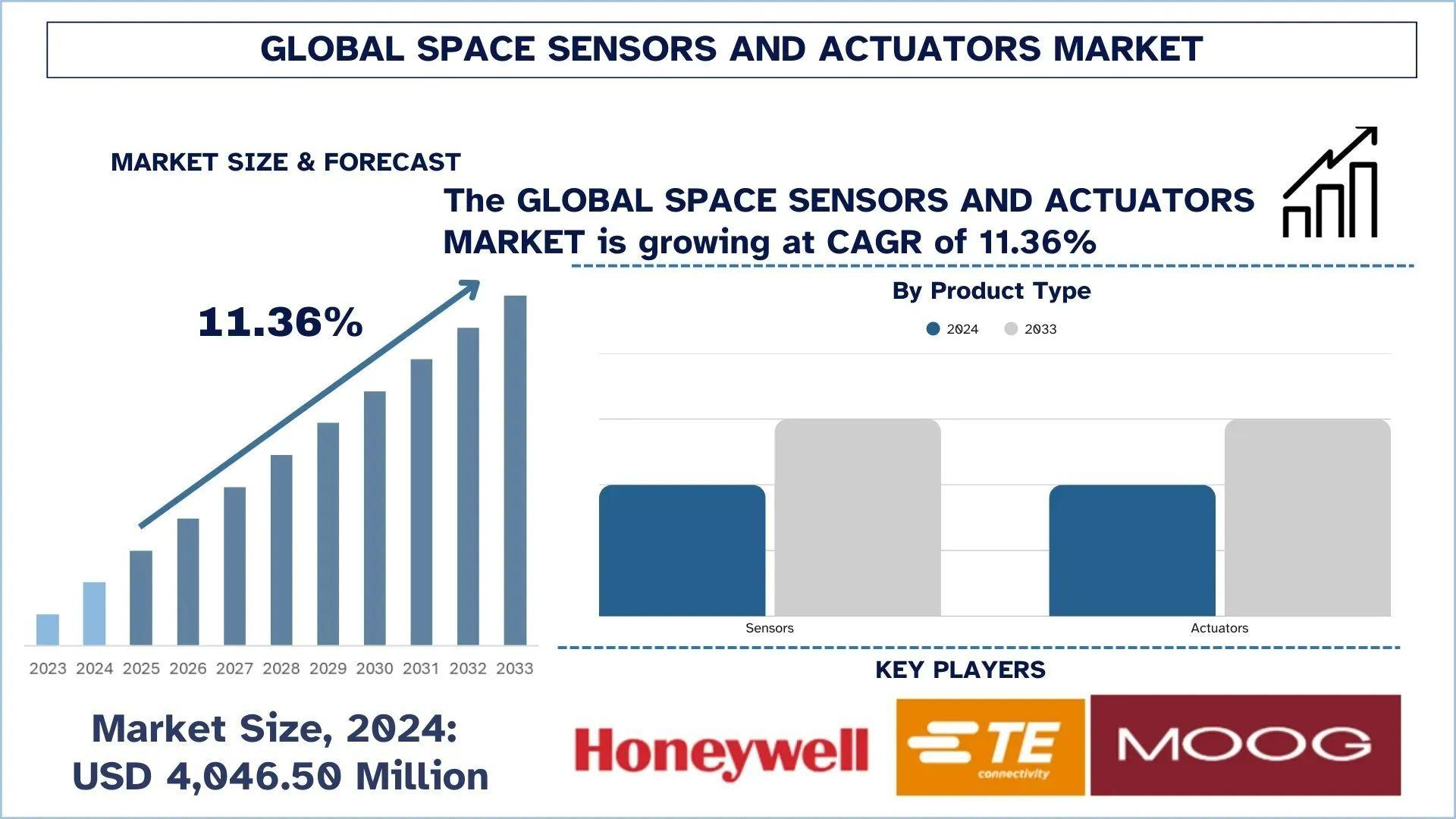
According to a new report by UnivDatos, The Space Sensors and Actuators Market is expected to reach USD million in 2033 by growing at a CAGR of 11.36%. Space sensors and actuators are now an essential capability for spacecraft performance in the modern era, with use in attitude determination and control, stabilization, navigation, station-keeping, and high-precision pointing of payloads. The market is growing as governments and commercial operators step up investments in Earth observation and broadband connectivity, as well as in navigation and missions in the defense area. Simultaneously, there is an emerging trend among spacecraft OEMs to embrace miniaturization, SWaP methodology, and radiation-tolerant elements to address leaner constellation economies and extended mission assurance.
Rising LEO Constellation Buildouts Drive Demand
The sheer acceleration of LEO constellation buildouts is one of the strongest drivers of the global market in space sensors and actuators, as it transforms satellite production into a faster and repeatable manufacturing process. Each new batch of LEO spacecraft cycles a stable bill of materials of mission critical parts star trackers, IMUs/gyros, sun sensors, magnetometers, thermal/power sensors on the sensing side, coupled with reaction wheels, magnetorquers, propulsion actuators on the actuation side, and precision mechanisms- since these systems are core to the attitude determination, stabilization, pointing and station-keeping. The most recent operation demonstrates the consistency of that demand. SpaceX is ongoing with Starlink by launching satellites in regular propaganda, with several launch operations by the end of February 2026, and other satellites being launched in rapid succession. Concurrently, other rival constellations are scaling. In January 2026, Eutelsat ordered a significant follow-on contract with Airbus to add further OneWeb LEO satellites to the fleet in order to sustain and extend service coverage. Additionally, the program now known as Amazon Leo has not only graduated to deployment, with the first full-scale spacecraft-to-spacecraft operational launches and wider go-to-market collaborations, but has also anchored a multi-year pipeline of spacecraft that must have qualified sensors and actuators at scale.
Access sample report (including graphs, charts, and figures): https://univdatos.com/reports/space-sensors-and-actuators-market?popup=report-enquiry
According to the report, North America held the dominant market share in the Space Sensors and Actuators Market
North America remains at the forefront to a large extent because its space economy generates a steady, repeatable flywheel of sensors and actuators. Great institutional missions and national security programs maintain a reliable supply chain of spacecraft construction, where flight heritage, radiation tolerance, and high-quality qualification support a high content of subsystems and high prices, and NASA budget planning remains focused on long-term investment in space technology and mission enabling capabilities to sustain component demand in many programs. Meanwhile, modernization of defense is becoming more and more constellation-based, i.e., vendors are observing repetitive purchases and frequent refresh cycles, instead of single purchases; the high satellite procurements and Tranche strategy of the Space Development Agency is more evidence of this period and directly drives the demand for precision attitude-control sensing and actuation equipment. Overlay the high-rate commercial manufacturing impulse in the region, in which firms are establishing production and processing capacity to scale LEO networks, and North America is the beneficiary of volume and speed, and this translates to incessant acquisition of miniaturized and dependable sensor suites and rapid actuators.
Key Offerings of the Report
Market Size, Trends, & Forecast by Revenue | 2025−2033.
Market Dynamics – Leading Trends, Growth Drivers, Restraints, and Investment Opportunities
Market Segmentation – A detailed analysis By Product Type, By Platform, By End-User, and By Region
Competitive Landscape – Top Key Vendors and Other Prominent Vendors
Related Report:-
Space DC-DC Converter Market: Current Analysis and Forecast (2025-2033)
Space Cryogenics Market: Current Analysis and Forecast (2024-2032)
Commercial Space Payload Market: Current Analysis and Forecast (2023-2030)
Space Management Software Market: Current Analysis and Forecast (2022-2030)
Space Propulsion System Market: Current Analysis and Forecast (2022-2030)
Contact Us:
UnivDatos
Contact Number - +1 978 733 0253
Email - contact@univdatos.com
Website - www.univdatos.com
Linkedin- https://www.linkedin.com/company/univ-datos-market-insight/mycompany/

 English
 Arabic
 French
 Spanish
 Portuguese
 Deutsch
 Turkish
 Dutch
Dutch
 Italiano
 Russian
 Romaian
 Greek
Greek