

Missile Interceptor Market Forecast Report Reveals Steady Growth at 4.7% CAGR and Rising Global Security Demand
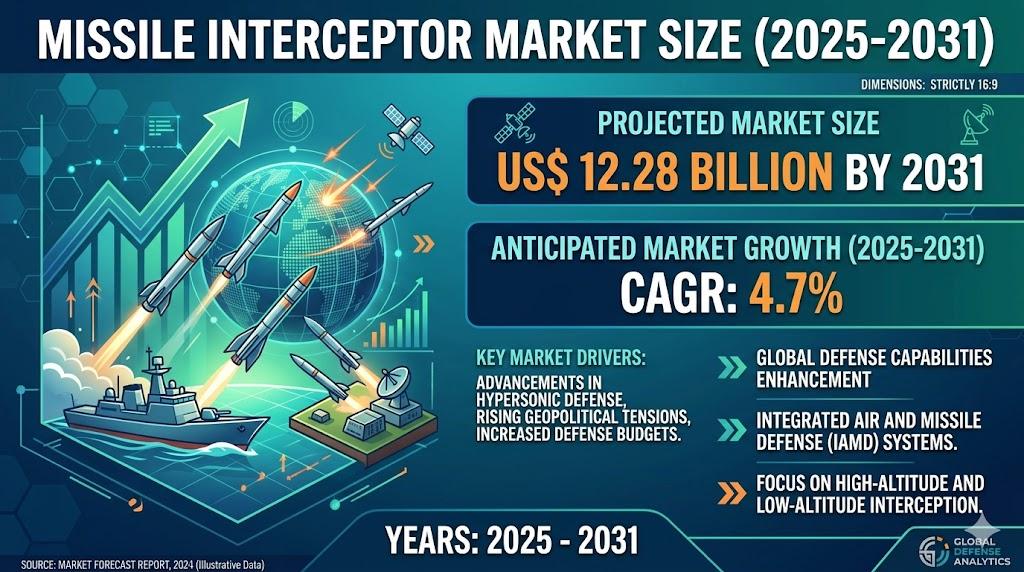
The global defense landscape is experiencing a rapid transformation driven by evolving security challenges and geopolitical instabilities. The Missile Interceptor Market size is expected to reach US$ 12.28 billion by 2031.The market is anticipated to register a CAGR of 4.7% during 2025 to 2031.The continuous proliferation of missile technology, particularly ballistic missiles and cruise missiles, has led to a growing demand for advanced missile defense systems, including interceptors.Countries with high defense expenditure are investing heavily in missile defense systems to protect critical infrastructure, military bases, and civilian populations from missile threats.
Market Drivers and Proliferation of Threats
The primary catalyst for the missile interceptor market is the global development of advanced missile threats.The continuous development of more sophisticated and accurate missile systems, including hypersonic missiles, has escalated the need for cutting-edge missile interceptor technologies.Hypersonic missiles pose significant challenges for current missile defense systems due to their high speed and low altitude flight path.The development of hypersonic missile interceptors that can counteract these fast-moving and unpredictable threats is a major focus for defense organizations worldwide.This challenge to existing missile defense strategies is leading to increased investments in advanced interceptor systems capable of defending against these high-speed, evasive threats.
Geopolitical Tensions and Regional Conflicts
Growth in regional conflicts and arms proliferation remains a critical factor pushing nations to enhance their missile defense capabilities.The ongoing conflicts in regions like the Middle East, South Asia, and Eastern Europe are forcing countries to focus heavily on national security.As tensions rise, especially in areas like the Korean Peninsula, the South China Sea, and Eastern Europe, there is an increasing need for countries to build up their defense infrastructure, including missile interceptors.
Furthermore, the proliferation of missile technology to regional players and non-state actors exacerbates the need for robust interception systems.In particular, the deployment of long-range missiles in regions such as North Korea, Iran, and other nations poses a direct threat to neighboring countries and global security.This widespread geopolitical uncertainty and the growing risk of missile attacks have created a strong demand for missile interceptors as part of national defense strategies.
Download Sample Report: https://www.theinsightpartners.com/sample/TIPRE00002935
Modernization Initiatives and Defense Integration
Major military powers, such as the United States, China, India, and Russia, are allocating significant resources to develop and deploy advanced missile defense systems, including interceptors.As part of modernization efforts, many countries are replacing aging missile defense systems with more advanced technologies that offer greater interception accuracy, faster response times, and a broader defense range.
Additionally, missile interceptors are increasingly being integrated into multi-layered defense systems.Examples include the United States Ground-based Midcourse Defense (GMD), Israel’s Iron Dome, and India’s Advanced Air Defence (AAD) system. These national modernization initiatives are expected to drive continuous demand for next-generation missile interceptors that span different operational ranges, such as up to 125 Kms, 125 to 200 Kms, and above 200 Kms.
Key Market Players
The missile interceptor industry features an array of established defense contractors focusing on technological advancements and expanding their offerings to meet shifting consumer preferences and defense requirements. Key players operating in the market include:
-
Aerojet Rocketdyne
-
BAE Systems, Inc.
-
Boeing
-
Israel Aerospace Industries
-
Lockheed Martin Corporation
-
MBDA
-
Northrop Grumman
-
Rafael Advanced Defense Systems Ltd.
-
Raytheon Technologies
-
Thales Group
Future Outlook
The future of the missile interceptor market will be heavily influenced by technological adaptation and innovation. One major trend is the emergence of Directed Energy Weapons (DEWs), such as high-energy lasers and microwave weapons, which are increasingly being considered as viable solutions for missile interception.DEWs offer the potential for extremely fast, precise, and cost-effective missile defense, as they can engage multiple targets with minimal logistical effort compared to traditional missile interceptors.As end-user demand rises due to technological advancements and greater awareness of product benefits, businesses are expanding their portfolios to deliver highly specialized endoatmospheric and exoatmospheric interceptors, ensuring the market expands steadily over the forecast period.
About Us
The Insight Partners is a leading global market research and consulting firm specializing in delivering actionable insights across various industries. Our research reports combine extensive primary and secondary research to provide accurate market intelligence, helping businesses make informed strategic decisions. The company provides detailed analysis on emerging technologies, market trends, competitive landscapes, and growth opportunities across sectors including technology, healthcare, manufacturing, and energy.
Contact Us:
Contact Person: Ankit Mathur
Email: ankit.mathur@theinsightpartners.com
Phone: +1-646-491-9876
Also Available in :Korean |German |Japanese |French |Chinese |Italian |Spanish

 English
 Arabic
 French
 Spanish
 Portuguese
 Deutsch
 Turkish
 Dutch
Dutch
 Italiano
 Romaian
 Portuguese (Brazil)
 Greek
Greek