

Soft Commodities Trading: Price Drivers, Seasonality & Global Supply Chain Impact
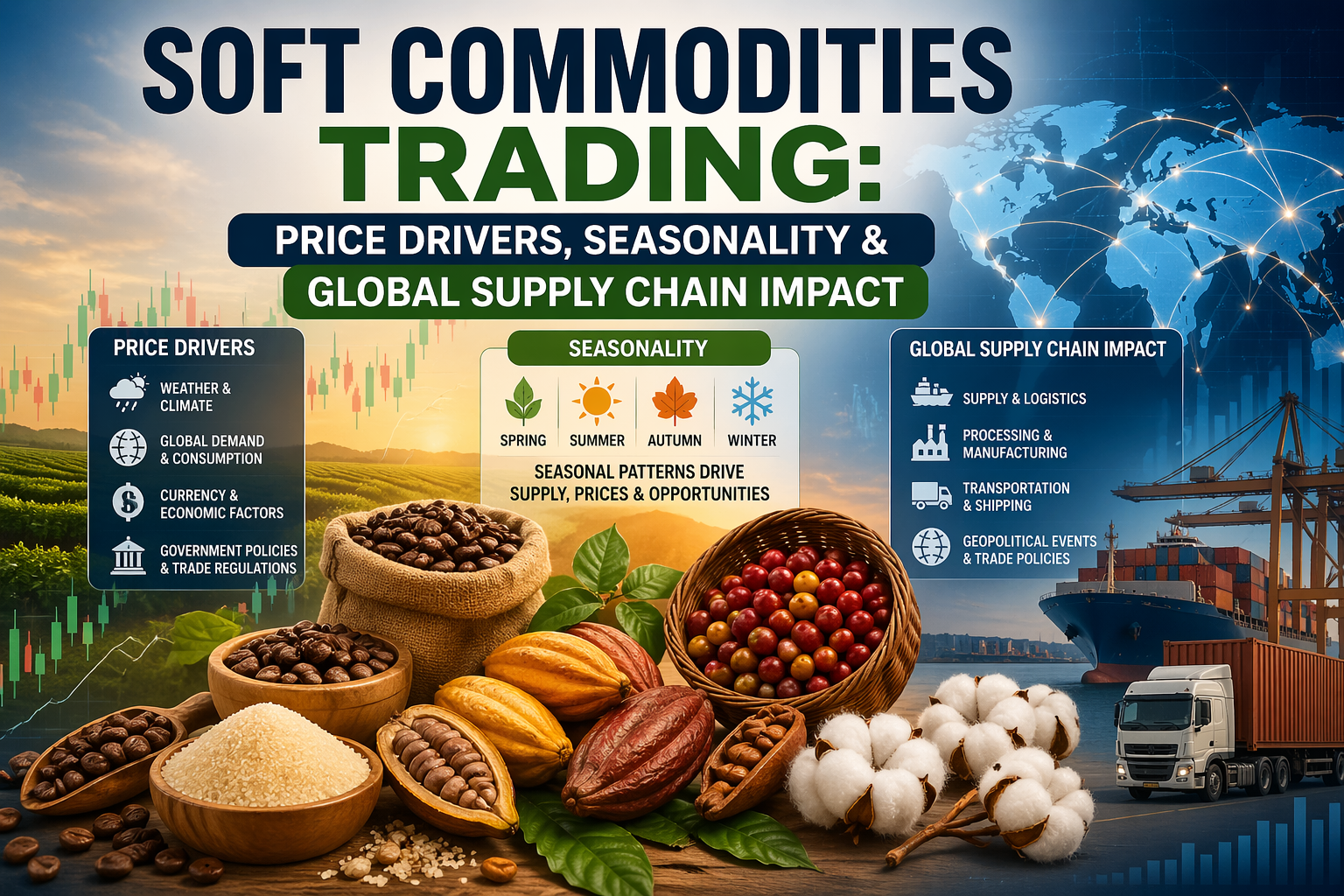
Soft commodities trading is an important part of financial markets. It focuses on trading agricultural products instead of metals or energy. They are not mined but grown, and their prices vary with weather conditions, demand, and supply. Understanding soft commodity markets helps traders make informed decisions and mitigate risks.
Soft commodities are price-volatile in trading. This states that prices can change within a short period. These movements come with opportunities and threats. To overcome these barriers, traders must understand market price drivers, seasonal patterns, and international supply chains to achieve their goals. Starting with:
What are Soft Commodities?
Soft commodities are agricultural products that are grown and harvested. Their prices depend on farming conditions, climate changes, and global demand.
Types of soft commodities include:
· Coffee: Most traded because of its consumption all over the world.
· Sugar: affected by the food and energy markets.
· Cotton: Linked with the textile industry
· Cocoa: Chocolate demand and products.
· Wheat: popular in food commodities.
Understanding what are soft commodities assists traders in knowing the markets they can fit their strategy.
What are the Price Drivers in Soft Commodities Trading?
Price drivers in soft commodities are the factors that cause fluctuation in supply & demand. These factors are often connected when trading soft commodities. Check out some major price drivers that can cause major fluctuations:
1. Weather Conditions
The weather most influences price movement. Droughts, floods, or storms can lower crop supply. Prices tend to increase when supply decreases. This directly impacts traders and they must closely monitor weather forecasts to anticipate price changes. Thus, they can make informed decisions and plan strategies.
2. Supply and Demand
When production is high and demand is low, prices will decrease. High demand leads to high prices. To deal with this, traders should analyse market trends and adjust their strategies. Changes in supply and demand can create profit opportunities or increase the risk of losses.
3. Currency Fluctuations
The US dollar is commonly used to trade soft commodities. A strong dollar makes soft commodities like grains and coffee more expensive for other countries, reducing demand. This affects trading, as many transactions are denominated in USD. Traders should monitor exchange rates because a stronger dollar can reduce profits, while a weaker dollar can boost competitiveness.
4. Government Policies
Export bans, subsidies, and tariffs can impact supply and lead to sudden price shifts. Traders need to stay informed about government regulations and policies, as these can cause unforeseen market volatility and significantly affect their trading positions.
5. Global Events
Events such as conflicts or pandemics can disrupt production and transport, leading to sudden changes in costs. Traders should stay alert to global news that can disrupt supply chains, creating both challenges and opportunities in the market.
What is The Impact of Seasonality on Soft Commodities?
Seasonality in soft commodities refers to changes in predictable prices throughout the year. Due to the soft commodity’s agricultural nature, crops are planted, nurtured, and harvested at definite times. The cycles produce repetitive price patterns.
Seasonal Patterns Include:
· Planting season: The price can increase because of uncertainty.
· Growing season: Weather risks are volatility.
· Harvest time: The price can be lowered because of the increased supply.
As a sign, when frost damages crops during their growing season, prices can rise. Likewise, wheat prices may fall during the harvest period as more wheat is produced.
Seasonality will enable traders to better strategise when to enter or exit.
What are the Impact of Global Supply Chain on Soft Commodities Trading?
The global supply chain is a network that links producers, exporters, and consumers. Any disruption in this chain affects pricing.
The main Supply Chain aspects include:
· Transportation delays
· Shipping costs
· Storage availability
· Port congestion
When goods fail to reach markets on time, supply declines in the importing countries. The result is an increase in prices. On the other hand, logistics help keep prices stable.
To traders, it is important to track the updates of the supply chain. It gives an understanding of price fluctuations in the short term.
What are the Advantages of CFDs in Soft Commodities Trading?
CFDs let traders speculate on price changes without buying the underlying asset. One of the advantages of CFDs is their accessibility to both beginner and experienced traders.
Key Benefits Include:
· Capacity to trade without possession of tangible items.
· The availability of both the growing and declining markets.
· Reduced capital requirements compared to traditional trading.
· Flexible trading hours
Traders can easily enter soft commodities markets using CFDs. This minimises entry barriers and contributes to increased participation.
Leverage is an important factor in the benefits of CFDs. With less capital, traders can control larger positions. But this also brings about risk, and therefore, risk management is required.
How to Mitigate Risk in Soft Commodities Trading?
Risk management protects traders from significant losses. Effective risk management helps traders make informed decisions and minimises the impact of market volatility. By setting limits and utilising tools like stop-loss orders, traders can protect their capital and stay in the game longer.
To do that, diversify your investments, set take-profit and stop-loss levels, avoid excessive leverage despite the benefits of CFDs, and keep an eye on global news and reports. Risk control is important to achieve long-term sustainability in trading.
Conclusion
The trade of soft commodities is unique, influenced by weather, demand, seasonality, and supply chains, presenting both risks and opportunities. Beginners should grasp the basics of the market and use CFDs wisely with proper risk management. Traders can succeed in the market and make smart financial choices with the right approach and ongoing learning. Take note, trading soft commodities requires proper attention and good predictive skills.

 English
 Arabic
 Spanish
 Portuguese
 Deutsch
 Turkish
 Dutch
Dutch
 Italiano
 Russian
 Romaian
 Portuguese (Brazil)
 Greek
Greek