In modern manufacturing, achieving strong, repeatable, and high-speed metal joints is essential for productivity and product reliability. A projection welder is one of the most efficient resistance welding solutions used in high-volume production environments where precision and consistency are critical. From automotive assemblies to electrical components and heavy industrial fabrication, projection welding plays a vital role in automated manufacturing systems.
As a global leader in industrial welding and metal-joining technologies, Heron Welder provides advanced resistance welding solutions designed for OEMs, automation integrators, and production engineers seeking high-efficiency joining systems.
What is a Projection Welder?
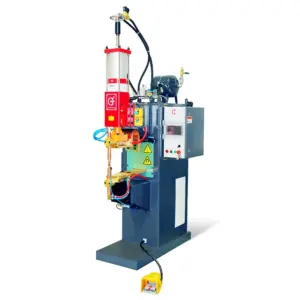
A projection welder is a type of resistance welding machine that joins metal parts using localized projections (raised points or embossed features) on one or both workpieces. These projections concentrate welding current and pressure at specific points, enabling controlled heat generation and precise fusion.
Unlike traditional spot welding, where electrodes determine the contact area, projection welding relies on pre-formed or natural projections to define the welding points. This makes it ideal for multi-point welding in a single operation.
Common materials used include:
- Low carbon steel
- Stainless steel
- Galvanized steel
- Electrical-grade metals
Working Principle of Projection Welding
The projection welding process operates on the principle of resistance heating combined with controlled pressure.
Step-by-Step Process:
- Workpiece Alignment
Two metal parts are placed between copper alloy electrodes.
- Projection Contact
Raised projections on one surface make initial contact with the flat or mating surface.
- Current Application
A high electrical current is passed through the projections.
- Heat Concentration
Due to reduced contact area, electrical resistance is higher at the projection points, generating localized heat.
- Plastic Deformation & Fusion
The projections collapse under pressure, forming a solid-state weld nugget at each point.
- Cooling Phase
The weld solidifies under maintained pressure to ensure strength and consistency.
This controlled process enables multi-point welding in a single cycle, significantly improving production efficiency.
Types of Projection Welding Applications
Projection welding is highly versatile and is used in several configurations depending on industrial requirements.
1. Nut and Bolt Projection Welding
One of the most common applications in automotive and appliance manufacturing. Nuts or threaded fasteners are welded onto sheet metal using engineered projections for precise alignment and strength.
2. Embossed Sheet Welding
Sheet metal components are designed with embossed projections that allow controlled multi-point welding, widely used in enclosures, brackets, and structural assemblies.
3. Wire and Mesh Welding
Projection welding is used for joining wire forms or mesh structures where multiple contact points are required simultaneously.
4. Heavy Industrial Components
Thicker materials and structural parts benefit from projection welding due to its ability to distribute current across multiple weld points.
Industrial Applications of Projection Welders
A projection welder is widely used across industries requiring high-strength, repeatable welds with minimal distortion.
Automotive Industry
- Seat frames
- Chassis components
- Nut and bolt fastening systems
- Brackets and reinforcements
Electrical & Electronics
- Busbars
- Terminal connections
- Electrical enclosures
- Switchgear assemblies
HVAC and Appliances
- Compressor mounts
- Sheet metal housings
- Structural panels
Heavy Engineering
- Fabricated steel structures
- Industrial equipment frames
- Machinery components
Projection welding is particularly valuable in automated production lines, where cycle time reduction and repeatability are essential.
Advantages of Projection Welding Technology
Using a projection welder offers several engineering and production benefits:
High Production Efficiency
Multiple welds can be completed in a single cycle, reducing overall manufacturing time.
Precision and Consistency
Controlled projection points ensure uniform weld quality across batches.
Reduced Electrode Wear
Since heat is localized at projections, electrode degradation is minimized compared to spot welding.
Strong Mechanical Joints
Weld strength is highly reliable due to concentrated fusion zones.
Easy Automation Integration
Projection welding systems integrate seamlessly with robotic arms and automated assembly lines.
Projection Welder vs Spot Welder
While both systems use resistance welding principles, they differ in process control and application suitability.
Spot Welding
- Uses electrode tips to define weld point
- Best for simple two-sheet joining
- Limited multi-point capability
Projection Welding
- Uses pre-formed projections
- Enables multiple welds simultaneously
- Better for nuts, fasteners, and structured components
- Higher automation compatibility
For OEMs and high-volume manufacturers, projection welding is often the preferred choice due to its scalability and repeatability.
Best Practices for Projection Welding Operations
To achieve optimal performance from a projection welder, several engineering factors must be controlled:
Proper Projection Design
Projection size, shape, and placement must be engineered based on material thickness and conductivity.
Accurate Pressure Control
Insufficient or excessive force can lead to weak joints or projection collapse before proper fusion.
Optimized Current Settings
Welding current must be calibrated to ensure consistent heat generation across all projections.
Electrode Maintenance
Regular cleaning and alignment of electrodes ensure stable performance and reduce defects.
Material Compatibility
Matching similar or compatible metals ensures strong metallurgical bonding.
Implementing these best practices significantly improves weld consistency and reduces production defects.
Heron Welder: Advanced Solutions for Projection Welding Systems
As a trusted manufacturer of industrial welding technologies, Heron Welder specializes in delivering high-performance projection welding machines designed for modern manufacturing environments.
Our projection welding solutions are engineered for:
- High-volume automotive production lines
- Precision electrical component assembly
- Automated manufacturing integration
- Heavy-duty industrial fabrication
Heron systems are designed with:
- Advanced resistance welding control systems
- High-duty cycle transformers
- Precision pneumatic and servo pressure control
- Seamless automation compatibility
- Energy-efficient welding performance
We focus on helping manufacturers achieve:
- Reduced cycle time
- Improved weld consistency
- Lower operational cost
- Higher production reliability
Whether you are upgrading an existing production line or developing a fully automated welding system, Heron provides tailored engineering support to meet your manufacturing requirements.
Frequently Asked Questions (FAQs)
1. What is a projection welder used for?
A projection welder is used to join metal parts using localized projections, commonly applied in automotive, electrical, and industrial manufacturing.
2. How is projection welding different from spot welding?
Projection welding uses pre-formed projections to concentrate current at specific points, while spot welding relies on electrode contact to define the weld area.
3. Can projection welding be automated?
Yes, projection welding is highly compatible with robotic and automated production systems, making it ideal for mass manufacturing.
4. What materials can be welded using a projection welder?
Common materials include carbon steel, stainless steel, and galvanized steel, depending on application requirements.
5. Why is projection welding preferred in automotive manufacturing?
It enables fast, multi-point welding with high repeatability, making it ideal for high-volume automotive production lines.
Conclusion
A projection welder is a powerful and efficient solution for manufacturers seeking precision, speed, and scalability in metal joining processes. Its ability to deliver consistent multi-point welds makes it indispensable in modern automated production environments.
Request a Custom Welding Solution
Heron Welder provides advanced projection welding systems tailored to your production needs. Whether you require a standalone machine or a fully integrated automated welding line, our engineering team can design a solution optimized for performance, efficiency, and long-term reliability.
Contact Heron Welder today to request a quote or consultation for your customized projection welding system.



 English
 Arabic
 French
 Spanish
 Portuguese
 Deutsch
 Dutch
Dutch
 Italiano
 Russian
 Romaian
 Portuguese (Brazil)
 Greek
Greek