

Indoor Robots Market Supply Chain Analysis and Industry Growth 2032
Indoor Robots Market Overview
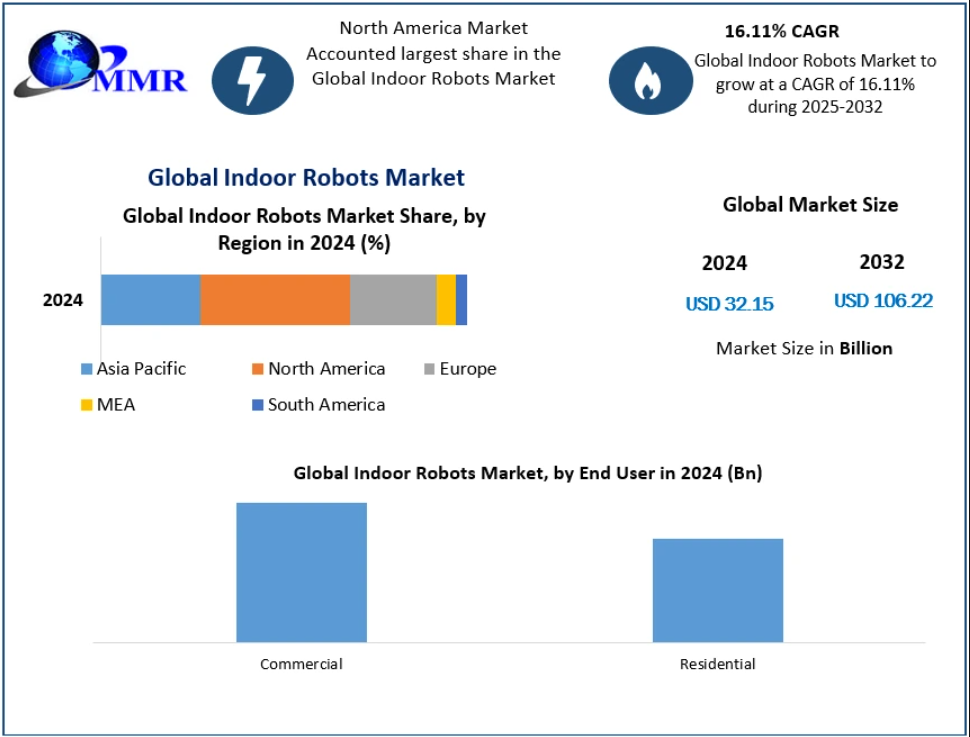
The global Indoor Robots Market was valued at USD 32.15 billion in 2024 and is projected to reach nearly USD 106.22 billion by 2032, growing at a CAGR of 16.11% during the forecast period from 2025 to 2032. The market is witnessing rapid expansion due to the increasing adoption of robotics in residential, commercial, healthcare, hospitality, and retail sectors.
Indoor robots are designed to perform various automated tasks within enclosed environments such as homes, offices, hospitals, hotels, shopping malls, and educational institutions. These robots are equipped with advanced technologies including artificial intelligence (AI), machine learning, sensors, and computer vision systems, enabling them to interact with humans, navigate indoor spaces, and perform tasks efficiently.
The growing demand for automation, rising labor costs, and increasing interest in smart technologies are significantly driving the development and adoption of indoor robotic solutions worldwide.
To know the most attractive segments, click here for a free sample of the report:https://www.maximizemarketresearch.com/request-sample/33164/
Market Dynamics
Rising Adoption of Robots in Domestic and Commercial Applications
The increasing use of robots for household and commercial purposes is one of the major factors driving the indoor robots market. Indoor robots are now widely used for cleaning, room service delivery, customer engagement, cooking assistance, security monitoring, and healthcare support.
Hotels, restaurants, banks, and retail stores are increasingly deploying service robots to improve customer experiences and operational efficiency. For example, hospitality robots are capable of delivering room service, guiding guests, and assisting hotel staff with repetitive tasks. These solutions help businesses reduce operational costs while enhancing service quality.
Cleaning robots have become especially popular in residential and commercial spaces due to their convenience and efficiency. Robotic vacuum cleaners and automated floor-cleaning systems reduce human effort and improve cleaning accuracy through intelligent navigation systems.
Industry 4.0 and AI Integration
The rapid growth of Industry 4.0 technologies is transforming the robotics industry. Artificial intelligence, machine learning, cloud computing, and advanced sensors have significantly improved the capabilities of indoor robots. Modern robots can now communicate with users, recognize surroundings, adapt to changing environments, and collaborate with humans more effectively.
These advancements have expanded the role of robots beyond repetitive industrial functions to include personalized services, healthcare assistance, and intelligent automation in indoor environments.
Challenges Restraining Market Growth
Despite strong market growth, certain factors continue to limit widespread adoption. High costs associated with advanced robotic systems, particularly medical robots and AI-powered service robots, remain a major challenge for small businesses and consumers.
In addition, concerns regarding human safety, data privacy, and technical reliability may slow market expansion in some sectors. However, ongoing technological improvements and decreasing component costs are expected to reduce these challenges over time.
Segment Analysis
By Product
Based on product type, the market is segmented into:
- Medical Robot
- Cleaning Robot
- Entertainment Robot
- Security & Surveillance Robot
- Education and Research Robot
- Personal Assistant Robot
- Public Relation Robot
Among these, the cleaning robot segment is expected to hold the largest market share during the forecast period. Cleaning robots are widely used in households, offices, hospitals, and commercial buildings because they improve cleaning efficiency and reduce manual labor.
These robots are equipped with intelligent mapping systems, sensors, and vacuum technologies that allow them to detect obstacles, identify cleaning paths, and clean autonomously. Increasing consumer demand for smart home appliances is further driving segment growth.
Medical robots are also witnessing increasing adoption in healthcare facilities for surgeries, patient assistance, rehabilitation, and hospital logistics.
By End User
The indoor robots market is categorized into:
- Commercial
- Residential
The commercial segment is expected to dominate the market due to rising deployment of robots in hotels, hospitals, airports, retail stores, warehouses, and educational institutions. Businesses are increasingly investing in robotic automation to improve customer engagement, reduce labor dependency, and increase operational efficiency.
The residential segment is also growing rapidly with the rising popularity of robotic vacuum cleaners, smart assistants, and home automation systems.
To know the most attractive segments, click here for a free sample of the report:https://www.maximizemarketresearch.com/request-sample/33164/
Regional Insights
North America
North America is expected to dominate the global indoor robots market throughout the forecast period. The region benefits from strong technological infrastructure, high consumer awareness, and significant investments in robotics research and development.
Countries such as the United States and Canada are actively adopting robotic technologies across healthcare, hospitality, retail, and residential sectors. The presence of leading robotics manufacturers and AI technology companies further supports regional market growth.
The increasing use of robots for domestic cleaning, healthcare surgeries, and customer service applications is accelerating market expansion in North America.
Asia Pacific
Asia Pacific is expected to witness significant growth during the forecast period due to increasing adoption of robots in security, surveillance, and personal assistance applications. Countries such as China, Japan, and South Korea are leading innovators in robotics technology and automation solutions.
Growing urbanization, rising disposable income, and increasing demand for smart devices are encouraging the use of indoor robots across residential and commercial sectors in the region.
Recent Industry Development
In September 2024, iRobot Corporation launched the Roomba i7 robotic vacuum cleaner. The device features advanced mapping technology that allows it to learn home layouts, clean specific rooms by command, and automatically empty its dustbin. The product launch reflects the growing demand for intelligent and fully automated cleaning solutions in smart homes.
Competitive Landscape
The indoor robots market is highly competitive, with major companies focusing on product innovation, AI integration, strategic partnerships, and expansion into emerging applications.
Key players operating in the market include:
- iRobot Corporation
- SoftBank Robotics Group
- LG Electronics
- Toyota Motor Corporation
- FANUC CORPORATION
- KUKA AG
- Kawasaki Heavy Industries, Ltd.
- Ecovacs
- Knightscope, Inc.
- Intuitive Surgical, Inc.
Conclusion
The global indoor robots market is expected to experience substantial growth over the coming years due to rapid advancements in AI, robotics, and smart automation technologies. Increasing demand for intelligent cleaning systems, healthcare automation, customer service robots, and personal assistant devices is transforming the way indoor environments operate.
As industries continue to adopt automation to improve efficiency and customer experience, indoor robots are expected to play an increasingly important role in residential, commercial, and healthcare applications worldwide.
Related Reports:

 English
 Arabic
 French
 Spanish
 Portuguese
 Deutsch
 Dutch
Dutch
 Italiano
 Russian
 Romaian
 Portuguese (Brazil)
 Greek
Greek