

The Digital Acceleration of Public Information Displays and Number Analysis Networks
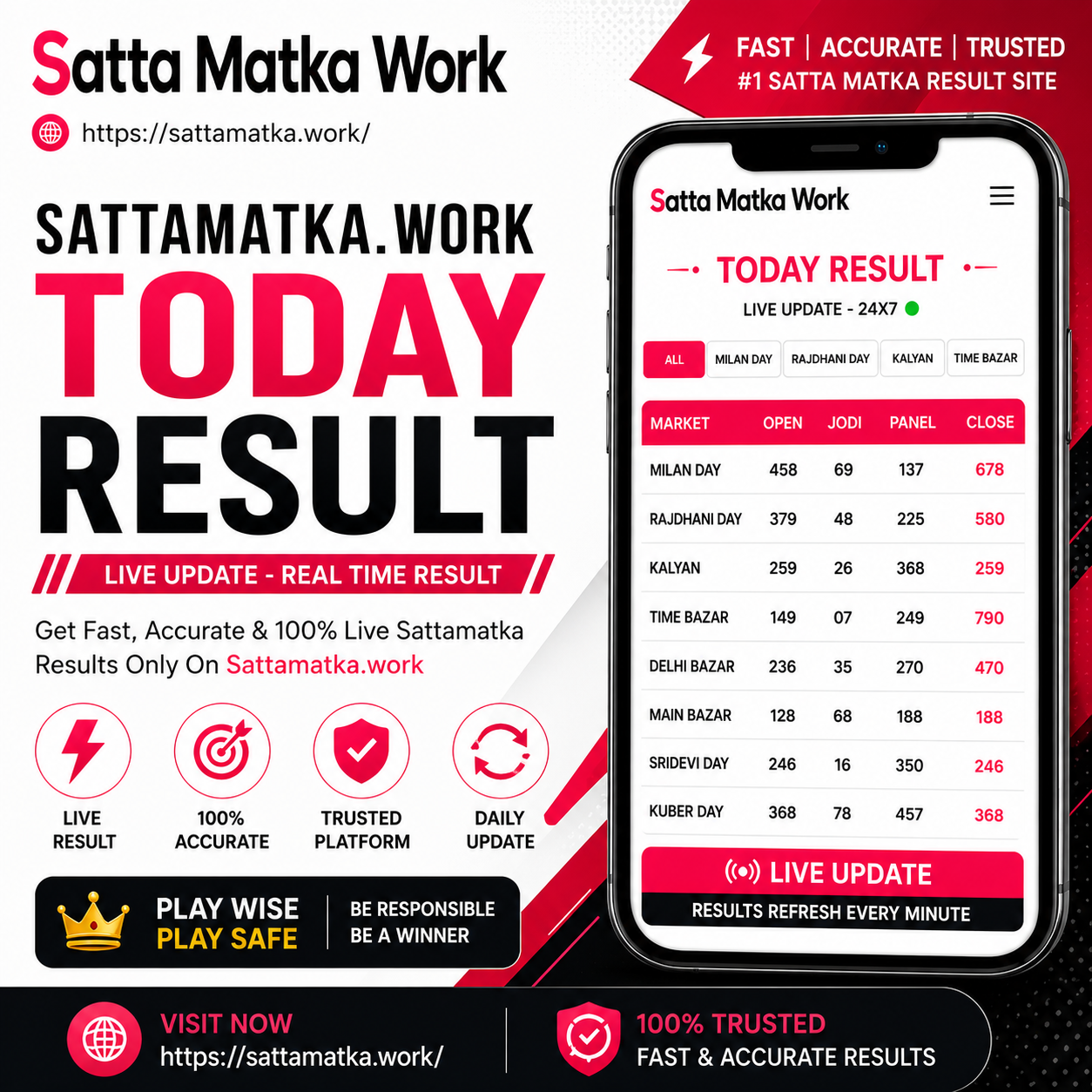
The continuous evolution of global communications has completely shifted how specialized data is categorized, organized, and accessed by public users. Systems that once depended on manual handwriting, physical charts, and slow voice calls have successfully transitioned into modern web-based tracking nodes. Within the subcontinental market of numerical analysis, specialized portals serve as core administrative hubs for processing heavy traffic during data updates. For analytical trackers studying these trends, utilizing a secure matka live result fast display interface has become a critical requirement to verify daily figures without experiencing browser delays. Evaluating these modern systems highlights the structure of automated databases, the cultural growth of online forums, and the safety measures necessary to navigate data channels securely.
The Evolution of Public Data Dissemination
Historically, regional number games like Satta Matka relied entirely on localized physical infrastructures. Results were written by hand on regional registers or displayed on blackboards outside specific neighborhood hubs, creating frequent information delays between states.
With the widespread integration of high-speed mobile internet across urban and rural sectors, these manual systems moved directly to open-access internet architectures. Modern web platforms are built strictly to function as informational databases rather than transactional environments. They accommodate a vast user base that visits the site specifically to analyze daily pattern shifts, view multi-year archival charts, and observe collective calculation strategies. By moving to this open-access model, a verified dp boss satta matka live result platform provides a clean, transparent layer for pattern observation, removing numerical lookup data away from unverified local networks and placing it into structured, public spaces.
Technical Infrastructure of Automated Information Boards
When users attempt to monitor rapidly updating numbers, identifying an authentic, high-capacity tracking portal is always the primary operational challenge. A reliable web framework must be capable of processing major traffic spikes during peak evening update windows without creating database lag or security crashes. A standard, verified platform integrates automated rendering scripts that update real-time numerical arrays for various daily markets such as Kalyan, Milan, Sridevi, and Main Bazar without producing database delays.
Furthermore, accessing a verified boss matka live result panel gives researchers access to multi-year historical logs. These extensive databases track and preserve day-to-day fluctuations, allowing statistical analysts to cross-verify structural charts and plot probability distribution curves based on historic recurrence tables.
Deconstructing the Matrix Notation Format
For individuals researching the technical mechanics of these automated tracking boards, reading the published sequences requires a precise understanding of traditional algebraic notation. Data outputs are consistently presented in a structured, multi-segment string, traditionally resembling an array such as 346-30-145.
This string breaks down into three separate computational fields:
-
The Opening Cluster: The initial block of three numbers (
346) represents the starting metrics drawn during the early market window. In analytical frameworks, these numbers are summed (3+4+6=13), and the final digit (3) acts as the initial coordinate of the pair. -
The Core Jodi: The middle pair of numbers (
30) represents the central coordinate tracking cell. Statistical analysts focus heavily on this specific cell to map out probability curves based on chronological data trends. -
The Closing Cluster: The final block of three numbers (
145) marks the second phase of the market calculation. These digits are similarly combined (1+4+5=10), with the last number (0) establishing the final closing coordinate of the mathematical sequence.
Compliance, Cyber Hygiene, and Digital Ethics
While evaluating algorithmic variations or reading public chart projections on public tracking networks may appear to be a passive hobby, users must remain deeply mindful of the strict legal frameworks surrounding these operations. In India, gaming regulations are localized and managed primarily by individual state laws under the historical foundation of the Public Gambling Act of 1867. Consequently, traditional lottery operations are strictly prohibited or categorized as illegal activities in most territorial zones.
Financial discipline is absolutely critical when navigating these informational spheres. Regardless of how intricate, historical, or mathematically sound a platform's guessing charts look, these numerical outputs are ultimately bound by unpredictable probability. Users are strongly urged to treat these websites purely from an educational, research, or historical context. Adhering to fundamental cyber safety rules—such as withholding private phone numbers, never sharing financial banking profiles, and refusing requests from individuals claiming to sell "fixed" combinations—is vital to maintaining a secure online presence.

 English
 Arabic
 French
 Spanish
 Portuguese
 Deutsch
 Dutch
Dutch
 Italiano
 Russian
 Romaian
 Portuguese (Brazil)
 Greek
Greek