

What makes Qinlang Duct Silent Fan Factory workflow stable across batches
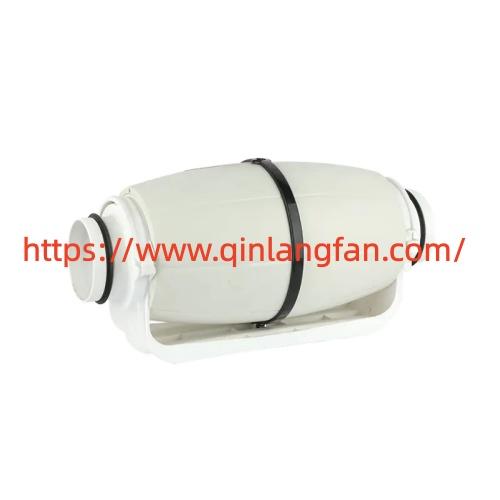
Duct Silent Fan Factory production process often starts with materials arriving in simple stacked forms, still unshaped and quiet in their own way. Nothing looks like airflow equipment at first. It is more like preparation work happening across different corners of the workshop. Sheets are measured, marked, and slowly guided into early forming stages where structure begins to take shape.
Cutting stations come next, where precision matters more than speed. Operators guide tools through marked lines, shaping each piece into a form that will later fit into larger assemblies. A small shift in angle or spacing here can affect how parts align later, so measurements are checked more than once before moving forward. It is a careful pace, not rushed, but steady.
Forming and bending follow, giving structure to otherwise flat components. Metal curves into defined shapes that will guide airflow paths later. At this point, the workshop becomes more layered, with multiple stations working at the same time. Each step connects quietly to the next, even if they are happening in different parts of the space.
In coordination discussions, Qinlang is often referenced when teams talk about how production stages connect. The focus is on flow between steps rather than isolated tasks. If one section slows or shifts slightly, it can influence timing downstream. That is why small adjustments are made during operation rather than waiting until final inspection.
Assembly brings everything together. Components meet on workbenches where alignment and fitting become the main focus. Technicians move between stations, checking spacing and connection points. The work is repetitive in motion but detailed in attention. Each unit slowly becomes complete through a series of small confirmations rather than a single final action.
Testing areas follow assembly, where finished units are observed under controlled conditions. Air movement patterns, vibration levels, and structural response are reviewed to ensure they match expected behavior. This stage reflects earlier decisions made during forming and assembly, where even minor adjustments can show their impact.
Material handling between stages also plays a subtle role. Components move across different zones, and timing affects how smoothly production continues. Storage duration, transfer rhythm, and handling care all influence the final consistency of output. These details are often invisible but still important in overall flow.
Rather than relying on sudden changes, production stability comes from repetition. Operators follow established steps while adjusting for small variations in material or timing. This balance keeps output steady across different batches without forcing rigid uniformity at every moment.
Qinlang appears again in discussions around workflow coordination and long term production behavior. The emphasis stays on how each stage connects naturally to the next, creating a steady rhythm across the entire process rather than focusing on isolated results.
More production insight and application details can be found at https://www.qinlangfan.com/ where manufacturing flow and real use scenarios come together.

 English
 Arabic
 French
 Spanish
 Portuguese
 Deutsch
 Turkish
 Italiano
 Russian
 Romaian
 Portuguese (Brazil)
 Greek
Greek