

Training Validation and Test Sets Demystified
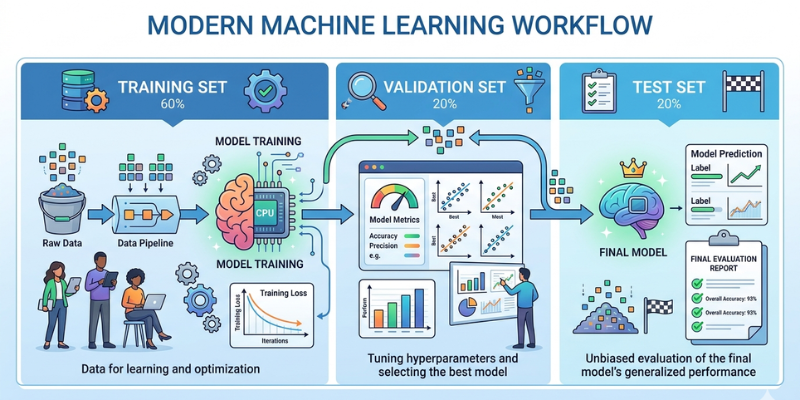
Machine learning models identify patterns within data, but they must also demonstrate their effectiveness on novel and unencountered information. This is where training, validation, and test sets become important. These three datasets help data scientists build reliable models and measure their true performance. Understanding these concepts is one of the first steps toward mastering machine learning and analytics. If you are planning to build practical skills in this field, you can explore Data Science Courses in Bangalore at FITA Academy to strengthen your understanding with guided learning and hands-on practice.
What is a Training Set
A training set is the portion of data used to teach a machine learning model. The model studies the patterns, relationships, and trends present in this dataset. During this stage, the algorithm adjusts itself repeatedly to improve predictions and reduce errors.
For example, if you are building a model to predict house prices, the training data may include information such as location, number of rooms, and previous selling prices. The model uses this information to learn how different factors influence the final price.
The training set is usually the largest portion of the dataset because the model needs enough examples to understand the data properly. A weak or limited training set can lead to poor predictions and unreliable outcomes.
Why Validation Sets Matter
After training the model, the next step is validation. A validation set helps check how well the model performs while it is still being improved. This dataset is different from the training set, which means the model has not seen this data before.
Validation helps data scientists adjust settings such as learning rate, model complexity, or algorithm selection. It also helps detect overfitting. Overfitting happens when a model memorizes the training data instead of learning general patterns. As a result, it performs poorly on new data.
For beginners, it is helpful to think of the validation set as a practice exam before the final test. It gives feedback and allows improvements before the model is fully evaluated. If you want to gain practical exposure to these important machine learning concepts, take a Data Science Course in Hyderabad to work with real datasets and industry-focused projects.
Understanding the Test Set
The test set is the final stage of evaluation. It is used only after the model has completed training and validation. This dataset measures how accurately the model performs in real-world situations.
The model should never learn from the test set. If the test data influences the training process, the final evaluation may become misleading. A properly separated test set gives an honest picture of the model’s capabilities.
For example, imagine preparing for a driving test. Training is similar to learning with an instructor, validation is like practicing under supervision, and the test set represents the final driving exam. The final score shows how well you can handle real situations independently.
Common Dataset Splitting Ratios
Data scientists often divide datasets using common ratios such as 70 15 15 or 80 10 10. In these examples, the first number represents the training set, the second represents the validation set, and the last represents the test set.
The right ratio depends on the size and quality of the dataset. Large datasets can support bigger test and validation sets, while smaller datasets may require more training data for better learning.
It is also important to shuffle data before splitting. This prevents patterns or order in the data from affecting model performance.
Training, validation, and test sets form the foundation of machine learning evaluation. Each dataset serves a unique purpose and helps create models that are accurate, stable, and trustworthy. Beginners who understand these concepts early can avoid common mistakes and build stronger machine learning projects in the future. If you are ready to deepen your skills and learn practical data science techniques, join a Data Science Course in Ahmedabad to gain confidence through structured learning and real-world applications.
Also check: The Role of Domain Knowledge in Data Science

 English
 Arabic
 Spanish
 Portuguese
 Deutsch
 Turkish
 Dutch
Dutch
 Italiano
 Russian
 Romaian
 Portuguese (Brazil)
 Greek
Greek