

How Metformin Hydrochloride 250mg Works Inside the Body: The Science Behind the World's Most Prescribed Diabetes Drug
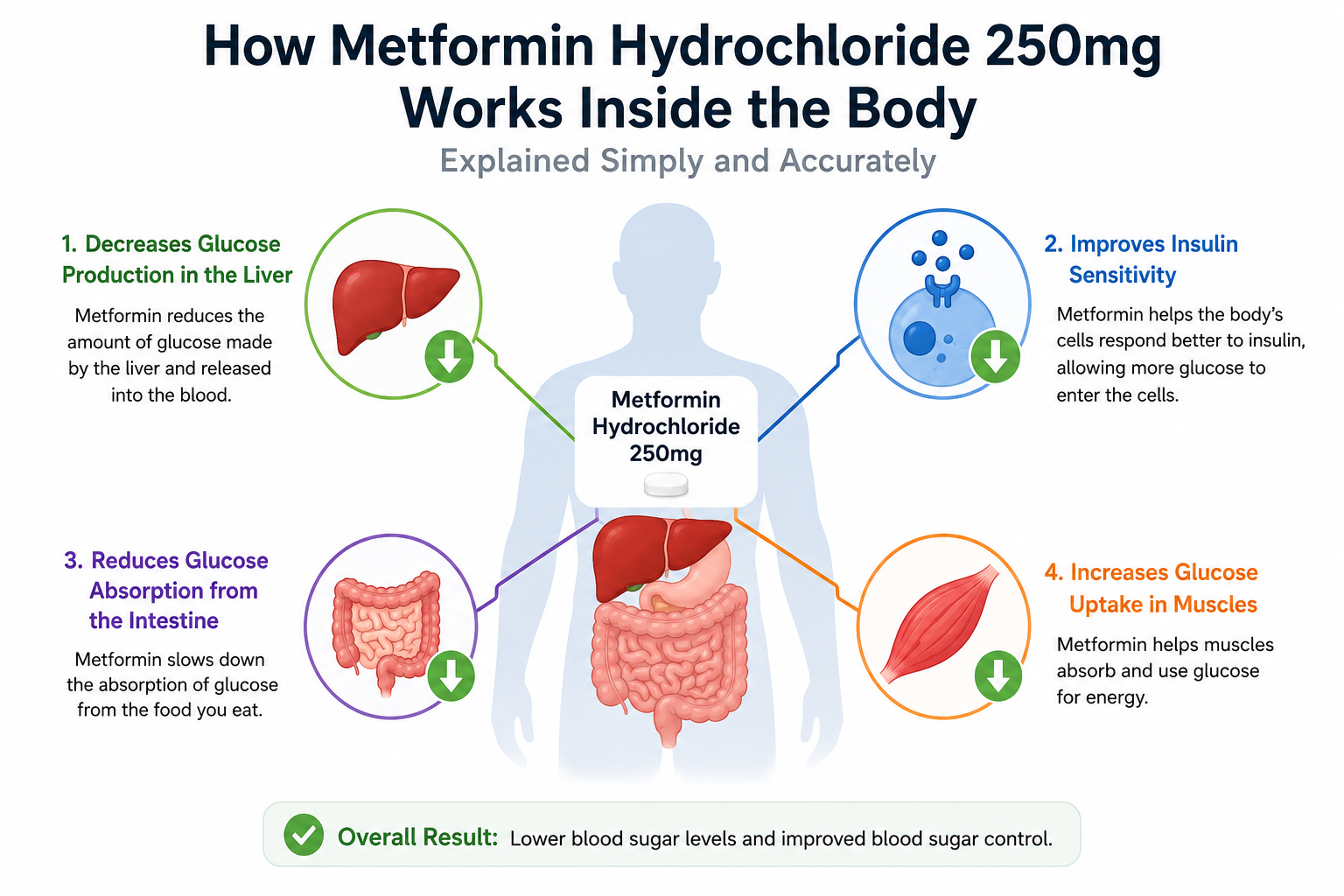
How Metformin Hydrochloride 250mg Works Inside the Body Explained Simply and Accurately
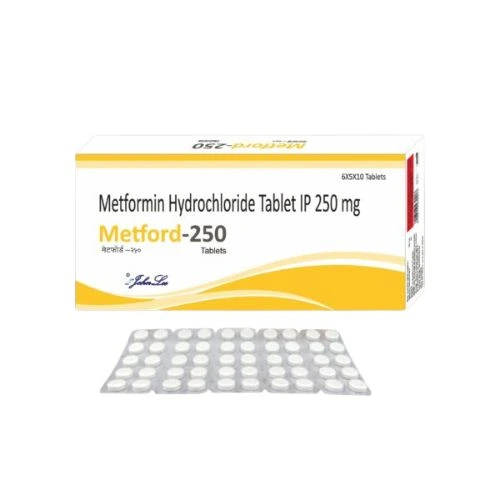
Your doctor hands you a prescription. Metformin 250mg. Take it with food.
That's often where the explanation ends.
Most patients go home with a vague sense that the pill 'helps with blood sugar' but no real understanding of what's actually happening inside their body. And that matters more than you might think. Research consistently shows that patients who understand how their medication works are significantly more likely to take it correctly, tolerate side effects, and stick with treatment long enough to see results.
So let's fix that. Here is exactly what Metformin Hydrochloride 250mg does from the moment it reaches your gut to the cascading effects inside your liver, muscles, and even your intestinal bacteria.
The Journey: From Your Gut to Your Liver
Metformin is absorbed in the small intestine after you take it with food. This is why food timing matters; it's not just about stomach comfort. Food slows gastric emptying, which allows metformin to be absorbed more gradually and consistently.
Once absorbed, metformin does something unusual for a medication: it concentrates preferentially in the gut wall, the liver, and red blood cells rather than distributing evenly across all tissues. Its plasma protein binding is essentially zero. It doesn't piggyback on carrier proteins the way many drugs do.
The liver is its primary target. And what happens there is where the real action begins.
The AMPK Mechanism: Metformin's Core Engine
What Is AMPK?
AMPK stands for AMP-activated protein kinase. Think of it as the body's master metabolic sensor, a molecular switch that gets flipped when cellular energy drops. When AMPK activates, the cell essentially says: 'Energy is low. Stop spending. Start conserving and generating.'
Glucose production in the liver is energetically expensive. When AMPK is activated, it suppresses this process, specifically a pathway called gluconeogenesis, which is the liver's method of manufacturing new glucose from non-carbohydrate sources like amino acids and lactate.
How Metformin Activates AMPK
Here's the mechanism most patient guides skip entirely:
Metformin mildly inhibits Complex I of the mitochondrial electron transport chain in liver cells. This reduces ATP production slightly and causes AMP levels to rise relative to ATP, exactly the low-energy signal that activates AMPK.
The result: AMPK switches on, gluconeogenesis shuts down, and the liver produces less glucose overnight. For a type 2 diabetes patient, this directly lowers fasting blood glucose, which tends to be high in the morning before eating.
Improving Insulin Sensitivity in Muscle Tissue
Metformin's second major action happens not in the liver but in peripheral tissue, particularly skeletal muscle.
In type 2 diabetes, muscle cells develop insulin resistance. Insulin knocks on the door (binds to receptors), but the cell doesn't open it properly. Glucose stays in the bloodstream instead of entering the muscle where it's needed for energy.
Metformin improves this signal transduction, the chain of molecular events that follows insulin binding. It activates glucose transporter proteins (particularly GLUT4) that pull glucose from the blood into the muscle cell. The door opens more easily.
This effect is entirely insulin-dependent. Metformin doesn't create its own glucose transport; it amplifies the insulin signal that was already there but wasn't being heard properly. This distinction is why it cannot cause hypoglycemia on its own: no insulin stimulus, no effect.
Slowing Glucose Absorption in the Intestine
The third mechanism is the most straightforward: metformin slows the rate at which glucose from your food passes through the intestinal wall into the bloodstream.
After a carbohydrate-containing meal, blood glucose normally rises sharply within 30 to 60 minutes. Metformin blunts this spike by reducing intestinal glucose transport specifically by downregulating sodium-glucose co-transporters in the gut lining.
The result is a flatter, slower post-meal glucose curve. Insulin doesn't have to work as hard. The pancreatic beta cells get a break.
Importantly, this gut-level effect may also explain why some patients experience GI side effects (nausea, diarrhea), particularly when metformin is taken without food or at higher doses. The drug is very active in the gut, not just in the liver.
|
Mechanism |
Where It Acts |
Blood Sugar Effect |
Timeline |
|
AMPK activation / hepatic gluconeogenesis suppression |
Liver |
Lowers fasting glucose (morning) |
Days to weeks |
|
Insulin sensitization (GLUT4 upregulation) |
Skeletal muscle |
Improves post-meal glucose uptake |
Weeks |
|
Intestinal glucose absorption reduction |
Small intestine |
Flattens post-meal glucose spike |
Immediate per dose |
|
Gut microbiome modulation (emerging) |
Colon/gut bacteria |
Metabolic / weight benefits |
Weeks to months |
The Gut Microbiome Mechanism The One Most Guides Ignore
This is where metformin science gets genuinely exciting and genuinely underreported in patient-facing content.
Research over the last five years has established that metformin significantly alters the composition of gut microbiota. Specifically, it increases populations of Akkermansia muciniphila, a bacterium strongly associated with improved metabolic health, reduced intestinal permeability, and lower systemic inflammation.
A 2019 Nature Medicine study found that a portion of metformin's blood sugar-lowering effect could be transferred between individuals via gut microbiota transplantation. This is extraordinary: it suggests the drug's metabolic benefits are partly mediated through changes in your intestinal ecosystem, not just through direct cellular action.
What this means practically: diet quality matters for metformin efficacy. A high-fibre diet that feeds beneficial gut bacteria may amplify metformin's effects. A diet that disrupts the microbiome (ultra-processed foods, excessive alcohol) may blunt them. This interaction is rarely discussed in standard prescribing conversations.
What Most Blogs Miss About How Metformin Works
|
The Insights Competitors Skip: These are the mechanistic details that matter clinically but rarely make it into consumer-facing metformin content. |
Metformin Does Not Stimulate Insulin. This Is Its Superpower
Every sulfonylurea drug works by forcing the pancreas to make more insulin. Over the years, this exhausts the beta cells that produce insulin, contributing to disease progression. Metformin does the opposite; it works around insulin resistance without demanding more output from an already-stressed pancreas.
This is why endocrinologists consider it disease-modifying in a way that many other diabetes drugs are not. It doesn't borrow against your future pancreatic function.
The Mitochondrial Action Is a Double-Edged Sword
Metformin's mild inhibition of mitochondrial Complex I is the root of both its therapeutic power and its primary serious risk. Under normal circumstances, the liver's lactate metabolism compensates without issue. But in states of tissue hypoxia (low oxygen) such as acute heart failure, severe infection, or kidney failure, this lactate clearance can be impaired.
When lactate builds up alongside metformin's mitochondrial effect, the risk of lactic acidosis emerges. This is not a mystery; it's the direct downstream consequence of the mechanism. Understanding this explains precisely which clinical situations require holding the drug.
The B12 Absorption Mechanism Is Anatomically Specific
Metformin's B12 depletion effect isn't a vague drug interaction it has a precise anatomical mechanism. Metformin interferes with calcium-dependent binding of the intrinsic factor-B12 complex to receptors in the terminal ileum (the last segment of the small intestine). Without this binding, B12 passes through unabsorbed.
This is why B12 injections or sublingual (under the tongue) B12 supplements bypass the problem, as they don't require gut absorption. Knowing the mechanism tells you the solution.
Expert Insights
|
Molecular Pharmacology Perspective: "What makes metformin scientifically fascinating is that we still don't fully understand all of its mechanisms — despite 60 years of use. The AMPK pathway was only confirmed as its primary mechanism in the early 2000s. The gut microbiome effects are even more recent. For a drug this old to keep generating new mechanistic discoveries is remarkable. It suggests we may still be underutilizing it." — Reflects findings from Foretz et al. and recent microbiome pharmacology literature. |
|
Clinical Endocrinology Perspective: "Patients always ask why they need to take it with food. I explain it's not just about nausea — it's about how the drug is absorbed and where it acts. Metformin is genuinely gut-active, not just a pill that passes through on its way to the bloodstream. When patients understand the intestinal mechanism, they stop skipping the food requirement." — Reflects clinician-reported adherence patterns in diabetes education literature. |
Frequently Asked Questions
Q1: How long does it take for Metformin 250mg to start working?
The intestinal glucose absorption effect begins with the first dose. The liver glucose suppression effect (fasting glucose reduction) becomes measurable within 1 to 2 weeks at a stable dose. Meaningful HbA1c reduction — the gold-standard measure of 3-month blood sugar control — is typically seen after 6 to 12 weeks at a therapeutic dose. Note that 250mg is a starter dose; most patients need 1,000 to 2,000mg daily for full clinical effect.
Q2: Does Metformin work without insulin?
For its liver mechanism (AMPK / gluconeogenesis suppression), yes — metformin is largely insulin-independent. For its muscle mechanism (GLUT4 upregulation), it amplifies existing insulin signaling, so some endogenous insulin is needed. This is why metformin works in type 2 diabetes (where insulin resistance, not complete insulin absence, is the problem) but is not effective as a sole agent in type 1 diabetes.
Q3: Why does Metformin cause stomach problems?
Because the gut is one of its primary sites of action. Metformin is highly concentrated in the intestinal wall and alters gut motility, microbiome composition, and local transport proteins. This biological activity is the same mechanism that generates clinical benefit — and occasional GI disruption. Taking it with food slows absorption and dramatically reduces these effects. Extended-release formulations distribute the dose more slowly and reduce GI side effects by up to 50%.
Q4: Can Metformin stop working over time?
Metformin doesn't develop true pharmacological tolerance. If it appears to 'stop working,' the most common explanations are: disease progression (type 2 diabetes is often progressive), weight gain, reduced adherence, or unaddressed comorbidities like sleep apnea or thyroid dysfunction. A reassessment of the full clinical picture — rather than simply blaming the drug — is the right response.
Q5: Does Metformin affect the kidneys directly?
No, metformin does not damage or affect kidney function directly. However, it is cleared entirely by the kidneys, so impaired kidney function causes metformin to accumulate. This accumulation, combined with the mitochondrial mechanism, creates the conditions for lactic acidosis. The drug is contraindicated or dose-adjusted based on eGFR thresholds, not because it harms the kidney, but because the kidney's ability to clear it determines safety.
The Takeaway
Metformin Hydrochloride 250mg does not do one simple thing inside your body. It's doing four things simultaneously: suppressing your liver's glucose factory, retraining your muscle cells to respond to insulin, slowing how fast sugar enters your bloodstream after meals, and reshaping the microbial ecosystem in your gut.
That's why a 60-year-old drug is still the foundation of type 2 diabetes treatment in 2026. And why researchers are now testing it for cancer, aging, and longevity.
Understanding how it works doesn't just satisfy curiosity. It gives you the context to take it correctly, tolerate the adaptation period, and trust the process because now you know what the process actually is.
Medical Disclaimer: This article is for educational purposes only and does not constitute medical advice. Metformin Hydrochloride is a prescription medication. Always consult your doctor, pharmacist, or a qualified healthcare provider before starting, changing, or stopping any medication.

 English
 Arabic
 French
 Spanish
 Portuguese
 Deutsch
 Turkish
 Dutch
Dutch
 Italiano
 Russian
 Romaian
 Portuguese (Brazil)