

North America Digital Air Traffic Control Market Trends, Share and Scope 2034
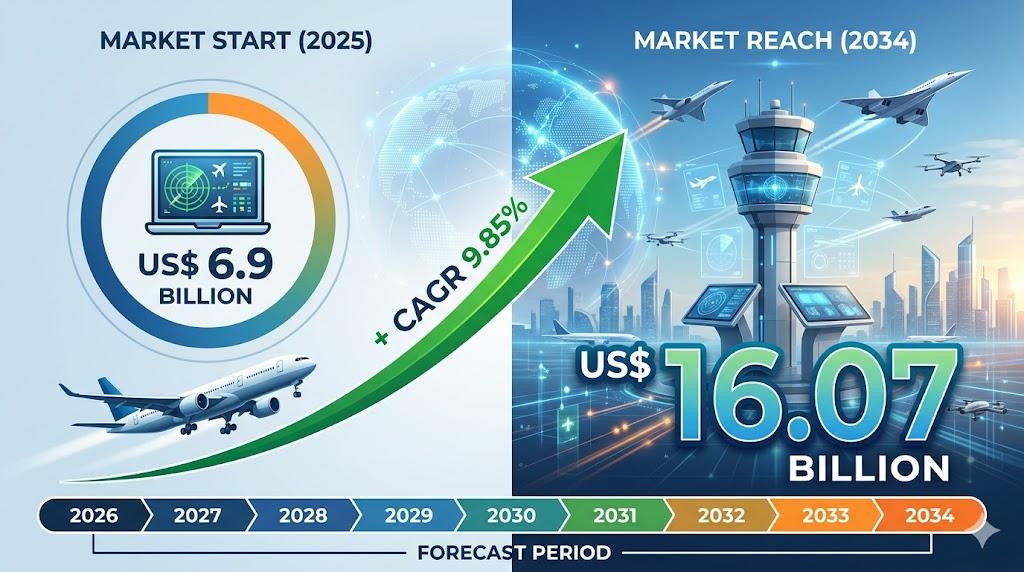
The Digital Air Traffic Control Market is experiencing strong growth due to increasing air traffic volumes, rising demand for modernization of aviation infrastructure, and the adoption of advanced digital technologies in airspace management systems. According to market analysis, the global digital air traffic control market size is projected to reach US$ 16.07 billion by 2034 from US$ 6.9 billion in 2025. The market is anticipated to register a CAGR of 9.85% during the forecast period 2026 to 2034.
Digital air traffic control systems are designed to enhance operational efficiency, improve situational awareness, and ensure safer management of aircraft movements. These systems replace traditional analog and radar-based processes with integrated digital platforms that support real-time data exchange and decision making.
Market Drivers and Key Trends
One of the primary drivers of the Digital Air Traffic Control Market is the rapid increase in global passenger and cargo flights. This growth places significant pressure on existing air traffic management infrastructure, pushing aviation authorities to adopt advanced digital solutions.
Another key factor is the rising emphasis on aviation safety and efficiency. Digital systems help reduce human error, improve coordination between control centers, and enable predictive traffic management. Additionally, the integration of artificial intelligence, automation, and cloud-based systems is further transforming the air traffic control ecosystem.
Governments and aviation regulators across various regions are also investing in smart airport initiatives. These initiatives encourage the deployment of next generation communication, navigation, and surveillance systems, which directly support market expansion.
Technological Advancements in Air Traffic Control
The market is witnessing rapid technological advancements, including remote tower operations, digital flight data processing systems, and enhanced surveillance technologies. These innovations enable controllers to manage multiple airports from centralized locations, reducing operational costs and improving efficiency.
Furthermore, the adoption of digital twins and advanced simulation systems is helping air navigation service providers optimize airspace usage and improve decision making in complex traffic scenarios.
Download Sample Report: https://www.theinsightpartners.com/sample/TIPRE00017697
Key Players in the Digital Air Traffic Control Market
The market is highly competitive, with several global companies focusing on innovation, strategic partnerships, and system integration capabilities. Key players include:
- Adacel Systems Inc.
- ADB Safegate
- Frequentis
- Indra Sistemas
- Kongsberg
- Leonardo S.p.A.
- NATS Limited
- Saab AB
- Searidge Technologies
- Thales Group
These companies are actively investing in research and development to enhance automation, improve system interoperability, and expand their global footprint in air traffic management solutions.
Market Challenges
Despite strong growth prospects, the Digital Air Traffic Control Market faces certain challenges. High initial investment costs for infrastructure upgrades remain a major barrier, especially for developing regions. Additionally, cybersecurity risks associated with digital aviation systems are a growing concern, requiring continuous improvements in data protection and system resilience.
Integration complexity between legacy systems and modern digital platforms also poses operational difficulties for aviation authorities transitioning toward full digitalization.
Future Outlook
The future of the Digital Air Traffic Control Market is expected to be shaped by increased automation, artificial intelligence integration, and expanded use of remote and digital tower technologies. As air travel demand continues to rise, aviation stakeholders will increasingly prioritize scalable and efficient air traffic management solutions.
By 2034, the market is expected to become more standardized and interconnected, with stronger global collaboration between air navigation service providers. The shift toward fully digital ecosystems will not only improve safety and efficiency but also support sustainable aviation growth by optimizing flight routes and reducing fuel consumption.
Overall, continuous technological innovation and government support for aviation modernization will remain key factors driving long term expansion of the digital air traffic control industry.
About Us
The Insight Partners is a leading global market research and consulting firm specializing in delivering actionable insights across various industries. Our research reports combine extensive primary and secondary research to provide accurate market intelligence, helping businesses make informed strategic decisions. The company provides detailed analysis on emerging technologies, market trends, competitive landscapes, and growth opportunities across sectors including technology, healthcare, manufacturing, and energy.
Contact Us:
Contact Person: Ankit Mathur
Email: ankit.mathur@theinsightpartners.com
Phone: +1-646-491-9876
Also Available in :Korean |German |Japanese |French |Chinese |Italian |Spanish

 English
 Arabic
 French
 Spanish
 Portuguese
 Deutsch
 Turkish
 Dutch
Dutch
 Italiano
 Russian
 Romaian
 Greek
Greek