

Challenges Facing the Food Allergy Diagnostics Testing Market: Insights for 2034
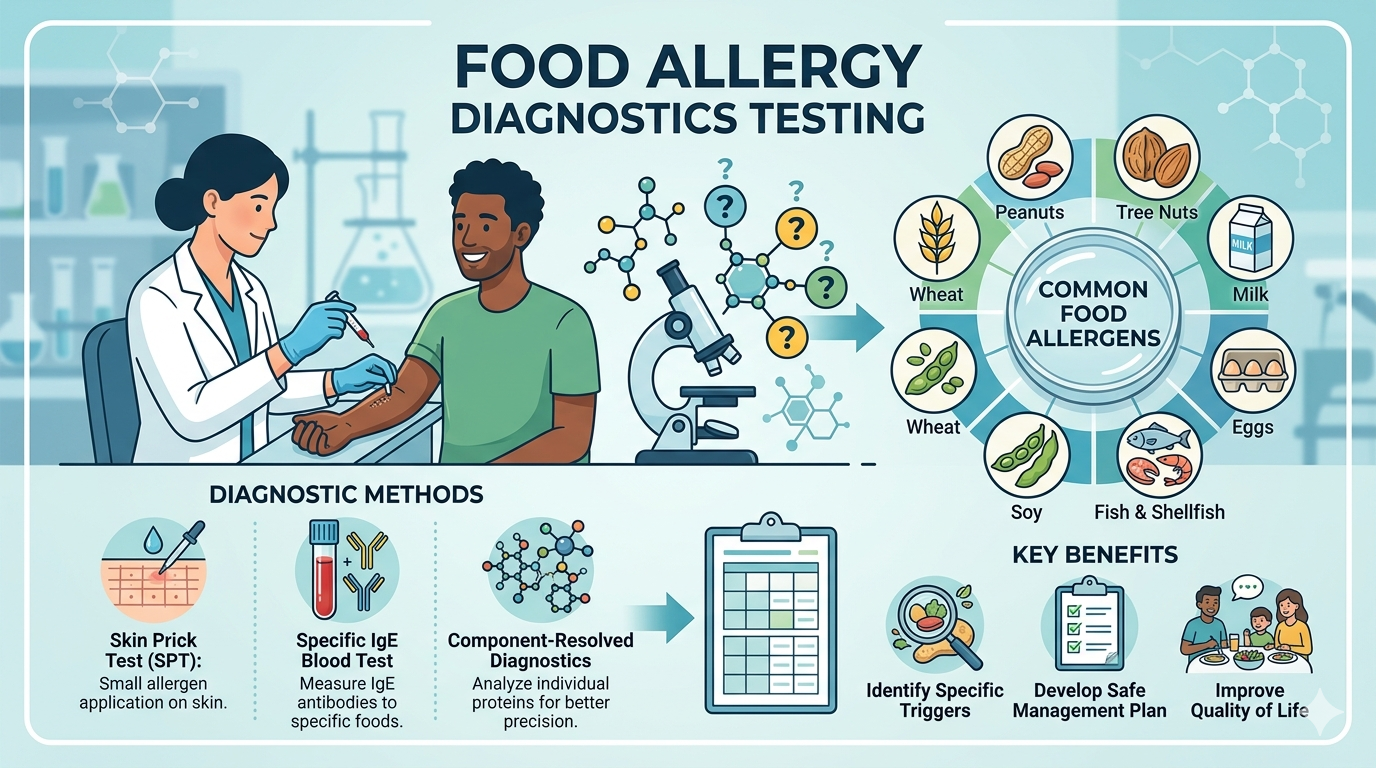
The global landscape for food allergy diagnostics testing is evolving rapidly as healthcare systems prioritize early disease detection and precision-based care. Rising cases of food allergies among children and adults have increased the demand for accurate and rapid diagnostic solutions across hospitals, diagnostic laboratories, and research institutes. Advances in immunology and biotechnology are reshaping testing approaches, enabling healthcare providers to identify allergens with improved specificity and efficiency.
The Food Allergy Diagnostics Testing Market Trends indicate strong growth potential driven by technological innovation, increasing awareness regarding food-related allergic reactions, and the growing adoption of personalized healthcare solutions. The industry is projected to grow from US$ 2.76 billion in 2025 to US$ 4.92 billion by 2034, registering a CAGR of 7.52% during the forecast period from 2026 to 2034. Increasing investments in laboratory infrastructure and the integration of AI-supported diagnostic tools are further supporting expansion across developed and emerging economies.
Get Sample PDF @ https://www.theinsightpartners.com/sample/TIPRE00006924
Rising Prevalence of Food Allergies Driving Demand
The increasing incidence of food allergies worldwide remains one of the primary factors accelerating industry expansion. Food allergies linked to peanuts, dairy products, shellfish, soy, and gluten are becoming more common due to changing dietary patterns, environmental influences, and genetic predisposition. This has intensified the need for reliable diagnostic procedures that can identify allergens at an early stage.
Healthcare professionals are increasingly recommending diagnostic testing to prevent severe allergic reactions and improve patient outcomes. Governments and healthcare organizations are also conducting awareness campaigns regarding allergy management, which is contributing to higher testing adoption rates. The growing emphasis on preventive healthcare has strengthened demand for routine allergy screening across pediatric and adult populations.
Technological Advancements Transforming Diagnostic Procedures
Technological innovation is playing a critical role in enhancing the accuracy and speed of allergy testing methods. Immunoassay-based technologies continue to dominate due to their high sensitivity and ability to detect multiple allergens simultaneously. At the same time, LC-MS-based and HPLC-based diagnostic platforms are gaining traction for their advanced analytical capabilities.
Artificial intelligence and machine learning are increasingly being integrated into diagnostic workflows to improve result interpretation and clinical decision-making. AI-powered platforms can analyze patient allergy patterns and support healthcare professionals in delivering more precise diagnoses. In addition, digital healthcare integration and automated laboratory systems are streamlining testing procedures and reducing turnaround times.
At-home allergy testing kits are emerging as a major trend, particularly among consumers seeking convenient and accessible healthcare solutions. These kits allow individuals to collect samples remotely and receive results through digital platforms, supporting wider accessibility and patient engagement.
Segment Analysis Highlights Emerging Opportunities
Based on diagnostics tests, the skin prick test segment continues to hold a significant share due to its cost effectiveness and widespread clinical acceptance. Blood tests are also experiencing substantial demand because they provide safer alternatives for patients at risk of severe allergic reactions. Oral food challenges remain important for confirming allergy diagnoses, particularly in specialized clinical settings.
By technology, immunoassay-based testing leads the industry owing to its established reliability and broad adoption in diagnostic laboratories. However, LC-MS-based technologies are expected to witness rapid expansion because of their superior sensitivity and multiplexing capabilities.
In terms of end users, diagnostic laboratories account for a major share due to increasing sample volumes and expanding laboratory networks worldwide. Hospitals and clinics are also strengthening their diagnostic capabilities to provide integrated allergy management services. Academic research institutes continue to contribute through ongoing studies focused on allergy biomarkers and innovative diagnostic techniques.
Regional Landscape and Competitive Environment
North America remains a leading regional contributor due to advanced healthcare infrastructure, high awareness levels, and strong presence of major industry participants. The United States continues to dominate regional growth through continuous innovation in allergy diagnostics and increased healthcare spending.
Europe follows closely with expanding research activities and favorable reimbursement policies supporting allergy testing adoption. Asia Pacific is anticipated to register the fastest growth rate owing to rising healthcare investments, increasing urbanization, and growing awareness regarding allergic disorders in countries such as China, India, and Japan.
Key companies operating in the industry are focusing on strategic collaborations, product launches, and technological enhancements to strengthen their competitive positions. Major participants include:
- Thermo Fisher Scientific
- Siemens
- Eurofins Scientific
- Intertek Group
- Omega Diagnostics Group
- bioMérieux
- NEOGEN Corporation
- TÜV SÜD
- HYCOR Biomedical
- R-Biopharm
Emerging Trends Shaping Future Development
Personalized nutrition planning based on allergy profiles is becoming increasingly popular among healthcare providers and consumers. Diagnostic insights are being used to create individualized dietary recommendations that improve patient safety and quality of life.
The integration of digital health technologies is also reshaping patient engagement and monitoring. Mobile applications linked with diagnostic platforms allow users to track symptoms, manage dietary restrictions, and communicate with healthcare professionals more effectively.
Furthermore, increasing research into molecular allergy diagnostics is expected to create opportunities for highly targeted and accurate testing solutions. Continuous improvements in biomarker identification and precision medicine approaches are likely to support long-term industry development.
Future Outlook
The outlook for the food allergy diagnostics testing industry remains highly positive through 2034. Rising allergy prevalence, technological innovation, expanding healthcare access, and increasing awareness regarding preventive healthcare are expected to sustain strong growth momentum. AI-powered diagnostics, at-home testing solutions, and personalized nutrition strategies are anticipated to redefine the future competitive landscape.
Related Report:
1) Defibrillator Market Key Players and Forecast by 2031
2) Infection Control Market Analysis by Size, Share & Growth 2031
3) Laboratory Water Distiller Market Size, Share & Demand by 2034
About Us -
The Insight Partners provides comprehensive syndicated and tailored market research services in the healthcare, technology, and industrial domains. Renowned for delivering strategic intelligence and practical insights, the firm empowers businesses to remain competitive in ever-evolving global markets.
Contact Us:
Ankit Mathur | The Insight Partners
E-mail: ankit.mathur@theinsightpartners.com
Phone: +1-646-491-9876
Also Available in : Korean German Japanese French Chinese Italian Spanish

 English
 Arabic
 French
 Spanish
 Portuguese
 Deutsch
 Turkish
 Dutch
Dutch
 Italiano
 Romaian
 Portuguese (Brazil)
 Greek
Greek