

Programmable Pacemakers Market Redefines Cardiac Care: Trends and Growth to 2031
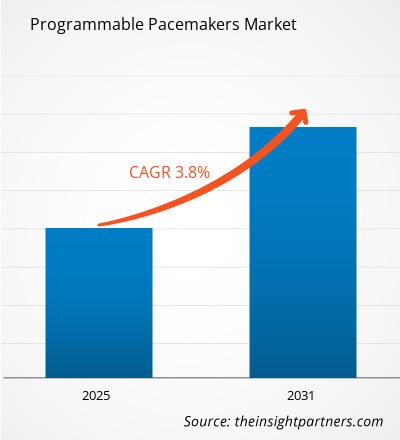
Pune, India - The programmable pacemakers market is at the heart of modern cardiology, bringing together advanced electronics, intelligent software, and compassionate care. As cardiovascular diseases rise globally, programmable pacemakers give clinicians the flexibility to fine-tune pacing settings non‑invasively, matching support to each patient’s unique heart rhythm and daily activity. The Programmable Pacemakers Market is expected to register a CAGR of 3.8% from 2025 to 2031.
Market Size, Share, Trends, Analysis, and Forecast by 2031
Growing adoption of minimally invasive cardiac procedures and advanced implantable devices is steadily expanding the programmable pacemakers market through 2031.
Dual‑chamber and biventricular devices account for a substantial share, while leadless and MRI‑compatible pacemakers are gaining traction as premium offerings.
Key trends include remote monitoring, Bluetooth‑enabled devices, and cloud‑based data platforms that allow cardiologists to adjust programmable pacemakers without frequent clinic visits.
Analysis of product mix shows implantable programmable pacemakers dominating over external models, with hospitals and specialized cardiac centers driving the majority of implant volumes.
By 2031, continuous improvements in battery life, device miniaturization, and software algorithms are expected to sustain robust momentum across adult and geriatric patient segments.
Global and Regional Analysis
In North America, high awareness of cardiac health, strong reimbursement environments, and rapid adoption of digital health tools support widespread use of programmable pacemakers. Europe emphasizes quality standards and regulatory rigor, with countries such as Germany, the UK, and France advancing the use of MRI‑safe and remotely monitored devices in public and private systems.
Asia Pacific is emerging as a key growth hub in the programmable pacemakers market, driven by aging populations, rising incidence of arrhythmias, and expanding cardiology infrastructure in China, India, Japan, and Southeast Asia. Latin America and the Middle East & Africa are seeing gradual uptake as specialized cardiac centers, training initiatives, and telecardiology networks extend access to life‑saving pacing therapy.
Key Drivers Accelerating Market Growth
Rising prevalence of bradycardia, heart block, and heart failure stands as a primary driver, prompting more patients to seek long‑term rhythm support. Programmable pacemakers enable physicians to personalize pacing modes, rate‑response settings, and diagnostic features, improving both survival and quality of life.
Favorable clinical guidelines and growing preference for minimally invasive implantation encourage early intervention, while remote follow‑up capabilities reduce hospital visits and travel burdens for older patients. Technological advances, including longer‑lasting batteries and enhanced safety features, further build trust among cardiologists, patients, and caregivers.
Key Players
St. Jude Medical (Abbott)
Medtronic
Boston Scientific
Biotronik
MicroPort
Lepu Medical
Pacetronix
Vitatron
OSCOR
Get More Information: - https://www.theinsightpartners.com/reports/programmable-pacemakers-market
Pune, India - The programmable pacemakers market is at the heart of modern cardiology, bringing together advanced electronics, intelligent software, and compassionate care. As cardiovascular diseases rise globally, programmable pacemakers give clinicians the flexibility to fine-tune pacing settings non‑invasively, matching support to each patient’s unique heart rhythm and daily activity. The Programmable Pacemakers Market is expected to register a CAGR of 3.8% from 2025 to 2031.
Market Size, Share, Trends, Analysis, and Forecast by 2031
Growing adoption of minimally invasive cardiac procedures and advanced implantable devices is steadily expanding the programmable pacemakers market through 2031.
Dual‑chamber and biventricular devices account for a substantial share, while leadless and MRI‑compatible pacemakers are gaining traction as premium offerings.
Key trends include remote monitoring, Bluetooth‑enabled devices, and cloud‑based data platforms that allow cardiologists to adjust programmable pacemakers without frequent clinic visits.
Analysis of product mix shows implantable programmable pacemakers dominating over external models, with hospitals and specialized cardiac centers driving the majority of implant volumes.
By 2031, continuous improvements in battery life, device miniaturization, and software algorithms are expected to sustain robust momentum across adult and geriatric patient segments.
Global and Regional Analysis
In North America, high awareness of cardiac health, strong reimbursement environments, and rapid adoption of digital health tools support widespread use of programmable pacemakers. Europe emphasizes quality standards and regulatory rigor, with countries such as Germany, the UK, and France advancing the use of MRI‑safe and remotely monitored devices in public and private systems.
Asia Pacific is emerging as a key growth hub in the programmable pacemakers market, driven by aging populations, rising incidence of arrhythmias, and expanding cardiology infrastructure in China, India, Japan, and Southeast Asia. Latin America and the Middle East & Africa are seeing gradual uptake as specialized cardiac centers, training initiatives, and telecardiology networks extend access to life‑saving pacing therapy.
Key Drivers Accelerating Market Growth
Rising prevalence of bradycardia, heart block, and heart failure stands as a primary driver, prompting more patients to seek long‑term rhythm support. Programmable pacemakers enable physicians to personalize pacing modes, rate‑response settings, and diagnostic features, improving both survival and quality of life.
Favorable clinical guidelines and growing preference for minimally invasive implantation encourage early intervention, while remote follow‑up capabilities reduce hospital visits and travel burdens for older patients. Technological advances, including longer‑lasting batteries and enhanced safety features, further build trust among cardiologists, patients, and caregivers.
Key Players
St. Jude Medical (Abbott)
Medtronic
Boston Scientific
Biotronik
MicroPort
Lepu Medical
Pacetronix
Vitatron
OSCOR
Get More Information: - https://www.theinsightpartners.com/reports/programmable-pacemakers-market
Programmable Pacemakers Market Redefines Cardiac Care: Trends and Growth to 2031
Pune, India - The programmable pacemakers market is at the heart of modern cardiology, bringing together advanced electronics, intelligent software, and compassionate care. As cardiovascular diseases rise globally, programmable pacemakers give clinicians the flexibility to fine-tune pacing settings non‑invasively, matching support to each patient’s unique heart rhythm and daily activity. The Programmable Pacemakers Market is expected to register a CAGR of 3.8% from 2025 to 2031.
Market Size, Share, Trends, Analysis, and Forecast by 2031
Growing adoption of minimally invasive cardiac procedures and advanced implantable devices is steadily expanding the programmable pacemakers market through 2031.
Dual‑chamber and biventricular devices account for a substantial share, while leadless and MRI‑compatible pacemakers are gaining traction as premium offerings.
Key trends include remote monitoring, Bluetooth‑enabled devices, and cloud‑based data platforms that allow cardiologists to adjust programmable pacemakers without frequent clinic visits.
Analysis of product mix shows implantable programmable pacemakers dominating over external models, with hospitals and specialized cardiac centers driving the majority of implant volumes.
By 2031, continuous improvements in battery life, device miniaturization, and software algorithms are expected to sustain robust momentum across adult and geriatric patient segments.
Global and Regional Analysis
In North America, high awareness of cardiac health, strong reimbursement environments, and rapid adoption of digital health tools support widespread use of programmable pacemakers. Europe emphasizes quality standards and regulatory rigor, with countries such as Germany, the UK, and France advancing the use of MRI‑safe and remotely monitored devices in public and private systems.
Asia Pacific is emerging as a key growth hub in the programmable pacemakers market, driven by aging populations, rising incidence of arrhythmias, and expanding cardiology infrastructure in China, India, Japan, and Southeast Asia. Latin America and the Middle East & Africa are seeing gradual uptake as specialized cardiac centers, training initiatives, and telecardiology networks extend access to life‑saving pacing therapy.
Key Drivers Accelerating Market Growth
Rising prevalence of bradycardia, heart block, and heart failure stands as a primary driver, prompting more patients to seek long‑term rhythm support. Programmable pacemakers enable physicians to personalize pacing modes, rate‑response settings, and diagnostic features, improving both survival and quality of life.
Favorable clinical guidelines and growing preference for minimally invasive implantation encourage early intervention, while remote follow‑up capabilities reduce hospital visits and travel burdens for older patients. Technological advances, including longer‑lasting batteries and enhanced safety features, further build trust among cardiologists, patients, and caregivers.
Key Players
St. Jude Medical (Abbott)
Medtronic
Boston Scientific
Biotronik
MicroPort
Lepu Medical
Pacetronix
Vitatron
OSCOR
Get More Information: - https://www.theinsightpartners.com/reports/programmable-pacemakers-market
0 Comments
0 Shares
2K Views
0 Reviews

 Arabic
 French
 Spanish
 Portuguese
 Deutsch
 Turkish
 Dutch
Dutch
 Italiano
 Russian
 Romaian
 Portuguese (Brazil)
 Greek
Greek