

The global tourism sector is in the middle of a profound change, thanks to the integration of Artificial Intelligence (AI) and Virtual Reality (VR). In practice, these breakthrough technologies are helping make trips feel more customized, immersive, easier to reach, and also sustainable for both travelers and for companies across the world.
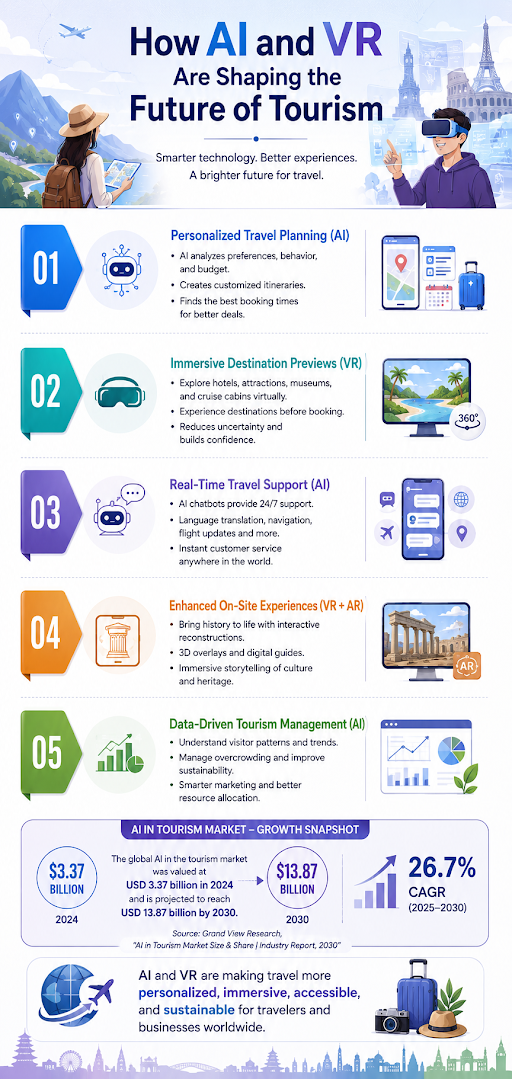
AI acts like the ultimate digital architect. It looks at individual user preferences and behavioral datasets, then builds those AI-powered recommendation engines that help in curating custom itineraries, and they also keep an eye on pricing in real time so the booking window is basically optimized. Once the journey is actually underway, 24/7 AI chatbots help remove transit friction by offering instant translation, localized navigation, and real time updates too. And on top of that, AI analytics lets tourism boards track crowd patterns, refine resource allocation, and deal with over-tourism as well.
Simultaneously, VR is starting to revolutionize the exploration experience. With immersive, high-fidelity previews, prospective travelers can literally “walk through” a hotel, step into a cruise cabin, or wander around famous landmarks globally, all before they book. That sort of experience removes a lot of purchasing uncertainty, because they can almost sense the place first. On-site, mixing VR and Augmented Reality (AR) breathes life into heritage tourism, and it makes cultural storytelling feel more vivid, using interactive 3D reconstructions from the past.
This technological paradigm shift reflects massive industrial momentum. The global AI in the tourism market is projected to show a robust CAGR of 26.7% from 2025–2030. In the meantime, as these ecosystems evolve, they keep redefining how humanity discovers the world in a way that feels new. For more details visit : https://www.reviewsbell.com/list-category/travel-tourism
AI acts like the ultimate digital architect. It looks at individual user preferences and behavioral datasets, then builds those AI-powered recommendation engines that help in curating custom itineraries, and they also keep an eye on pricing in real time so the booking window is basically optimized. Once the journey is actually underway, 24/7 AI chatbots help remove transit friction by offering instant translation, localized navigation, and real time updates too. And on top of that, AI analytics lets tourism boards track crowd patterns, refine resource allocation, and deal with over-tourism as well.
Simultaneously, VR is starting to revolutionize the exploration experience. With immersive, high-fidelity previews, prospective travelers can literally “walk through” a hotel, step into a cruise cabin, or wander around famous landmarks globally, all before they book. That sort of experience removes a lot of purchasing uncertainty, because they can almost sense the place first. On-site, mixing VR and Augmented Reality (AR) breathes life into heritage tourism, and it makes cultural storytelling feel more vivid, using interactive 3D reconstructions from the past.
This technological paradigm shift reflects massive industrial momentum. The global AI in the tourism market is projected to show a robust CAGR of 26.7% from 2025–2030. In the meantime, as these ecosystems evolve, they keep redefining how humanity discovers the world in a way that feels new. For more details visit : https://www.reviewsbell.com/list-category/travel-tourism
The global tourism sector is in the middle of a profound change, thanks to the integration of Artificial Intelligence (AI) and Virtual Reality (VR). In practice, these breakthrough technologies are helping make trips feel more customized, immersive, easier to reach, and also sustainable for both travelers and for companies across the world.
AI acts like the ultimate digital architect. It looks at individual user preferences and behavioral datasets, then builds those AI-powered recommendation engines that help in curating custom itineraries, and they also keep an eye on pricing in real time so the booking window is basically optimized. Once the journey is actually underway, 24/7 AI chatbots help remove transit friction by offering instant translation, localized navigation, and real time updates too. And on top of that, AI analytics lets tourism boards track crowd patterns, refine resource allocation, and deal with over-tourism as well.
Simultaneously, VR is starting to revolutionize the exploration experience. With immersive, high-fidelity previews, prospective travelers can literally “walk through” a hotel, step into a cruise cabin, or wander around famous landmarks globally, all before they book. That sort of experience removes a lot of purchasing uncertainty, because they can almost sense the place first. On-site, mixing VR and Augmented Reality (AR) breathes life into heritage tourism, and it makes cultural storytelling feel more vivid, using interactive 3D reconstructions from the past.
This technological paradigm shift reflects massive industrial momentum. The global AI in the tourism market is projected to show a robust CAGR of 26.7% from 2025–2030. In the meantime, as these ecosystems evolve, they keep redefining how humanity discovers the world in a way that feels new. For more details visit : https://www.reviewsbell.com/list-category/travel-tourism
0 Σχόλια
0 Μοιράστηκε
83 Views
0 Προεπισκόπηση

 English
 Arabic
 French
 Spanish
 Portuguese
 Deutsch
 Turkish
 Dutch
Dutch
 Italiano
 Russian
 Romaian
 Portuguese (Brazil)