• Butyl Rubber Market Trends Indicate Steady Industry Growth

    The Butyl Rubber Market is experiencing consistent global growth as industries increasingly adopt high-performance synthetic elastomers for applications that require durability, flexibility, and exceptional air-retention properties. Widely recognized for its superior permeability and resistance to chemicals, butyl rubber has become an essential material across automotive manufacturing, pharmaceutical packaging, adhesives, sealants, and industrial construction.

    https://www.businessmarketinsights.com/reports/butyl-rubber-market
    Butyl Rubber Market Trends Indicate Steady Industry Growth The Butyl Rubber Market is experiencing consistent global growth as industries increasingly adopt high-performance synthetic elastomers for applications that require durability, flexibility, and exceptional air-retention properties. Widely recognized for its superior permeability and resistance to chemicals, butyl rubber has become an essential material across automotive manufacturing, pharmaceutical packaging, adhesives, sealants, and industrial construction. https://www.businessmarketinsights.com/reports/butyl-rubber-market
    Butyl Rubber Market Share by Size and Growth 2033
    Butyl rubber market is projected to reach US$ 6.6 billion by 2033 with a CAGR of 6.1%; segmented by product type, application, end use industry,
    0 Comentários 0 Compartilhamentos 507 Visualizações 0 Anterior
  • Globally, SBR Prices moved upward by around 1–2% during Q3 2025. This modest growth was mainly supported by stable demand from automotive manufacturing, especially tire production, and steady raw material availability. While some regions experienced price gains due to healthy consumption, others faced downward pressure caused by weaker demand, refinery disruptions, or logistical challenges. Overall, the market remained balanced, avoiding extreme volatility.

    Access Real-Time Prices on Styrene Butadiene Rubber: https://www.price-watch.ai/styrene-butadiene-rubber-prices/
    Globally, SBR Prices moved upward by around 1–2% during Q3 2025. This modest growth was mainly supported by stable demand from automotive manufacturing, especially tire production, and steady raw material availability. While some regions experienced price gains due to healthy consumption, others faced downward pressure caused by weaker demand, refinery disruptions, or logistical challenges. Overall, the market remained balanced, avoiding extreme volatility. Access Real-Time Prices on Styrene Butadiene Rubber: https://www.price-watch.ai/styrene-butadiene-rubber-prices/
    WWW.PRICE-WATCH.AI
    Styrene Butadiene Rubber (SBR)
    Styrene butadiene rubber (SBR) price trend analysis with forecast, demand, market trends, historical data, suppliers, outlook and spot prices .
    0 Comentários 0 Compartilhamentos 142 Visualizações 0 Anterior
  • During Q3 2025, Polyolefin Elastomer prices across the global market showed a clear downward direction. This decline was visible in almost all major regions, with prices falling by around 4% to 5% on average. The market weakness reflected a broader slowdown in economic activity, particularly in industries that rely heavily on Polyolefin Elastomers, such as automotive manufacturing, industrial production, and engineering applications.

    Read full report analysis: https://www.price-watch.ai/polyolefin-elastomer-prices/
    During Q3 2025, Polyolefin Elastomer prices across the global market showed a clear downward direction. This decline was visible in almost all major regions, with prices falling by around 4% to 5% on average. The market weakness reflected a broader slowdown in economic activity, particularly in industries that rely heavily on Polyolefin Elastomers, such as automotive manufacturing, industrial production, and engineering applications. Read full report analysis: https://www.price-watch.ai/polyolefin-elastomer-prices/
    WWW.PRICE-WATCH.AI
    Polyolefin Elastomer (POE)
    Polyolefin elastomer (POE) price trend with weekly updated forecast, market trends, historical data, production, suppliers and spot prices.
    0 Comentários 0 Compartilhamentos 218 Visualizações 0 Anterior
  • Isoprene rubber is a widely used synthetic elastomer known for its elasticity, durability and performance close to natural rubber. It plays a critical role in industries such as automotive manufacturing industrial goods, medical products and consumer applications. For manufacturers and procurement teams monitoring the Isoprene Rubber Price Trend is essential to control costs, plan sourcing strategies and reduce exposure to market volatility.
    Price movements in this market are shaped by a mix of raw material availability, energy costs, regional demand and broader supply chain conditions. Understanding these factors helps buyers make informed and timely decisions.
    Read More: https://www.price-watch.ai/isoprene-rubber-prices/
    Isoprene rubber is a widely used synthetic elastomer known for its elasticity, durability and performance close to natural rubber. It plays a critical role in industries such as automotive manufacturing industrial goods, medical products and consumer applications. For manufacturers and procurement teams monitoring the Isoprene Rubber Price Trend is essential to control costs, plan sourcing strategies and reduce exposure to market volatility. Price movements in this market are shaped by a mix of raw material availability, energy costs, regional demand and broader supply chain conditions. Understanding these factors helps buyers make informed and timely decisions. Read More: https://www.price-watch.ai/isoprene-rubber-prices/
    WWW.PRICE-WATCH.AI
    Isoprene Rubber
    Isoprene rubber price trend analysis with weekly forecasts, demand supply, market trends, production, spot prices and historical data.
    0 Comentários 0 Compartilhamentos 272 Visualizações 0 Anterior
  • Styrene Price Trend Insights: Global Market Prices, Cost Drivers, Trade Dynamics, and Forecast for Strategic Procurement

    Styrene is a material that quietly plays a role in many products we use daily, from packaging and household items to construction materials and electronics. Because of its wide use, changes in styrene prices trend often ripple through different industries and, indirectly, affect consumers as well. Understanding the styrene price trend does not require deep technical knowledge. It can be explained through common experiences like fuel costs, supply and demand, and overall economic mood.

    Please Submit Your Query for Styrene Price Trend, demand-supply, suppliers, market analysis:https://www.price-watch.ai/book-a-demo/

    What Styrene Is and Why Its Price Matters

    Styrene is mainly used to make plastics and synthetic rubber. Items like food containers, insulation boards, disposable cups, and even parts of cars rely on styrene-based products. When the price of styrene rises or falls, manufacturers feel the impact first. Over time, these changes can influence the cost of finished goods. This is why tracking the styrene price trend matters not just for businesses, but also for understanding broader market behavior.

    Raw Materials and Their Influence on Styrene Prices

    One of the biggest factors affecting the styrene price trend is the cost of its raw materials. Styrene is produced using petroleum-based inputs, so its price often moves in line with crude oil and natural gas markets. When oil prices rise, production becomes more expensive, and styrene prices usually follow. On the other hand, when energy prices drop, manufacturers often find some relief, which can soften styrene prices. This connection is similar to how transportation costs rise when fuel becomes expensive.

    Supply, Demand, and Market Balance

    Like most products, styrene prices are heavily influenced by supply and demand. When industries such as packaging, construction, or automotive manufacturing are growing, demand for styrene increases. Higher demand with limited supply often pushes prices upward. During slower economic periods, demand may weaken, leading to price stability or even declines. This cycle feels familiar, much like seasonal demand for certain consumer goods that become cheaper when fewer people are buying them.

    The Role of Manufacturing and Plant Operations

    Styrene production depends on large industrial plants that must operate smoothly to maintain supply. Any disruption, such as maintenance shutdowns, technical issues, or unexpected accidents, can reduce output. When supply tightens suddenly, prices tend to rise. When plants run efficiently and production is strong, the market often experiences more stable pricing. This is similar to how shortages in everyday products can lead to sudden price hikes in local markets.

    Conclusion

    The styrene price trend is shaped by many familiar factors, including raw material costs, supply and demand, production efficiency, and overall economic health. Although it operates behind the scenes, styrene pricing has a real impact on industries and daily life. By viewing it through simple, experience-based examples, the movement of styrene prices becomes easier to understand and more relatable to everyday market behavior.

    Please Submit Your Query for Styrene Price Trend, demand-supply, suppliers, market analysis:https://www.price-watch.ai/book-a-demo/

    About Price Watch™ AI

    Price-Watch AI is an India-based, independent raw material price reporting agency that provides real-time price forecasts and data-driven insights into global raw material markets. Price-Watch AI specializes in tracking raw material prices, analyzing market trends, and delivering timely updates on plant shutdowns, supply disruptions, capacity expansions, and demand-supply dynamics. The Price-Watch AI platform empowers manufacturers, traders, and procurement professionals to make faster, smarter decisions. Leveraging AI-powered forecasting and over a decade of historical data, Price-Watch AI transforms market volatility into actionable opportunity.

    Futura Tech Park,
    C Block, 8th floor 334,
    Old Mahabalipuram Road,
    Sholinganallur, Chennai,
    Tamil Nadu, Pincode - 600119.

    LinkedIn: https://www.linkedin.com/company/price-watch-ai/
    Facebook: https://www.facebook.com/people/Price-Watch/61568490385598/
    Twitter: https://x.com/pricewatchai
    Website: https://www.price-watch.ai/

    Styrene Price Trend Insights: Global Market Prices, Cost Drivers, Trade Dynamics, and Forecast for Strategic Procurement Styrene is a material that quietly plays a role in many products we use daily, from packaging and household items to construction materials and electronics. Because of its wide use, changes in styrene prices trend often ripple through different industries and, indirectly, affect consumers as well. Understanding the styrene price trend does not require deep technical knowledge. It can be explained through common experiences like fuel costs, supply and demand, and overall economic mood. 👉 👉 👉 Please Submit Your Query for Styrene Price Trend, demand-supply, suppliers, market analysis:https://www.price-watch.ai/book-a-demo/ What Styrene Is and Why Its Price Matters Styrene is mainly used to make plastics and synthetic rubber. Items like food containers, insulation boards, disposable cups, and even parts of cars rely on styrene-based products. When the price of styrene rises or falls, manufacturers feel the impact first. Over time, these changes can influence the cost of finished goods. This is why tracking the styrene price trend matters not just for businesses, but also for understanding broader market behavior. Raw Materials and Their Influence on Styrene Prices One of the biggest factors affecting the styrene price trend is the cost of its raw materials. Styrene is produced using petroleum-based inputs, so its price often moves in line with crude oil and natural gas markets. When oil prices rise, production becomes more expensive, and styrene prices usually follow. On the other hand, when energy prices drop, manufacturers often find some relief, which can soften styrene prices. This connection is similar to how transportation costs rise when fuel becomes expensive. Supply, Demand, and Market Balance Like most products, styrene prices are heavily influenced by supply and demand. When industries such as packaging, construction, or automotive manufacturing are growing, demand for styrene increases. Higher demand with limited supply often pushes prices upward. During slower economic periods, demand may weaken, leading to price stability or even declines. This cycle feels familiar, much like seasonal demand for certain consumer goods that become cheaper when fewer people are buying them. The Role of Manufacturing and Plant Operations Styrene production depends on large industrial plants that must operate smoothly to maintain supply. Any disruption, such as maintenance shutdowns, technical issues, or unexpected accidents, can reduce output. When supply tightens suddenly, prices tend to rise. When plants run efficiently and production is strong, the market often experiences more stable pricing. This is similar to how shortages in everyday products can lead to sudden price hikes in local markets. Conclusion The styrene price trend is shaped by many familiar factors, including raw material costs, supply and demand, production efficiency, and overall economic health. Although it operates behind the scenes, styrene pricing has a real impact on industries and daily life. By viewing it through simple, experience-based examples, the movement of styrene prices becomes easier to understand and more relatable to everyday market behavior. 👉 👉 👉 Please Submit Your Query for Styrene Price Trend, demand-supply, suppliers, market analysis:https://www.price-watch.ai/book-a-demo/ About Price Watch™ AI Price-Watch AI is an India-based, independent raw material price reporting agency that provides real-time price forecasts and data-driven insights into global raw material markets. Price-Watch AI specializes in tracking raw material prices, analyzing market trends, and delivering timely updates on plant shutdowns, supply disruptions, capacity expansions, and demand-supply dynamics. The Price-Watch AI platform empowers manufacturers, traders, and procurement professionals to make faster, smarter decisions. Leveraging AI-powered forecasting and over a decade of historical data, Price-Watch AI transforms market volatility into actionable opportunity. Futura Tech Park, C Block, 8th floor 334, Old Mahabalipuram Road, Sholinganallur, Chennai, Tamil Nadu, Pincode - 600119. LinkedIn: https://www.linkedin.com/company/price-watch-ai/ Facebook: https://www.facebook.com/people/Price-Watch/61568490385598/ Twitter: https://x.com/pricewatchai Website: https://www.price-watch.ai/

    0 Comentários 0 Compartilhamentos 816 Visualizações 0 Anterior
  • Rising Adoption in Manufacturing and Healthcare Fuels Laser Technology Market Expansion

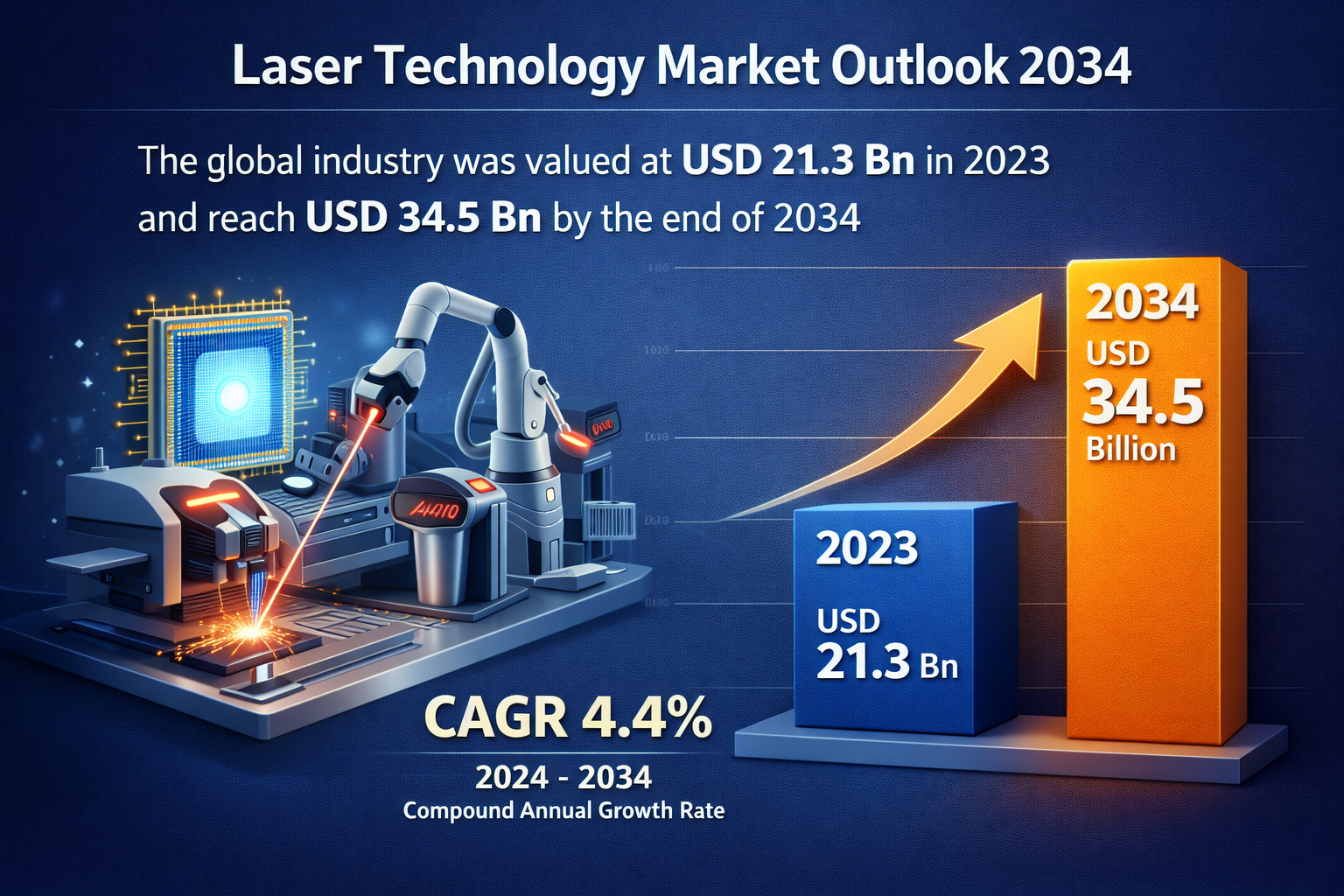
    The Laser Technology Market was valued at USD 21.3 billion in 2023 and is expected to register steady growth over the forecast period. Driven by increasing adoption across manufacturing, healthcare, electronics, and defense applications, the market is projected to reach USD 34.5 billion by 2034, expanding at a CAGR of 4.4% from 2024 to 2034.

    Increase in adoption of laser systems in the medical sector and surge in government initiatives to modernize defense technologies are key factors driving the global laser technology market size. Laser technology is a dynamic field that provides high-precision cuts and is ideal for cutting complex shapes.

    Transform Your Strategy: Explore In-Depth Data – Sample Available! https://www.transparencymarketresearch.com/sample/sample.php?flag=S&rep_id=36371

    Laser technology entails the usage of lasers, which are devices that generate a beam of light. Laser emits light through a process of optical amplification based on the stimulated emission of electromagnetic radiation.

    Unlike normal light, which emits in several directions and is made up of many wavelengths (colors), laser light is coherent. It travels in a straight line, with all the light waves moving in phase with each other and at a single wavelength (color). This gives laser its characteristic brightness and precision.

    Market Segmentation

    Segment

    Primary Categories

    By Service Type

    Installation & Integration, Maintenance & Repair, Training & Consulting.

    By Sourcing Type

    In-house (OEM manufacturing), Outsource (Laser-as-a-Service/Job shops).

    By Application

    Laser Processing (Cutting, Welding, Marking), Optical Communications, Medical, R&D.

    By Industry Vertical

    Telecommunications, Automotive, Healthcare, Aerospace & Defense, Semiconductor.

    By Region

    North America, Europe, Asia Pacific, Latin America, Middle East & Africa.


    Regional Analysis

    Asia Pacific (Largest Market): Dominates with over 40% market share. Driven by China, Japan, and South Korea’s massive semiconductor and automotive manufacturing hubs.
    North America: Leads in high-end R&D and military laser applications. It is a hub for medical laser innovation and quantum computing integration.
    Europe (Fastest Growth): Predicted to see rapid adoption in the medical sector and "Green Manufacturing" initiatives, specifically in Germany and the UK.
    Market Drivers and Challenges

    Drivers

    Rise of Electric Vehicles (EVs): High-power blue and fiber lasers are essential for welding copper components in EV batteries.
    Precision Healthcare: Increasing demand for non-invasive surgeries and diagnostic tools like Optical Coherence Tomography (OCT).
    5G and 6G Infrastructure: The need for Vertical-Cavity Surface-Emitting Lasers (VCSELs) in high-speed data centers.
    Challenges

    High Initial Investment: Advanced femtosecond and high-power systems remain expensive for Small-to-Medium Enterprises (SMEs).
    Technical Complexity: A shortage of skilled technicians capable of maintaining complex laser-robotic integrated systems.
    Regulatory Hurdles: Stringent safety standards (Class 4 laser protocols) vary significantly across international borders.
    Market Trends

    AI Integration: Real-time monitoring and "self-healing" laser systems that use AI to adjust beam parameters during the cutting process to minimize waste.
    Ultrafast Lasers: Transitioning from lab environments to industrial floors for "cold" micromachining (processing without heat damage).
    Sustainability: Development of "Green Lasers" that consume up to 30% less energy compared to traditional CO2 systems.
    Future Outlook (2025-2034)

    The next decade will see lasers move into Quantum Technology, where they will be used to cool atoms for quantum sensing and computing. Furthermore, the deployment of Directed Energy Weapons (DEW) in defense and the use of lasers for Space Debris Mitigation are expected to move from experimental phases to operational reality.

    Rising Adoption in Manufacturing and Healthcare Fuels Laser Technology Market Expansion The Laser Technology Market was valued at USD 21.3 billion in 2023 and is expected to register steady growth over the forecast period. Driven by increasing adoption across manufacturing, healthcare, electronics, and defense applications, the market is projected to reach USD 34.5 billion by 2034, expanding at a CAGR of 4.4% from 2024 to 2034. Increase in adoption of laser systems in the medical sector and surge in government initiatives to modernize defense technologies are key factors driving the global laser technology market size. Laser technology is a dynamic field that provides high-precision cuts and is ideal for cutting complex shapes. Transform Your Strategy: Explore In-Depth Data – Sample Available! https://www.transparencymarketresearch.com/sample/sample.php?flag=S&rep_id=36371 Laser technology entails the usage of lasers, which are devices that generate a beam of light. Laser emits light through a process of optical amplification based on the stimulated emission of electromagnetic radiation. Unlike normal light, which emits in several directions and is made up of many wavelengths (colors), laser light is coherent. It travels in a straight line, with all the light waves moving in phase with each other and at a single wavelength (color). This gives laser its characteristic brightness and precision. Market Segmentation Segment Primary Categories By Service Type Installation & Integration, Maintenance & Repair, Training & Consulting. By Sourcing Type In-house (OEM manufacturing), Outsource (Laser-as-a-Service/Job shops). By Application Laser Processing (Cutting, Welding, Marking), Optical Communications, Medical, R&D. By Industry Vertical Telecommunications, Automotive, Healthcare, Aerospace & Defense, Semiconductor. By Region North America, Europe, Asia Pacific, Latin America, Middle East & Africa. Regional Analysis Asia Pacific (Largest Market): Dominates with over 40% market share. Driven by China, Japan, and South Korea’s massive semiconductor and automotive manufacturing hubs. North America: Leads in high-end R&D and military laser applications. It is a hub for medical laser innovation and quantum computing integration. Europe (Fastest Growth): Predicted to see rapid adoption in the medical sector and "Green Manufacturing" initiatives, specifically in Germany and the UK. Market Drivers and Challenges Drivers Rise of Electric Vehicles (EVs): High-power blue and fiber lasers are essential for welding copper components in EV batteries. Precision Healthcare: Increasing demand for non-invasive surgeries and diagnostic tools like Optical Coherence Tomography (OCT). 5G and 6G Infrastructure: The need for Vertical-Cavity Surface-Emitting Lasers (VCSELs) in high-speed data centers. Challenges High Initial Investment: Advanced femtosecond and high-power systems remain expensive for Small-to-Medium Enterprises (SMEs). Technical Complexity: A shortage of skilled technicians capable of maintaining complex laser-robotic integrated systems. Regulatory Hurdles: Stringent safety standards (Class 4 laser protocols) vary significantly across international borders. Market Trends AI Integration: Real-time monitoring and "self-healing" laser systems that use AI to adjust beam parameters during the cutting process to minimize waste. Ultrafast Lasers: Transitioning from lab environments to industrial floors for "cold" micromachining (processing without heat damage). Sustainability: Development of "Green Lasers" that consume up to 30% less energy compared to traditional CO2 systems. Future Outlook (2025-2034) The next decade will see lasers move into Quantum Technology, where they will be used to cool atoms for quantum sensing and computing. Furthermore, the deployment of Directed Energy Weapons (DEW) in defense and the use of lasers for Space Debris Mitigation are expected to move from experimental phases to operational reality.
    0 Comentários 0 Compartilhamentos 2K Visualizações 0 Anterior
Patrocinado
Patrocinado